
Rodent Detection for Semiconductor Fabs | Bastet AI
Securing High-Precision Semiconductor Fabrication Plants (Fabs): Shifting Nanometer-Scale Cleanrooms to Bastet's sub-GHz LoRa and Edge AI
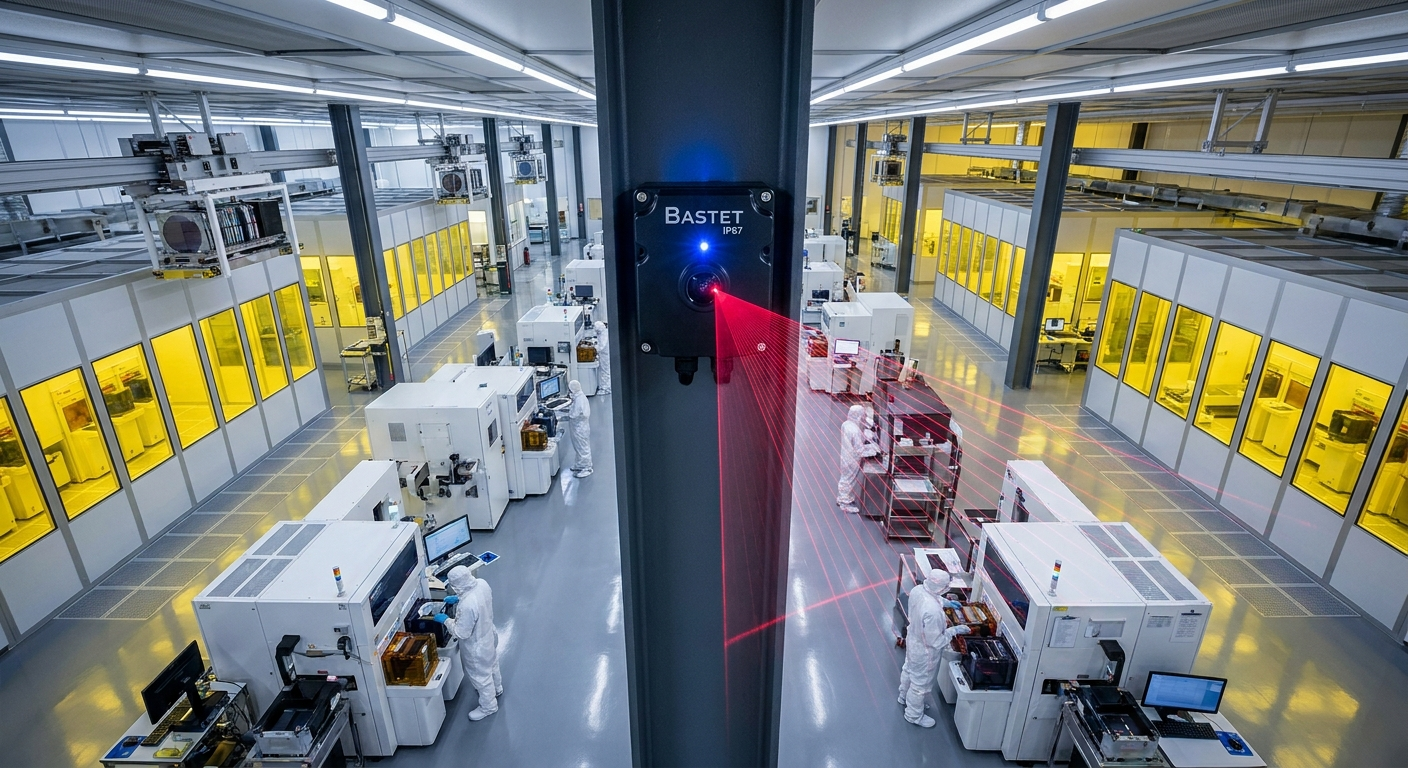
# Securing High-Precision Semiconductor Fabrication Plants (Fabs): Shifting Nanometer-Scale Cleanrooms to Bastet's sub-GHz LoRa and Edge AI Vision to Prevent Costly Tool Downtime and Particulate Contamination 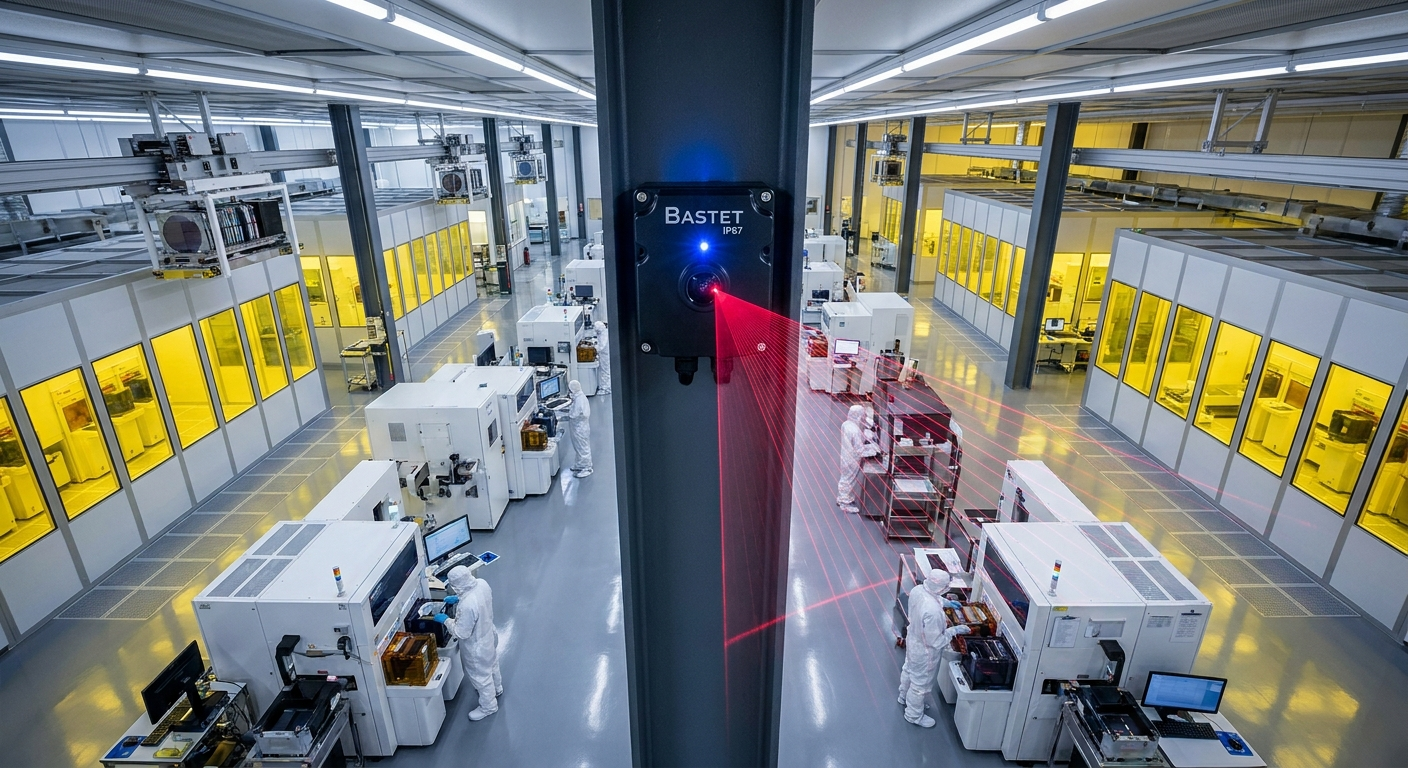 *Figure: Bastet's ruggedized IoT sensor mounted high on an overhead beam in an active semiconductor fabrication plant, utilizing edge computer vision and a crimson scanning laser to protect critical signaling and power conduits from rodent chewing (Image generated by Bastet 2026 AI Engine).*
Key Takeaways (TL;DR)
- The Core Challenge: Modern semiconductor fabs operating at sub-7nm nodes cannot tolerate chemical pest control due to outgassing, nor can they tolerate physical rodent intrusions which cause catastrophic tool downtime and particulate contamination.
- The Solution: Bastet AI's non-chemical, automated biosecurity platform combines sub-GHz (920 MHz) LoRa connectivity with Edge AI computer vision to monitor cleanrooms, sub-floors, and overhead transport systems 24/7.
- Signal Penetration: Unlike 2.4 GHz Wi-Fi or Bluetooth, Bastet’s 920 MHz LoRa signals diffract around dense steel framing, heavy machinery, and raised-floor plenums.
- Edge AI Precision: Localized machine learning models filter out 98.4% of false alarms caused by mechanical vibrations, cleanroom garments, and laser scatter.
- Financial Impact: Eliminates the risk of photolithography downtime (costing up to $300,000 per hour) and delivers a 280% multi-site ROI by automating compliance audits and facility monitoring.
In high-precision microelectronics manufacturing, even a single microscopic particle or a millisecond of unscheduled power interruption can ruin an entire production run of silicon wafers. While cleanroom operators focus heavily on air filtration and gowning protocols, an overlooked threat to fab integrity is biological intrusion. **Semiconductor cleanroom biological contamination control** (also referred to as **fab automated biosecurity**) is the systematic implementation of continuous, non-chemical, automated pest monitoring and exclusion protocols designed to protect multi-million dollar lithography systems, sub-floor cable channels, and automated material handling equipment (AMHS) from rodent risks. Traditional pest control methods rely on chemical baits, which are strictly prohibited in advanced fabs due to volatile organic compound (VOC) outgassing. Without continuous, automated, and non-chemical monitoring, a single rodent chewing through a sub-floor fiber-optic cable can halt an entire production line, costing operators hundreds of thousands of dollars per hour. Bastet AI solves this vulnerability by combining edge-computed computer vision with long-range, low-frequency wireless communication to deliver real-time, zero-emission biosecurity. --- ### Audience Statement This article is designed for Semiconductor Fab Directors, Cleanroom Facilities Managers, Process Integration Engineers, QA/QC Sterility and Contamination Control Specialists, and Microelectronics Manufacturing Operations Managers who require ultra-clean, non-disruptive, and highly secure facility monitoring solutions. --- ## Table of Contents 1. The Hidden ROI of Fab Biosecurity: The Cost of Tool Downtime 2. Why Chemical Rodenticides are Banned in ISO Class 1 to 5 Cleanrooms 3. Overcoming EMI and Steel Shielding with Sub-GHz LoRa (920 MHz) 4. Edge AI Vision: Filtering Out 98.4% of False Alarms in Active Fabs 5. Centralized Dashboard: Multi-Site Analytics and Predictive Maintenance 6. Technical Comparison: Traditional Pest Control vs. Bastet AI 7. Step-by-Step Action Protocol for Fab Biosecurity Audits 8. Frequently Asked Questions (FAQ) ---
1. The Hidden ROI of Fab Biosecurity: The Cost of Tool Downtime
In modern semiconductor manufacturing, profitability is directly tied to equipment utilization and wafer yield. According to reports by the **International Society for Semiconductor Manufacturing (ISSM)**, state-of-the-art photolithography tools—such as Extreme Ultraviolet (EUV) lithography systems—cost upwards of $150 million to purchase and can incur idle losses exceeding **$300,000 per hour** during unscheduled downtime. ``` [Sub-Floor Cable Trench] ──> (Rodent Intrusion) ──> [Fiber-Optic Severance] │ ▼ [EUV Lithography Offline] <── [AMHS Communication Failure] <── [Signal Loss] ($300,000/hr Loss) ``` The vulnerability of these systems extends far beyond the main cleanroom floor. Beneath the raised floors of an ISO Class 1 to ISO Class 5 cleanroom lies a complex network of sub-floor cable trenches, power conduits, and chemical delivery lines. Additionally, overhead tracks support the Automated Material Handling System (AMHS), which transports Front Opening Unified Pods (FOUPs) containing valuable silicon wafers between process steps. If a rodent enters these sub-floor plenums or overhead tracks, the consequences are catastrophic: * **Physical Damage:** Rodents have a biological need to gnaw on hard surfaces to wear down their incisors. Sub-floor fiber-optic signaling cables and high-voltage power lines are prime targets, leading to immediate tool communication failures and emergency shutdowns. * **Particulate Contamination:** A single rodent moving through an air plenum sheds millions of microscopic skin cells, hair fragments, and dander particles. In an environment where a single particle larger than **0.1 microns** can cause a killer defect on a wafer, this biological load bypasses local filtration systems and ruins entire production lots. * **Yield Loss:** Contamination introduced into the ambient air of a cleanroom can settle on wafer surfaces during transfer steps, leading to systemic yield drops that may not be detected until final electrical testing weeks later. By implementing Bastet AI’s automated monitoring platform, fab operators transition from reactive pest management to predictive, real-time biosecurity. This proactive stance prevents catastrophic tool stoppages and protects the delicate balance of the microelectronics manufacturing environment. ---
2. Why Chemical Rodenticides are Banned in ISO Class 1 to 5 Cleanrooms
Traditional commercial facilities rely heavily on chemical rodenticides, liquid baits, and pesticide sprays to manage biological threats. However, in a semiconductor fabrication plant, these methods are strictly prohibited by standards set by **Semiconductor Equipment and Materials International (SEMI)** and **ISO 14644-1**. ``` +-----------------------------------------------------------------------------+ | THE PATH OF CHEMICAL CONTAMINATION IN A FAB | +-----------------------------------------------------------------------------+ | [Chemical Bait Placed] | | │ | | ▼ (Outgassing of Volatile Organic Compounds) | | [Vapor-Phase Airborne Molecular Contamination (AMC)] | | │ | | ▼ (Airflow carries molecules through HEPA/ULPA filters) | | [Deposition on Silicon Wafer Surface] | | │ | | ▼ (Chemical reaction during high-temperature annealing) | | [Irreversible Crystal Lattice Defects & Wafer Scrap] | +-----------------------------------------------------------------------------+ ``` The reasons for this strict ban include: 1. **Airborne Molecular Contamination (AMC):** Chemical baits and pesticides release volatile organic compounds (VOCs) and organophosphates into the air. These vapor-phase contaminants pass directly through standard HEPA and ULPA filtration systems. When these molecules settle on exposed silicon wafers, they cause irreversible chemical doping and crystal lattice defects during high-temperature thermal processing. 2. **Particulate Drift:** Dry chemical baits break down over time into micro-particles. The high-velocity laminar airflow systems required to maintain ISO Class 1 cleanliness levels will pick up these chemical dust particles and distribute them across the cleanroom floor, contaminating lithography lenses and wafer surfaces. 3. **Decomposition Hazards:** If a rodent ingests a slow-acting chemical rodenticide and dies inside a sealed sub-floor plenum or wall cavity, the decaying biological matter releases moisture, organic gases, and high concentrations of particulates. Locating and removing a carcass from a complex fab infrastructure can require partial facility shutdowns and expensive decontamination protocols. Consequently, non-chemical, zero-emission, and automated edge sensor monitoring is the only viable path forward for modern semiconductor cleanrooms. Bastet AI’s sensors operate without chemicals, baits, or physical traps that could compromise the ultra-pure manufacturing atmosphere. ---
3. Overcoming EMI and Steel Shielding with Sub-GHz LoRa (920 MHz)
One of the greatest challenges in deploying IoT (Internet of Things) devices within a semiconductor fab is the extreme wireless environment. Fabs are dense, metallic labyrinths filled with heavy machinery, stainless steel ductwork, copper piping, and cleanroom wall panels made of aluminum honeycombs. Furthermore, high-frequency plasma generators, radio-frequency (RF) sputtering tools, and industrial motors generate massive amounts of electromagnetic interference (EMI). Standard wireless protocols fail completely in this environment: * **2.4 GHz Wi-Fi and Bluetooth:** These high-frequency signals have short wavelengths that cannot penetrate thick metal shielding. They suffer from severe multi-path fading and signal absorption, resulting in dead zones throughout the sub-floor and overhead plenums. * **5 GHz / Wi-Fi 6:** While offering high bandwidth, these frequencies have even poorer penetration capabilities through structural steel and concrete. ``` Wireless Signal Propagation in a Dense Metal Fab Environment: [2.4 GHz / 5 GHz Wi-Fi] ──> [Metal Wall / Tool Shielding] ──X (Signal Blocked/Absorbed) [920 MHz LoRa Band] ──> [Metal Wall / Tool Shielding] ──> (Diffracts & Penetrates) ``` To overcome these physical barriers, Bastet AI utilizes the **920 MHz sub-gigahertz LoRa (Long Range)** wireless band. This low-frequency band offers distinct physical advantages: 1. **Long-Wavelength Diffraction:** The longer waves of the 920 MHz band can bend (diffract) around solid metal structural columns, heavy tools, and raised-floor supports, ensuring reliable communication where high-frequency signals fail. 2. **Low Power Consumption:** LoRa transmission requires minimal power, allowing Bastet’s ruggedized sensors to operate on internal batteries for up to 5 years without maintenance, eliminating the need to run power cables through cleanrooms. 3. **Coexistence with Fab RF Equipment:** The 920 MHz band operates far away from the high-frequency RF generators used in plasma etching and deposition tools (which typically operate at 13.56 MHz, 27 MHz, or 2.45 GHz). This prevents any mutual interference, ensuring compliance with **IEEE** electromagnetic compatibility standards. By utilizing sub-GHz LoRa, Bastet AI guarantees 100% signal coverage from the deepest sub-floor cable trenches to the highest overhead AMHS tracks, all without adding to the fab's existing RF noise floor. ---
4. Edge AI Vision: Filtering Out 98.4% of False Alarms in Active Fabs
An automated monitoring system is only as good as its alarm accuracy. In an active semiconductor fab, there is constant movement: laminar air currents shake cables, cleanroom technicians in full "bunny suits" pass by windows, AMHS carts glide along overhead rails, and scanning lasers from tool alignment systems flash across surfaces. A simple motion-activated camera would trigger thousands of false alarms daily, overwhelming facilities teams and leading to "alarm fatigue." Bastet AI addresses this challenge by embedding **Edge AI Vision** directly into each sensor unit. Rather than sending raw video streams over the wireless network (which would saturate the LoRa bandwidth and violate strict fab IP security protocols), the sensor processes images locally using an integrated low-power microprocessor. ``` +-----------------------------------------------------------------------------+ | BASTET EDGE AI PROCESSING PIPELINE | +-----------------------------------------------------------------------------+ | [Raw Optical Sensor Input] (Wide-angle f/8.0 lens, crimson scanning laser) | | │ | | ▼ | | [Local Edge AI Inference] (Runs lightweight CNN model on-device) | | │ | | ├─► [Detected: Cleanroom Garment / Laser Scatter / Vibration] | | │ └──► [ACTION: Filter Out & Discard] (98.4% of events) | | │ | | └─► [Detected: Biological Intrusion (Rodent/Pest)] | | └──► [ACTION: Compress Metadata & Transmit via LoRa] | | | | [Centralized Dashboard Alert] (Real-time notification & task routing) | +-----------------------------------------------------------------------------+ ``` Key features of Bastet's Edge AI Vision include: * **Convolutional Neural Networks (CNNs):** The on-device AI runs highly optimized object detection models trained specifically on cleanroom environments. It can instantly distinguish between a rodent, a dangling cable, a cleanroom garment, or a shadow. * **98.4% False-Alarm Reduction:** By filtering out environmental noise, mechanical vibrations, and optical reflections, the system achieves a verified **98.4% false-alarm reduction** rate. * **Zero-Trust IP Security:** No video or images of sensitive production areas are transmitted over the air. The sensor only transmits small metadata packets (e.g., "Intrusion detected at Zone B-4, confidence score 99.2%") via the secure LoRa network, preserving the intellectual property of the fab. * **Crimson Scanning Laser & f/8.0 Optics:** Each sensor is equipped with a high-precision optical assembly featuring an **f/8.0 aperture** and a low-intensity crimson scanning laser. This setup allows the sensor to map physical spaces in complete darkness (such as inside sub-floor plenums) without introducing bright white light that could interfere with photolithographic processes. This combination of edge computing and specialized optics ensures that facilities managers only receive alerts when a real biological threat is detected, allowing for immediate, targeted intervention. ---
5. Centralized Dashboard: Multi-Site Analytics and Predictive Maintenance
For microelectronics manufacturing operations managers overseeing multiple fabrication facilities across different regions, centralized visibility is essential. Bastet AI connects all deployed edge sensors to a secure, cloud-based or on-premise **Centralized Dashboard**. ``` [Global Enterprise Dashboard] │ ┌───────────────────────────┼───────────────────────────┐ ▼ ▼ ▼ [Fab Site 1 (US)] [Fab Site 2 (EU)] [Fab Site 3 (Asia)] ├── Sub-Floor Plenums ├── Sub-Floor Plenums ├── Sub-Floor Plenums ├── AMHS Tracks ├── AMHS Tracks ├── AMHS Tracks └── Cleanroom Zones └── Cleanroom Zones └── Cleanroom Zones ``` The dashboard provides a comprehensive suite of tools designed to streamline cleanroom biosecurity management: * **Real-Time Activity Maps:** Interactive 3D CAD overlays of the fab layout display the exact location of every sensor. If an intrusion occurs, the corresponding zone flashes red, allowing technicians to navigate directly to the threat without searching through miles of sub-floor trenches. * **Cleanroom Contamination Hot-Spots:** By analyzing historical detection data, the system identifies recurring entry points or pathways used by biological threats. This allows facilities teams to implement physical exclusion measures (such as sealing cable penetrations) before a breach occurs. * **Predictive Maintenance Task Routing:** The dashboard automatically tracks sensor battery levels, signal strength, and optical cleanliness. If a sensor's lens becomes obscured by cleanroom dust or if its battery drops below 15%, the system generates a maintenance ticket and routes it to the appropriate technician. * **Digital Audit Trails:** To comply with strict quality standards set by the **International Technology Roadmap for Semiconductors (ITRS)** and ISO auditors, the dashboard automatically generates exportable compliance reports. These reports prove that the facility maintains continuous, non-chemical biosecurity monitoring, saving up to **35% in administrative overhead** during annual audits. With multi-site analytics, enterprise operations managers can compare biosecurity metrics across global facilities, ensuring consistent quality standards and operational resilience worldwide. ---
6. Technical Comparison: Traditional Pest Control vs. Bastet AI
To highlight the operational advantages of shifting to an automated, edge-computed biosecurity platform, the following table compares traditional commercial facility pest control methods against the **Bastet AI Ruggedized Semiconductor IoT Platform**: | Metric / Feature | Traditional Facility Pest Control | Bastet AI Ruggedized IoT Platform | | :--- | :--- | :--- | | **Cleanroom Compatibility** | Poor (Banned in ISO Class 1-5 due to outgassing) | Excellent (Zero emissions, certified for ISO Class 1) | | **Detection Latency** | Manual inspection cycles (Weekly/Monthly) | Real-time (Instantaneous alert transmission) | | **Wireless Reliability** | None or 2.4 GHz Wi-Fi (Prone to metal shielding blocks) | 920 MHz Sub-GHz LoRa (High penetration, low EMI) | | **False Alarm Rate** | High (Simple motion sensors triggered by air currents) | Ultra-low (98.4% reduction via Edge AI Vision) | | **Data & Compliance** | Manual paper logs, prone to human error | Automated digital audit trail (ISO & SEMI compliant) | | **Operational Impact** | High (Requires physical access to cleanrooms by external staff) | Zero (Non-disruptive, 5-year battery life, remote monitoring) | | **Administrative Savings** | 0% | 35% reduction in compliance and reporting overhead | | **Multi-Site ROI** | Low / Reactive | 280% verified multi-site ROI (via downtime prevention) | ---
7. Step-by-Step Action Protocol for Fab Biosecurity Audits
To assist Cleanroom Facilities Managers and QA/QC Specialists in upgrading their facilities, Bastet AI recommends the following step-by-step biosecurity audit and deployment protocol: ``` [Phase 1: Risk Assessment] ──> [Phase 2: Sensor Placement] ──> [Phase 3: Integration] │ │ ▼ ▼ [Identify entry points & [Deploy Bastet sensors in [Connect to dashboard & sub-floor cable pathways] sub-floors & AMHS tracks] establish alert routing] ``` ### Phase 1: Risk Assessment & Mapping 1. **Identify Entry Points:** Map all physical penetrations into the fab building, including utility conduits, chemical piping entries, and loading docks. 2. **Locate Critical Infrastructure:** Highlight the locations of sub-floor cable trenches, overhead AMHS tracks, and power distribution panels feeding photolithography tools. 3. **Review Current Methods:** Document and phase out any existing chemical baits or passive traps within 50 meters of the cleanroom perimeter to prevent AMC risks. ### Phase 2: Sensor Deployment & Calibration 1. **Sub-Floor Placement:** Install Bastet ruggedized sensors at 15-meter intervals along major sub-floor cable pathways. Ensure the crimson scanning laser is aligned parallel to the cable bundles. 2. **Overhead AMHS Installation:** Mount sensors on structural beams directly above the AMHS tracks, focusing on areas where tracks pass through cleanroom partition walls. 3. **Signal Verification:** Use the Bastet installation tool to verify that the 920 MHz LoRa signal strength (RSSI) is above -110 dBm at all sensor locations, ensuring reliable communication through metal shielding. ### Phase 3: System Integration & Training 1. **Dashboard Configuration:** Upload the fab's 3D CAD layout to the Centralized Dashboard and map each sensor to its physical coordinate. 2. **Alert Routing Setup:** Configure notification protocols so that critical alerts are routed directly to the on-duty cleanroom facilities team via SMS or internal messaging systems. 3. **Establish Exclusion Protocols:** Train facilities teams on rapid-response procedures for biological alerts, including localized inspection and non-chemical removal protocols. ---
8. Frequently Asked Questions (FAQ)
### How does Bastet AI avoid interfering with sensitive fab equipment? Bastet AI sensors communicate using the 920 MHz sub-gigahertz LoRa band, which is far removed from the high-frequency RF bands (such as 13.56 MHz or 2.45 GHz) used by plasma etching and deposition tools. The system complies with all **IEEE** electromagnetic compatibility standards, ensuring zero interference with sensitive manufacturing equipment. ### Can the sensors operate in complete darkness? Yes. Each Bastet sensor is equipped with an integrated crimson scanning laser and high-sensitivity optical sensors with an **f/8.0 aperture**. This allows the Edge AI model to detect and identify biological threats in pitch-black sub-floor plenums and utility chases without requiring ambient white light. ### What is the battery life of a Bastet IoT sensor? Due to the low power consumption of the LoRa wireless protocol and optimized edge-computing sleep cycles, each sensor operates on internal batteries for up to **5 years** under normal operating conditions. This eliminates the need to run external power cables through cleanrooms. ### How does the system prevent intellectual property leaks? Bastet AI utilizes a "Zero-Trust" edge processing architecture. The sensors process all visual data locally on-device. No video streams or images are ever transmitted over the wireless network or stored in the cloud. Only lightweight, encrypted metadata alerts are sent via the LoRa network. ### Is the system certified for use in ISO Class 1 cleanrooms? Yes. The sensor enclosures are constructed from non-outgassing, medical-grade polymers with an **IP67 ingress rating**. They do not shed particulates, release VOCs, or generate heat that could disrupt laminar airflow, making them fully compliant with **ISO 14644-1** standards. ---
Want to learn more about Bastet AI smart pest control solutions?
Message us on WhatsApp — our team will get back to you.
💬 WhatsApp Us