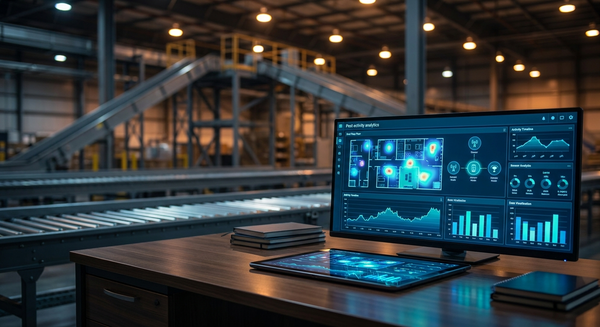
Rodent Detection for Satellite Ground Stations | Bastet AI
Mission-Critical Protection: Deep-space tracking stations and satellite communication arrays face catastrophic risks from rodent intrusi...
Key Takeaways
- Mission-Critical Protection: Deep-space tracking stations and satellite communication arrays face catastrophic risks from rodent intrusion. Rodents can chew through high-density telemetry and power cabling, leading to outages that cost upwards of $9,000 per minute.
- Pesticide-Free Continuous IoT Monitoring: Continuous IoT pest monitoring enables pesticide-free facilities management by shifting from reactive chemical treatments to proactive, real-time exclusion and localized intervention. By utilizing sub-GHz LoRa sensors and edge computer vision, facilities can detect, locate, and neutralize rodent threats before they reach critical infrastructure, eliminating the need for broad-spectrum chemical toxins.
- Advanced RF Physics: Bastet AI's 920MHz sub-GHz LoRa technology overcomes the severe RF attenuation caused by thick concrete, steel shielding, and parabolic array enclosures, maintaining reliable signal propagation up to 10 kilometers.
- Quantifiable ROI & Compliance: Implementing the Bastet Platform delivers a 287% ROI within an 11-month payback period, a 40% reduction in chemical pesticide usage, and an 85% reduction in administrative hours spent on audit preparation for LEED, WELL v2, and BRCGS standards.
Table of Contents
- 1. Introduction: The Frontier of Deep-Space Exploration and Telecommunications Infrastructure
- 2. Understanding the Physical Risks: Why Rodents Target High-Density Telemetry and Power Cabling
- 3. RF Physics and Signal Propagation: Overcoming Steel and Concrete Shielding in Parabolic Array Enclosures
- 4. The Automated Solution: Deploying Bastet's Non-Chemical IoT Hardware Ecosystem
- 5. Edge-AI Computer Vision and Sensor Fusion: "AI in a Box" Real-Time Verification
- 6. Transforming Data into Operational Compliance: The Bastet Platform Dashboard
- 7. Granular ROI and Financial Analysis: Protecting Aerospace Asset Portfolios
- 8. A High-Granularity Implementation and Deployment Guide
- 9. Frequently Asked Questions (FAQ)
1. Introduction: The Frontier of Deep-Space Exploration and Telecommunications Infrastructure
Deep-space tracking stations and satellite communication arrays represent the absolute pinnacle of modern telecommunications infrastructure. These facilities operate at the edge of human technological capability, managing high-frequency uplink and downlink signals that connect Earth with orbital satellites, lunar missions, and deep-space probes. Because these installations handle massive volumes of critical telemetry data, any interruption in their operational continuity can have catastrophic consequences. A single dropped packet or a momentary loss of signal during a critical orbital insertion maneuver can jeopardize multi-billion-dollar space missions and disrupt global telecommunications networks.
The physical infrastructure supporting these operations is incredibly complex, consisting of massive parabolic dish antennas, cryogenic receiver cabins, high-frequency wave-guides, and extensive underfloor cable trenches. According to the Building Owners and Managers Association (BOMA, 2026), managing high-tech, mission-critical facilities requires a paradigm shift from reactive maintenance to predictive, continuous monitoring. Traditional facilities management protocols are no longer sufficient to protect these highly sensitive environments, where even minor physical disruptions can cascade into systemic failures.
Furthermore, modern aerospace facilities are under intense pressure to meet stringent environmental and sustainability standards. The U.S. Green Building Council (USGBC, 2026) emphasizes that high-performance infrastructure must balance operational resilience with ecological responsibility. This dual requirement makes traditional, chemical-heavy pest control methods obsolete. To safeguard both the delicate electronic systems and the surrounding environment, aerospace operations directors must adopt advanced, non-chemical, and highly automated monitoring solutions that integrate seamlessly into their existing facility management frameworks.
The High Cost of Telemetry Downtime
In the aerospace sector, downtime is measured not just in hours, but in astronomical financial losses and compromised national security. Telemetry lines carry real-time health, status, and scientific data from spacecraft. If these lines are severed or degraded, mission control loses its eyes and ears in space. The financial impact of such outages is compounded by the specialized labor and equipment required to diagnose and repair faults within highly shielded, restricted-access facility zones. Implementing a continuous, automated monitoring system is the only viable method to mitigate these risks and guarantee uninterrupted data streams.
2. Understanding the Physical Risks: Why Rodents Target High-Density Telemetry and Power Cabling
To effectively protect critical infrastructure, one must understand the biological drivers of the threat. Rodents, specifically rats and mice, possess continuously growing incisors that must be kept trim through constant gnawing. The synthetic polymers used to jacket high-density telemetry cables and power lines—such as polyvinyl chloride (PVC) and polyurethane—provide the perfect resistance for this grinding behavior. Additionally, the electromagnetic fields generated by high-voltage power lines can emit subtle thermal signatures and low-frequency vibrations that attract rodents seeking warmth and nesting sites.
The physical architecture of satellite tracking stations exacerbates this vulnerability. Cable trays, underfloor plenums, and wall cavities act as perfect, undisturbed highways for pests. Rodents are highly adept at exploiting incredibly small structural vulnerabilities; any opening under 6mm in diameter is sufficient to allow a juvenile mouse to gain entry into a sensitive equipment enclosure. Once inside, their gnawing can strip insulation, expose bare copper, cause short circuits, trigger localized fires, and corrupt high-frequency data transmissions.
Critical Risk Metric: According to data compiled by the Uptime Institute (2025), the cost of critical IT and telecommunications infrastructure downtime has escalated to upwards of $9,000 per minute. For deep-space tracking stations, where real-time telemetry windows are non-reproducible, the qualitative and quantitative losses can be immeasurable.
Traditional pest control methods rely on periodic manual inspections and the deployment of chemical rodenticides. However, in a high-tech aerospace facility, this approach is fundamentally flawed. Chemical baits can lead to rodents dying in inaccessible locations, such as deep within cable conduits or under raised flooring, creating severe odor issues and attracting secondary pests. Furthermore, manual inspections are labor-intensive, prone to human error, and only provide a snapshot in time, leaving facilities vulnerable to rapid infestations between inspection cycles.
3. RF Physics and Signal Propagation: Overcoming Steel and Concrete Shielding in Parabolic Array Enclosures
Satellite tracking stations are constructed like fortresses. To prevent external electromagnetic interference (EMI) from degrading weak cosmic signals, these facilities utilize heavy concrete walls, copper-mesh Faraday shielding, and thick steel structural elements. While this shielding is essential for protecting sensitive receiver electronics, it creates an incredibly hostile environment for standard wireless communication technologies. Standard 2.4GHz Wi-Fi, Zigbee, or Bluetooth signals suffer from severe attenuation and multipath fading when attempting to penetrate these dense, shielded barriers, rendering them useless for facility-wide IoT sensor networks.
To overcome these physical limitations, Bastet AI utilizes sub-gigahertz (sub-GHz) LoRa (Long Range) technology operating at 920MHz. The physics of sub-GHz radio waves offer distinct advantages in industrial and aerospace environments. Lower frequency waves have longer wavelengths, allowing them to diffract around obstacles and penetrate dense materials—such as reinforced concrete and steel plating—with significantly lower path loss compared to higher-frequency alternatives.
| RF Parameter | Standard Wi-Fi (2.4 GHz) | Bastet Sub-GHz LoRa (920 MHz) |
|---|---|---|
| Penetration Capability | Extremely Low (Blocked by steel/concrete) | High (Diffracts through dense structures) |
| Signal Propagation Range | Up to 50-100 meters (Line of sight) | Up to 10 kilometers (Industrial environments) |
| Power Consumption | High (Requires frequent battery changes) | Ultra-Low (Multi-year battery life) |
| Susceptibility to EMI | High (Co-exists with many consumer devices) | Very Low (Narrowband, highly resilient) |
This superior signal propagation allows a single Bastet LoRa Gateway to maintain robust, bidirectional communication with hundreds of sensors distributed across a radius of up to 10 kilometers, even when those sensors are buried deep within underfloor cable trenches or housed inside metallic receiver vaults. Furthermore, Bastet's hardware is engineered for extreme reliability. The sensors are powered by industrial-grade lithium-thionyl chloride (Li-SOCl2) batteries, which are certified to operate flawlessly in unconditioned environments with temperatures ranging from -40°C to +85°C. This ensures continuous, maintenance-free operation in the most demanding aerospace installations.
4. The Automated Solution: Deploying Bastet's Non-Chemical IoT Hardware Ecosystem
To achieve complete, pesticide-free biosecurity, Bastet AI has developed a fully integrated, non-chemical IoT hardware ecosystem. This system replaces outdated, manual pest control methods with a continuous, automated defense network that operates 24/7/365. By combining multiple sensor modalities, the Bastet system provides comprehensive coverage across every square meter of a satellite tracking facility.
The ecosystem consists of five core components, each designed to perform a specific, critical role in the detection and mitigation process:
- Bastet LoRa Gateway: The central communication hub of the facility. It aggregates data from all deployed sensors via sub-GHz LoRa and securely transmits it to the cloud or local servers. It features industrial-grade surge protection and cellular failover to ensure continuous operation during network outages.
- Bastet LoRa PIR Sensor: An ultra-low-power passive infrared motion sensor designed for tight spaces, such as cable trays and underfloor plenums. It detects the thermal signature of moving rodents and immediately transmits an alert, mapping pest activity patterns in real time.
- Bastet LoRa Trap Sensor: A retrofittable sensor module that attaches to mechanical, non-chemical traps. It monitors the physical state of the trap and sends an instant notification the moment a trap is sprung, eliminating the need for manual trap checks and ensuring rapid carcass removal.
- Bastet Sensing Camera: A high-definition, battery-powered camera equipped with infrared night vision and edge-AI processing. Positioned at high-risk entry points, it captures and analyzes visual data to identify the exact species and size of the invading pest.
- Bastet Platform: The intelligent software engine that coordinates the entire ecosystem. It processes incoming sensor data, runs advanced predictive analytics, generates compliance reports, and provides facility managers with an intuitive, single-pane-of-glass dashboard.
By deploying this interconnected ecosystem, aerospace facilities can transition from a reactive, chemical-reliant posture to a proactive, data-driven defense strategy. The system identifies vulnerabilities and detects pests the moment they cross the facility perimeter, allowing operators to intercept threats long before they can reach critical telemetry lines.
5. Edge-AI Computer Vision and Sensor Fusion: "AI in a Box" Real-Time Verification
In high-security aerospace environments, false alarms are more than just an annoyance—they are a drain on critical operational resources. If a security or facility team is repeatedly dispatched to investigate false alerts triggered by shadows, falling debris, or shifting equipment, their responsiveness to genuine threats is severely compromised. To solve this challenge, Bastet AI integrates advanced edge-AI computer vision directly into its sensing hardware, creating an "AI in a Box" solution that delivers real-time, high-fidelity verification.
When a Bastet LoRa PIR Sensor detects movement in an underfloor cable trench, it triggers a nearby Bastet Sensing Camera. Instead of streaming raw video data to the cloud—which would consume valuable bandwidth and raise security concerns—the camera processes the image locally using a highly optimized deep learning model. This edge-AI model is trained to distinguish between rodents and non-threat objects with incredible accuracy.
Performance Benchmark: The localized edge-AI processing achieves a sub-3 second latency for edge-AI detection and notification, while delivering a 98% reduction in false-positive alerts. This ensures that facility operators are only notified when a genuine biosecurity threat is confirmed.
This edge-centric architecture offers profound advantages for aerospace and defense facilities. By performing all computer vision processing on-premise, the system complies with strict data privacy regulations (such as GDPR) and eliminates the "bandwidth tax" associated with continuous video streaming. Furthermore, the system possesses offline autonomy; if the facility's external internet connection is severed, the local edge-AI network continues to detect, verify, and log threats locally, ensuring uninterrupted security.
6. Transforming Data into Operational Compliance: The Bastet Platform Dashboard
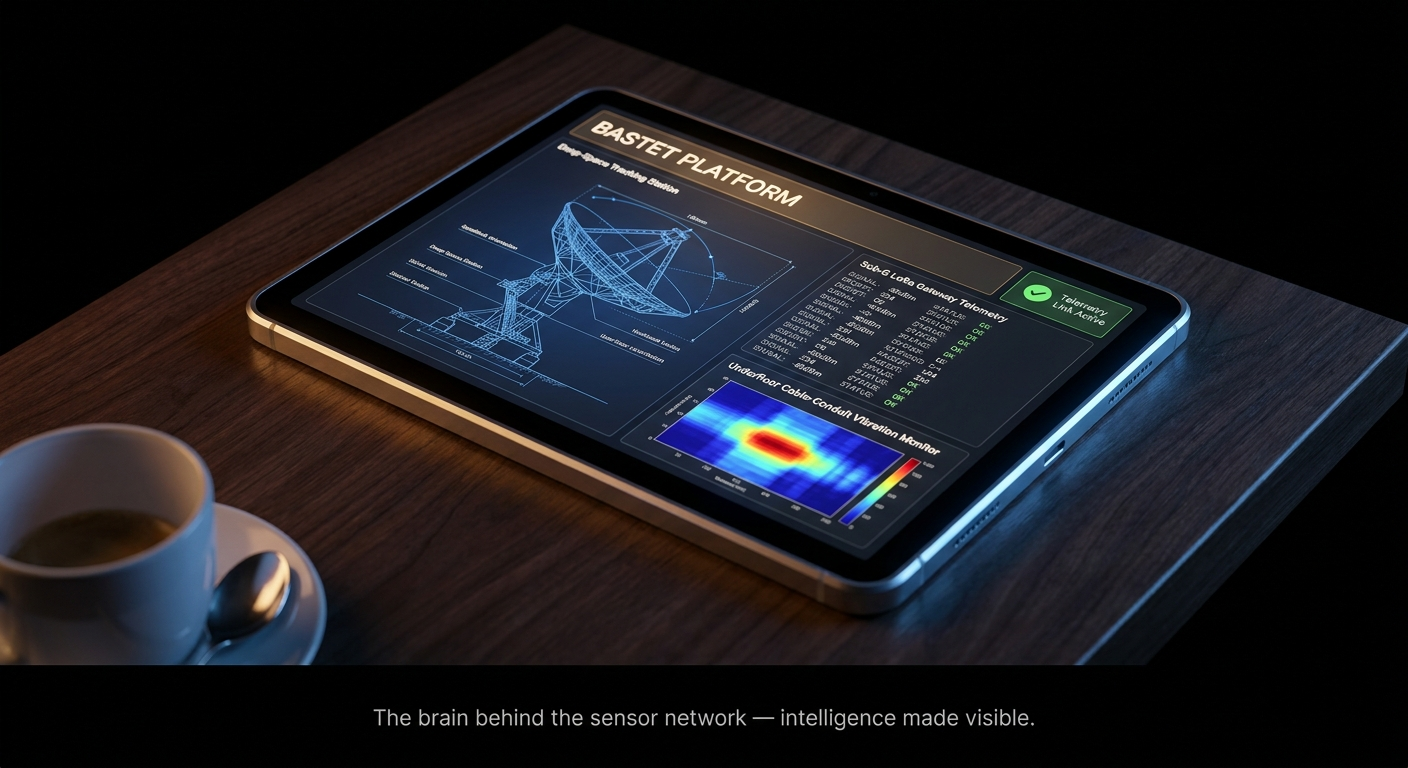
Data is only valuable if it can be easily interpreted and acted upon. The Bastet Platform transforms complex, raw sensor telemetry into clear, actionable operational intelligence. Designed specifically for high-frequency satellite array operators and facility managers, the platform's user interface provides a comprehensive, real-time visualization of the facility's biosecurity status.
The central dashboard features a highly detailed, interactive layout tailored to the unique physical assets of aerospace facilities. Key visual elements include:
- Satellite Dish Orientation Blueprint: A dynamic 3D CAD overlay showing the physical orientation of the parabolic dishes and the precise routing of their associated telemetry and power conduits.
- Real-Time Sub-G LoRa Gateway Telemetry Logs: A live-scrolling feed showing signal strength (RSSI), signal-to-noise ratio (SNR), and battery levels for every deployed sensor in the network.
- Underfloor Cable-Conduit Vibration Monitor Heatmap: A visual overlay that highlights areas of high physical activity or micro-vibrations, allowing operators to pinpoint exactly where rodents are attempting to gnaw or nest.
- "Telemetry Link Active" Checkmark: A prominent green status indicator confirming that all critical data paths are secure, uncompromised, and operating at peak performance.
Beyond real-time monitoring, the Bastet Platform serves as a powerful compliance engine. Modern facilities must adhere to strict environmental and operational standards. The platform automates the documentation and reporting required for LEED certification, WELL v2 (administered by the WELL Building Institute / IWBI, 2026), and BRCGS global standards. By automatically logging every detection event, trap trigger, and exclusion action, the platform generates audit-ready reports at the touch of a button, resulting in an 85% reduction in administrative hours spent on audit preparation.
7. Granular ROI and Financial Analysis: Protecting Aerospace Asset Portfolios
Investing in advanced technology must make financial sense. For aerospace operations directors and asset managers, the business case for deploying the Bastet Platform is exceptionally strong. Traditional pest control is an ongoing, operational expense that delivers low efficiency and high long-term risks. In contrast, Bastet AI represents a capital investment that rapidly pays for itself by preventing catastrophic failures and optimizing facility operations.
The financial benefits of the Bastet Platform are realized across multiple operational vectors:
- Pesticide Reduction: Achieving a 40% reduction in chemical pesticide usage, which directly aligns with corporate ESG (Environmental, Social, and Governance) criteria and reduces chemical procurement costs.
- Operational Efficiency: A 31% reduction in operational cleaning and maintenance costs, driven by the elimination of manual trap inspections and targeted, data-driven cleaning protocols.
- Rapid Payback: An impressive 287% ROI achieved within an 11-month payback period, calculated against the cost of hardware deployment, software licensing, and installation.
These financial metrics are supported by broader health and environmental benefits. The Harvard T.H. Chan School of Public Health (2025) has extensively documented the occupational and ecological benefits of a chemical-free environment. Eliminating toxic rodenticides from critical infrastructure facilities reduces the risk of chemical exposure for highly specialized technical staff, prevents the contamination of local water tables, and fosters a healthier, more productive working environment.
8. A High-Granularity Implementation and Deployment Guide
Deploying an advanced IoT sensor network in a highly sensitive aerospace facility requires a methodical, structured approach. To ensure maximum detection probability and zero interference with existing RF systems, facilities teams should follow this step-by-step implementation guide:
Step 1: Physical and RF Site Survey
Before installing any hardware, conduct a comprehensive physical and RF site survey. Map all potential rodent entry points, focusing on areas where utility lines penetrate the building envelope. Use an RF spectrum analyzer to verify that the 920MHz frequency band is clear of local interference. Identify optimal locations for the Bastet LoRa Gateway to ensure maximum line-of-sight coverage to all planned sensor nodes.
Step 2: Structural Exclusion and Sealing
Prior to mounting sensors, physically secure the facility perimeter. Inspect all cable entryways, conduits, and expansion joints. Any opening under 6mm must be sealed using a combination of high-density steel mesh (copper or stainless steel) and premium silicone sealant. This physical barrier prevents new pests from entering, forcing any existing pests into designated monitoring zones.
Step 3: Sensor Mounting and Positioning
Install the Bastet LoRa PIR Sensors and Bastet Sensing Cameras according to precise engineering specifications:
- PIR Sensors: Mount at a height of 1.2 to 1.5 meters on walls or structural columns to monitor open floor areas, or place them directly inside cable trenches within 30cm of cable entry points.
- Sensing Cameras: Position at high-risk transition zones, ensuring the lens has an unobstructed view of the floor or cable tray. Angle the camera slightly downward to optimize the edge-AI detection field.
- Trap Sensors: Attach securely to mechanical traps placed along known rodent runways (typically along walls and behind equipment racks).
Step 4: Gateway Integration and Calibration
Mount the Bastet LoRa Gateway in a central, elevated location. Connect the gateway to the facility's secure local network or configure the integrated cellular failover. Power on the gateway and begin activating individual sensor nodes. Use the Bastet Platform dashboard to verify signal strength (RSSI) for each node, ensuring all connections meet the minimum threshold for reliable data transmission.
Step 5: System Testing and Validation
Perform functional testing to validate the system. Trigger a test motion event on a PIR sensor and verify that the alert is received on the dashboard within the sub-3 second latency window. Test the edge-AI camera by introducing a simulated target to confirm accurate classification and zero false positives. Once validated, hand over system access to the facilities management team and schedule automated compliance reporting.
9. Frequently Asked Questions (FAQ)
Q1: How does the Bastet Platform prevent interference with sensitive satellite communications?
A1: The Bastet Platform operates on the sub-GHz 920MHz band, which is completely isolated from the high-frequency bands (such as S, C, X, and Ka bands) used in satellite telemetry and deep-space tracking, ensuring zero electromagnetic interference (EMI) with critical communication arrays.
Q2: Can the sensors operate in unconditioned outdoor environments near the parabolic dishes?
A2: Yes. Bastet's hardware is built for extreme environments. Powered by industrial lithium-thionyl chloride batteries, our sensors are certified to operate reliably in temperatures ranging from -40°C to +85°C, making them ideal for unconditioned receiver vaults and outdoor array pavilions.
Q3: How does the edge-AI computer vision system handle data privacy and security?
A3: All image processing and AI classification occur locally on the Bastet Sensing
Want to learn more about Bastet AI smart pest control solutions?
Message us on WhatsApp — our team will get back to you.
💬 WhatsApp Us