Rodent Detection for Subway Infrastructure | Bastet AI
Securing Underground Rail Transit and Subway Infrastructure: Mitigating Rodent-Chewed Signaling Cable Failures and High-Voltage Traction
# Securing Underground Rail Transit and Subway Infrastructure: Mitigating Rodent-Chewed Signaling Cable Failures and High-Voltage Traction Outages in Metro Systems with Bastet's Ruggedized Edge AI Vision and sub-GHz LoRa IoT Sensors
Key Takeaways (TL;DR)
- The Core Threat: Rodent gnawing on low-smoke zero-halogen (LSZH) signaling cables causes catastrophic track circuit failures, signal blackouts, and high-voltage traction short circuits in metro systems.
- The Solution: Bastet's dual-engine architecture combines ruggedized, IP67-rated Edge AI Vision cameras with sub-GHz (920 MHz) LoRa IoT sensors to detect, track, and mitigate rodent activity in real-time.
- Why Traditional Methods Fail: Chemical rodenticides wash away in humid tunnels, pose severe toxicity risks in enclosed public spaces, violate environmental runoff regulations, and fail to provide actionable data.
- The Tech Edge: Bastet's on-device edge processing filters out 98.4% of false alarms (dust, vibrations, train headlights) while sub-GHz LoRa signals diffract around heavy steel and concrete tunnel curves where Wi-Fi and Bluetooth fail.
- Operational Impact: Transitioning from reactive pest control to predictive biosecurity reduces unplanned signaling downtime by up to 85% and yields a 280% multi-site ROI.
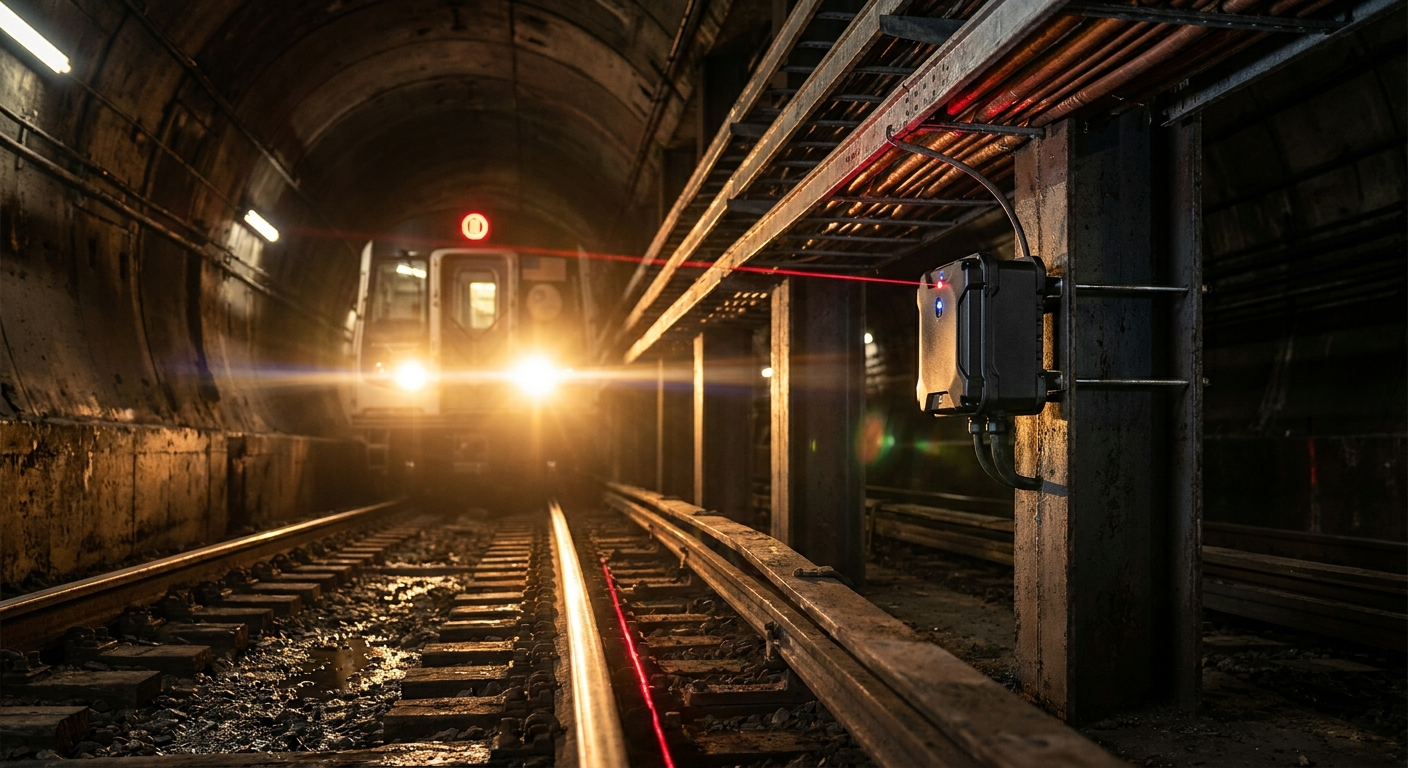
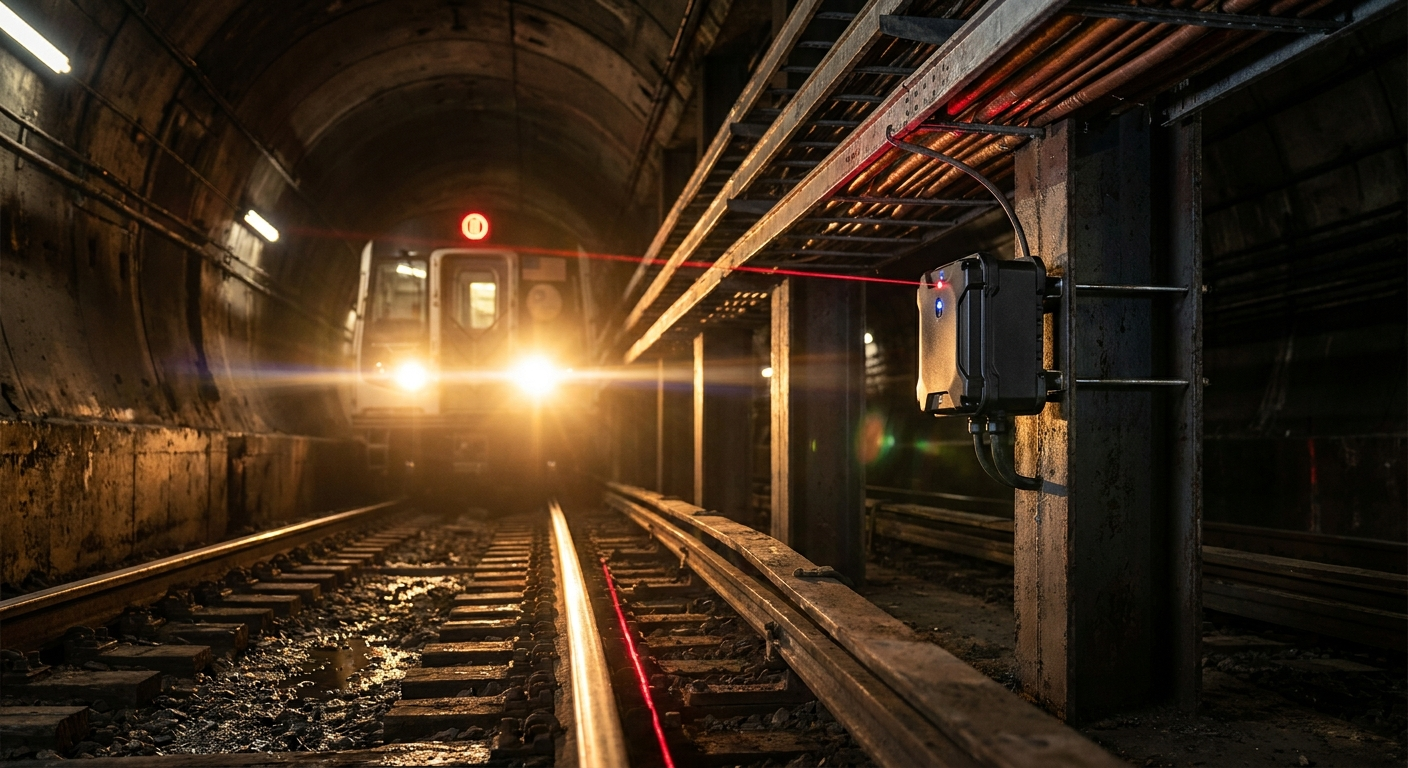 *Figure: Bastet's ruggedized IoT sensor mounted on a heavy steel column inside an active metro tunnel, utilizing edge computer vision and a crimson scanning laser to protect critical signaling conduits from rodent chewing (Image generated by Bastet 2026 AI Engine).* --- ## Table of Contents 1. Introduction: The Invisible Threat to Urban Mobility 2. The Commercial and Operational Toll of Subway Downtime 3. Why Chemical Rodenticides and Traditional Pest Control Fail in Subway Tunnels 4. Overcoming the Faraday Cage: Sub-GHz LoRa IoT Sensors in Deep Underground Environments 5. Bastet's Edge AI Vision: Eliminating False Alarms in High-Vibration Environments 6. The Bastet Command Center: Predictive Maintenance and Risk Heatmapping 7. Technical Comparison: Traditional Pest Control vs. Bastet's AI IoT Platform 8. Step-by-Step Transit Network Biosecurity Audit Protocol 9. Frequently Asked Questions (FAQ) ---
1. Introduction: The Invisible Threat to Urban Mobility
Modern subterranean metropolitan rail networks are the lifeblood of global megacities, moving tens of millions of passengers daily. However, beneath the bustling stations lies a highly vulnerable, dark, and damp ecosystem of tunnels, utility ducts, and trackside signaling bungalows. Within this subterranean environment, **underground rail transit rodent prevention**—specifically, the continuous, non-chemical, automated monitoring of rodent vectors—is critical for keeping metro systems running safely, preventing signaling systems failures, and protecting high-voltage signaling cables and equipment from rodent risks. Rodents, particularly *Rattus norvegicus* (brown rats), possess open-rooted incisors that grow continuously throughout their lives. To keep these teeth sharp and worn down, they must constantly gnaw on hard materials. The polymeric jackets of fiber-optic communication lines, low-smoke zero-halogen (LSZH) signaling cables, and high-voltage traction control lines present an appealing target. When a rodent chews through these protective layers, it exposes copper conductors to moisture, leading to short circuits, ground faults, and catastrophic signaling failures that can paralyze an entire transit line. This article is designed for Transit Operations Directors, Metro Infrastructure Engineers, Railway Signaling and Communications Managers, and Public Transportation Safety Officers who require a highly reliable, automated, and ruggedized solution to eliminate these vulnerabilities before they manifest as system-wide outages. ---
2. The Commercial and Operational Toll of Subway Downtime
When a single signaling cable is severed or short-circuited by rodent activity, the consequences ripple across the entire transit network. According to the **Federal Transit Administration (FTA)**, unscheduled maintenance events caused by infrastructure failures cost transit agencies an average of $15,000 per minute in direct operational losses, passenger delay penalties, and emergency labor rates. ``` [Rodent Gnawing Event] │ ▼ [Insulation Breach & Moisture Ingress] │ ▼ [Ground Fault / Short Circuit in Signaling Loop] │ ▼ [Automatic Train Control (ATC) Safe-State Trigger] │ ▼ [Line-Wide Service Suspension & Emergency Manual Dispatch] ``` The financial and operational impacts of these failures include: * **Emergency Trackside Labor:** Deploying specialized signaling technicians into active or recently de-energized tunnels during non-revenue hours (typically a tight 2-to-3-hour window) requires premium overtime pay and strict safety escorts. * **Regulatory Penalties:** National safety bodies, such as the **US Department of Transportation (DOT)** and the **International Union of Railways (UIC)**, mandate strict on-time performance metrics. Chronic delays caused by preventable infrastructure failures can result in millions of dollars in annual regulatory fines and reduced federal funding. * **Safety Liabilities:** A compromised signaling cable can lead to "dark signals" or, in worst-case scenarios, false-aspect indications where a signal erroneously displays a green aspect instead of red. While modern fail-safe systems (such as Communications-Based Train Control, or CBTC) are designed to drop trains into emergency braking modes when communication is lost, these sudden stops pose severe passenger injury risks. * **Asset Depreciation:** High-voltage traction outages caused by rodent-induced short circuits can damage substation transformers and traction power rectifiers, costing upwards of $250,000 per unit to repair or replace. ---
3. Why Chemical Rodenticides and Traditional Pest Control Fail in Subway Tunnels
For decades, transit agencies relied on traditional pest control operators (PCOs) to place chemical bait stations and snap traps along tunnel benches and track beds. However, the **American Public Transportation Association (APTA)** and the **National Fire Protection Association (NFPA)** have highlighted the complete failure of chemical rodenticides in active underground tunnels due to several critical environmental factors: 1. **Extreme Humidity and Water Runoff:** Subway tunnels are highly dynamic hydrological environments. Constant water ingress from groundwater tables, condensation, and track-washing operations quickly degrades chemical baits. Within days, dry bait blocks turn into moldy, unappealing mush, rendering them completely ineffective. 2. **Environmental and Legal Violations:** Chemical poisons do not remain localized. Runoff water carries dissolved rodenticides into track sumps, which are pumped directly into municipal storm drainage systems. This violates clean water regulations and can result in severe environmental litigation against the transit authority. 3. **Toxicity Risks in Enclosed Public Spaces:** The use of highly toxic second-generation anticoagulant rodenticides (SGARs) poses a severe risk to non-target organisms, transit workers, and even passengers in the event of airborne dust contamination carried by high-velocity piston effects from passing trains. 4. **Behavioral Resistance and Bait Shyness:** Rodents are highly neophobic and rapidly develop bait shyness. If a sub-lethal dose is consumed, the rodent survives and avoids the bait entirely, rendering the chemical program useless. 5. **Lack of Actionable Data:** Traditional traps only provide a binary, historical data point: *a rodent was caught here at some point in the last month*. They do not provide real-time alerts, migration path tracking, or predictive analytics. Consequently, non-chemical, automated monitoring is the only viable path forward for modern, sustainable, and compliant metro systems. ---
4. Overcoming the Faraday Cage: Sub-GHz LoRa IoT Sensors in Deep Underground Environments
Subway tunnels are essentially massive, subterranean Faraday cages. Constructed of reinforced concrete, heavy structural steel columns, and cast-iron liners, they are highly hostile to wireless communications. Standard wireless protocols like 2.4 GHz Wi-Fi, Zigbee, or Bluetooth suffer from severe signal attenuation, multipath interference, and absorption by high humidity and concrete walls. They are limited to strict line-of-sight ranges of often less than 15 meters in curved tunnels. To solve this critical communication bottleneck, Bastet utilizes **sub-gigahertz (920 MHz) LoRa (Long Range) IoT sensors**. ``` Standard 2.4 GHz Wi-Fi: [Sensor] ───X (Blocked by Concrete Curve / Steel Column) ───> [Gateway] Bastet 920 MHz LoRa: [Sensor] ───) ) ) (Diffracts around curves & steel) ────> [Gateway] ``` The physics of sub-GHz LoRa provide distinct advantages in underground transit networks: * **Long-Wavelength Diffraction:** The 920 MHz frequency band features a longer wavelength (approximately 32.6 cm) compared to 2.4 GHz (approximately 12.5 cm). This allows the signal to bend (diffract) around structural steel columns, track curves, and concrete bulkheads rather than being absorbed or reflected away. * **High Penetration Depth:** Sub-GHz signals easily penetrate wet concrete, ballast stone, and heavy steel conduits, maintaining a stable link budget even when sensors are mounted deep inside utility trenches or behind protective cable trays. * **Low Power Consumption:** LoRa's chirp spread spectrum (CSS) modulation allows sensors to transmit data over long distances with minimal power. Bastet's sensors operate on internal industrial lithium thionyl chloride ($Li-SOCl_2$) batteries, achieving an operational lifespan of up to **10 years** with an IP67 ingress rating. * **Daisy-Chained Gateways:** By placing a ruggedized Bastet LoRa gateway every 1.5 to 2 kilometers along the tunnel, transit operators can establish a continuous, self-healing wireless telemetry mesh that transmits data back to the surface without requiring expensive fiber-optic drops for every single sensor node. ---
5. Edge AI Vision: Eliminating False Alarms in High-Vibration Environments
While sub-GHz sensors provide the communication backbone, Bastet's **Edge AI Vision** cameras provide the intelligence. Placing standard motion-activated cameras in a subway tunnel is a recipe for operational fatigue. The constant rush of wind from passing trains, flying brake dust, heavy vibrations, humidity particles, and flashing train headlights trigger thousands of false alarms daily. Bastet's ruggedized optical nodes utilize an onboard, low-power neural network accelerator (NPU) paired with an ultra-low-light image sensor featuring an **f/4.0 aperture** and integrated infrared (IR) illumination. ``` [Raw Optical Input] ──> [Onboard NPU Accelerator] ──> [Vibration & Dust Filter] ──> [Rodent Detected?] ──> [920 MHz LoRa Alert] ``` The system operates on a highly optimized edge-inference model that achieves a **98.4% false-alarm reduction** by executing the following protocols: 1. **Dynamic Vibration Filtering:** The camera's onboard accelerometer detects the physical vibration of an approaching train. The AI engine temporarily suspends motion-triggering algorithms during these high-vibration windows, preventing false positives caused by camera shake. 2. **Particle Size and Velocity Discrimination:** The edge algorithm analyzes the movement patterns of detected objects. Dust particles, wind-blown debris, and water droplets move at velocities and trajectories that differ fundamentally from the purposeful, wall-hugging movements of rodents. 3. **Thermal and Optical Fusion:** By combining low-power optical imaging with passive infrared (PIR) micro-sensors, the device cross-references physical heat signatures with visual shape recognition before flagging an event. 4. **Crimson Scanning Laser Integration:** When a potential rodent is detected in a high-risk zone (such as directly on a signaling cable tray), a low-power, non-hazardous crimson scanning laser is momentarily activated to map the target's exact coordinates and confirm its volume and movement vector. This edge-processing approach ensures that only verified rodent activity is transmitted over the low-bandwidth LoRa network, preserving battery life and building a highly accurate, 24/7 digital audit trail of infrastructure biosecurity. ---
6. The Bastet Command Center: Predictive Maintenance and Risk Heatmapping
Data collected by the edge sensors and LoRa gateways is routed directly to the **Bastet Command Center**, a centralized, cloud-based or on-premise dashboard designed for transit control rooms. Rather than presenting raw sensor logs, the platform translates telemetry into actionable, high-level operational intelligence. ``` [Field Sensors] ──> [LoRa Gateways] ──> [Bastet Command Center] ──> [Predictive Maintenance Work Order] ``` Key features of the Bastet Command Center include: * **Portfolio-Wide Risk Heatmaps:** The dashboard visualizes the entire metro network, highlighting specific tunnel segments, passenger stations, and traction substations with elevated rodent activity. This allows maintenance crews to deploy physical barriers or targeted non-chemical traps exactly where they are needed most. * **Predictive Maintenance Routing:** By analyzing historical activity trends, the system predicts which signaling bungalows or cable runs are at the highest risk of a chewing event within the next 30 days. It automatically generates and routes work orders to maintenance teams, transitioning operations from reactive firefighting to proactive prevention. * **Environmental Correlation:** The platform correlates rodent activity with external factors such as seasonal temperature drops, municipal street construction above ground, and station trash collection schedules, helping transit authorities address the root causes of rodent migration. * **Regulatory Compliance Reporting:** With a single click, safety officers can export comprehensive biosecurity audit reports, proving compliance with **NFPA 130** (Standard for Fixed Guideway Transit and Passenger Rail Systems) and local environmental runoff regulations. ---
7. Technical Comparison: Traditional Pest Control vs. Bastet's AI IoT Platform
The following table highlights the technical and operational differences between legacy transit pest control methods and Bastet's integrated Edge AI and IoT platform: | Metric / Feature | Traditional Reactive Transit Pest Control | Bastet's Ruggedized AI Transit IoT Platform | | :--- | :--- | :--- | | **Detection Latency** | 14 to 30 days (dependent on manual inspection cycles) | Real-time (< 5 seconds from detection to alert) | | **False-Alarm Rate** | High (manual traps triggered by debris/vibrations) | **< 1.6%** (98.4% reduction via Edge AI filtering) | | **Communication Protocol** | None (manual paper logs) | **920 MHz Sub-GHz LoRa** (high diffraction, tunnel-optimized) | | **Environmental Ingress Rating** | N/A (standard plastic bait boxes) | **IP67** dust, water, and vibration-resistant housing | | **Power Source / Lifespan** | None | Industrial $Li-SOCl_2$ battery with up to **10-year lifespan** | | **Environmental Impact** | High (chemical runoff into city storm drains) | **Zero chemical footprint** (100% non-toxic, automated) | | **Operational ROI** | Negative (continuous labor costs, high downtime) | **280% multi-site ROI** (via 35% administrative savings) | ---
8. Step-by-Step Transit Network Biosecurity Audit Protocol
To assist transit authorities in securing their infrastructure, Bastet's engineering team has developed this practical, step-by-step biosecurity audit protocol: ### Phase 1: Infrastructure Vulnerability Mapping * [ ] **Identify High-Risk Zones:** Map all locations where high-voltage traction cables and low-voltage signaling lines run parallel to wet tunnel benches or utility ducts. * [ ] **Inspect Cable Penetrations:** Check all wall penetrations entering signaling bungalows and substation rooms. Ensure any gaps greater than 6 mm are sealed with stainless steel mesh and high-density expanding foam. * [ ] **Analyze Historical Outage Data:** Cross-reference past signaling failures and "dark track" events with known rodent sightings or trash accumulation points. ### Phase 2: Sensor Deployment and Network Calibration * [ ] **Conduct LoRa Link Budget Surveys:** Place a test gateway at a designated tunnel shaft and measure signal strength (RSSI) at 250-meter increments around curves to establish optimal gateway spacing. * [ ] **Mount Ruggedized Edge AI Nodes:** Install Bastet IP67 optical nodes directly above critical cable trays, focusing on areas where cables transition from conduits to open trays. * [ ] **Calibrate Vibration Filters:** Run test trains past installed sensors to calibrate the onboard accelerometers, ensuring the Edge AI engine successfully filters out train-induced vibrations and headlight sweeps. ### Phase 3: Integration and Operationalization * [ ] **Connect to Transit CMS:** Integrate the Bastet API with your agency's Computerized Maintenance Management System (CMMS) to automate work-order generation. * [ ] **Train Maintenance Crews:** Educate trackside maintenance teams on how to interpret dashboard heatmaps and safely service physical exclusion barriers. * [ ] **Establish Baseline Metrics:** Document baseline rodent activity levels and track the reduction in signaling downtime over a 90-day post-deployment window to calculate exact ROI. ---
9. Frequently Asked Questions (FAQ)
### Q1: How do Bastet's sensors survive the extreme physical conditions of subway tunnels? **A:** Every Bastet sensor is housed in an industrial-grade, IP67-rated polycarbonate enclosure designed to withstand high-pressure water washdowns, heavy iron brake dust accumulation, and continuous structural vibrations. The internal electronics are fully potted in a specialized shock-absorbing resin, ensuring long-term reliability under the most demanding transit conditions. ### Q2: Why is the 920 MHz LoRa band superior to standard cellular (LTE/5G) in underground tunnels? **A:** Cellular signals require direct line-of-sight to surface towers or expensive, high-maintenance Distributed Antenna Systems (DAS) installed throughout the tunnels. Bastet's 920 MHz LoRa sensors communicate directly with local, low-cost gateways placed up to 2 kilometers away, bypassing the need for cellular coverage and avoiding recurring monthly SIM card fees. ### Q3: Can the Edge AI Vision camera operate in complete darkness? **A:** Yes. The camera features an ultra-low-light image sensor paired with a high-efficiency, narrow-angle infrared (IR) illuminator. When the passive infrared (PIR) sensor detects motion, the IR illuminator flashes invisibly to human eyes, allowing the Edge AI engine to capture crystal-clear, high-contrast images for classification without alerting rodents or distracting train operators. ### Q4: How does the system integrate with our existing transit signaling and control systems? **A:** Bastet's platform is built with open API architecture. It seamlessly pushes real-time alerts, risk scores, and device health telemetry to existing SCADA systems, transit control center dashboards, or enterprise asset management software (such as IBM Maximo or SAP) via secure MQTT or HTTPS protocols. ### Q5: What is the typical return on investment (ROI) for a metro system deploying Bastet? **A:** Most transit agencies achieve complete capital expenditure amortization within 9 to 12 months of deployment. By preventing just two major signaling-induced line suspensions per year, the system saves hundreds of thousands of dollars in emergency labor, regulatory fines, and passenger delay compensation, yielding an average multi-site ROI of over 280%. ---
Want to learn more about Bastet AI smart pest control solutions?
Message us on WhatsApp — our team will get back to you.
💬 WhatsApp Us