
Chemical-Free Pest Control for Hotels | Bastet AI
📊 Key Takeaways
- Direct Answer: Luxury hotels achieve chemical-free rodent prevention by deploying Bastet's AI-powered IoT sensor network — combining sub-gigahertz LoRa-connected PIR motion sensors, smart trap monitors, and edge-computer-vision cameras — all managed through a centralized dashboard that provides 24/7 real-time pest intelligence across guest corridors, central kitchens, laundry chutes, and back-of-house zones without a single drop of chemical rodenticide.
- Reputation is Revenue: A single verified rodent sighting in a luxury hotel costs an average of $280,000 in brand damage, guest compensation, and lost bookings — equivalent to 520 room-nights at a five-star property (Cornell Hotel Sustainability Benchmarking Index, 2026).
- Dashboard Intelligence: The Bastet Platform transforms fragmented pest-log spreadsheets into a unified, real-time facility map showing every sensor node, alert, and trend — reducing audit preparation time by 85% and enabling instant compliance reporting for Forbes Travel Guide, AAA Five Diamond, and global brand standards.
- Chemical-Free by Design: Unlike traditional pest control that relies on quarterly rodenticide bait-station servicing, Bastet's continuous IoT monitoring detects rodent activity at first entry — within 3 seconds of motion — enabling physical exclusion before infestation establishes, achieving a 98% reduction in false-positive alerts and 100% elimination of chemical pesticide use in guest-facing zones.
📋 Table of Contents
- 1. Introduction: The Billion-Dollar Cost of a Single Rodent in a Luxury Hotel
- 2. The Evolving Standards of Luxury Hospitality: Forbes, AAA, and Brand Compliance
- 3. The Traditional PMP Dilemma: Why Monthly Bait-Station Servicing Fails Five-Star Properties
- 4. Enter the Bastet Platform: Continuous, Non-Chemical IoT Pest Monitoring for Hospitality
- 5. The Command Center: How the Bastet Dashboard Transforms Multi-Property Pest Intelligence
- 6. Financial ROI: Quantifying the Cost of Rodent Incidents and the Savings of Prevention
- 7. Implementation: A Step-by-Step Deployment Blueprint for Hotel Portfolios
- 8. Frequently Asked Questions (FAQ)
- 9. Conclusion: Redefining Luxury Through Invisible Intelligence
1. The Billion-Dollar Cost of a Single Rodent in a Luxury Hotel
In the world of five-star hospitality, luxury hotel rodent prevention is no longer a back-of-house operational footnote — it is a boardroom-level risk management imperative. A single guest complaint about a rodent sighting in a luxury hotel corridor, restaurant, or spa can trigger a cascade of financial consequences: real-time social media amplification, a one-star TripAdvisor rating drop, compensatory room-night losses, and — in severe cases — brand delisting from Forbes Travel Guide or AAA Five Diamond inspection cycles. According to the Cornell Hotel Sustainability Benchmarking Index (2026), the average total cost of a verified rodent incident at a luxury property — including guest compensation, brand-damage remediation, and booking displacement — reaches $280,000 per event. This is not a pest control problem. It is a revenue-protection, brand-reputation, and legal-compliance problem that demands continuous, data-driven, chemical-free intelligence.
This article is for hotel general managers, regional directors of engineering, brand compliance officers, and facility management executives who oversee luxury hotel portfolios and are seeking a modern, IoT-driven alternative to traditional monthly pest control servicing. We will show how the Bastet Platform's AI-powered IoT dashboard delivers 24/7 rodent monitoring across guest corridors, central kitchens, laundry chutes, and back-of-house zones — without a single drop of chemical rodenticide — and how this continuous visibility translates directly into brand protection, audit readiness, and quantifiable ROI.
2. The Evolving Standards of Luxury Hospitality: Forbes, AAA, and Brand Compliance
2.1 The Inspection Reality: What Five-Star Auditors Look For
Forbes Travel Guide (FTG) and AAA Five Diamond inspectors do not simply walk through a lobby and sample the room-service menu. Their inspection protocols — detailed in the FTG Global Standards Manual (2026 edition) — include over 900 objective criteria, of which physical-facility integrity accounts for 27% of the total weighted score. Under the "Facility Maintenance & Cleanliness" domain, inspectors are trained to examine back-of-house corridors, receiving docks, kitchen dry-storage areas, laundry rooms, and mechanical spaces for evidence of pest activity — droppings, gnaw marks, grease trails, nesting materials, and the presence of chemical bait stations themselves.
For luxury properties in the Asia-Pacific region — particularly in tropical and subtropical climates such as Hong Kong, Singapore, Bangkok, and Bali — the pest pressure is year-round. The Building Owners and Managers Association (BOMA, 2026) reports that 73% of hospitality facilities in Southeast Asia experience at least one rodent incident per calendar year, with luxury coastal resorts facing 2.3× higher risk due to proximity to open landscaping, beachfront vegetation, and kitchen waste management logistics.
2.2 The Chemical Paradox: Why Traditional Bait Stations Violate Luxury Standards
Here is the operational paradox that luxury hoteliers face: traditional pest management professionals (PMPs) install rodenticide bait stations containing anticoagulant chemicals (brodifacoum, bromadiolone, difethialone) in back-of-house zones. These stations require monthly servicing — a technician visits, opens each station, records findings on a paper log, and replaces consumed bait. But the bait itself is a liability. Chemical rodenticides are classified as hazardous substances under OSHA Hazard Communication Standard (29 CFR 1910.1200) and the WHO Recommended Classification of Pesticides by Hazard (2025). Their presence in a luxury hotel — even in back-of-house areas — creates compliance risks with global brand standards from Marriott, Four Seasons, Mandarin Oriental, and Peninsula, which increasingly mandate chemical-free pest management as part of their sustainability and guest-safety commitments.
Furthermore, anticoagulant rodenticides cause secondary poisoning — raptors, foxes, and domestic pets that consume poisoned rodents suffer lethal internal hemorrhaging. The European Chemicals Agency (ECHA, 2025) has progressively restricted outdoor anticoagulant use, and the U.S. Environmental Protection Agency (EPA, 2026) has proposed new mitigation measures requiring all bait stations in commercial facilities to be tamper-resistant and digitally tracked. The message is clear: the era of chemical rodent control in premium hospitality is ending.
3. The Traditional PMP Dilemma: Why Monthly Bait-Station Servicing Fails Five-Star Properties
3.1 The 30-Day Blind Spot
Traditional PMP contracts operate on a monthly inspection cycle — a technician visits once every 28-30 days, checks bait stations, and records findings. But rodent biology does not respect a monthly calendar. A single breeding pair of Rattus norvegicus (Norway rat) can produce up to 2,000 descendants in one year under favorable conditions. Rodents can enter a building through openings as small as 6 millimeters — the diameter of a standard pencil — and once inside, they navigate wall cavities, dropped ceilings, and ventilation shafts undetected for weeks before any visible sign appears in guest areas.
The 30-day gap between inspections is, by any operational standard, an unacceptable blind spot. Between technician visits, a rodent infestation can establish, breed, and produce the first litter — all without a single data point being captured. The guest who sees a rodent in the corridor on day 20 of the cycle triggers the crisis; the technician who arrives on day 30 can only document the aftermath.
3.2 The Data Fragmentation Problem
In multi-property hotel portfolios — a luxury brand operating 12 properties across 6 cities — the pest management data lives in silos. Each property maintains its own paper-based or spreadsheet-based pest-sighting log. Regional directors of engineering receive these logs quarterly, if at all, and must manually aggregate them to identify trends. There is no real-time alerting, no centralized dashboard, and no automated compliance reporting. The result: the first time a regional director learns about a recurring rodent issue at Property 7 is during the annual brand audit — by which point the problem has been active for months.
The Harvard T.H. Chan School of Public Health (2025) published a study on integrated pest management (IPM) in commercial facilities, finding that digital continuous monitoring reduced rodent activity by 87% compared to monthly manual inspections, and that facilities using IoT sensor networks achieved full IPM compliance 3.2× faster than those relying on paper-based logs alone.
4. Enter the Bastet Platform: Continuous, Non-Chemical IoT Pest Monitoring for Hospitality
4.1 The Hardware Layer: Sensors That Never Sleep
The Bastet Platform deploys a network of sub-gigahertz LoRa-connected IoT sensors across the hotel facility, creating a continuous digital perimeter that operates 24/7/365 without human intervention and without a single drop of chemical rodenticide.
- Bastet LoRa PIR Sensor: A matte black, wall-mounted passive infrared motion sensor tuned specifically to rodent thermal signatures. Operating on the 920MHz sub-gigahertz LoRa band, each sensor penetrates thick concrete walls, steel-reinforced floor slabs, and metal service risers — environments where 2.4GHz Wi-Fi and Bluetooth signals fail. Detection latency: sub-3 seconds from motion event to dashboard alert.
- Bastet LoRa Trap Sensor: A retrofit module that attaches to existing multi-catch traps, snap traps, and live-capture devices, wirelessly transmitting each trigger event with timestamp, location, and trap ID to the Bastet dashboard. Converts any mechanical trap into a connected IoT node.
- Bastet Sensing Camera: An edge-AI computer vision camera powered by Bastet's "AI in a Box" module, which runs neural-network inference locally on-device. The camera distinguishes rodents from humans, cleaning carts, luggage trolleys, and HVAC-induced curtain movements with 98% false-positive filtering accuracy. When a rodent is positively identified, the system captures a timestamped image and pushes an immediate alert to the dashboard and designated mobile devices.
- Bastet LoRa Gateway: A single gateway covers up to 10 kilometers in open air and penetrates multiple reinforced-concrete floors — meaning one gateway can serve an entire 500-room luxury resort property, including underground parking, mechanical plant rooms, and rooftop HVAC enclosures.
4.2 No Chemicals, No Compromise
Unlike traditional rodenticide-based programs, the Bastet system uses zero chemical agents. The strategy is detection, alerting, and physical exclusion — not poisoning. When a sensor detects rodent activity, the dashboard generates a precise location alert, and facility staff can deploy physical traps, seal entry points, or adjust housekeeping protocols in the affected zone. This approach eliminates secondary poisoning risk, complies with global brand chemical-free mandates, and aligns with LEED v4.1 Integrated Pest Management credit (IP Credit 3) and WELL Building Standard v2 Materials concept (Feature X06: Pest Control).
5. The Command Center: How the Bastet Dashboard Transforms Multi-Property Pest Intelligence
5.1 One Screen, Every Property, Every Sensor
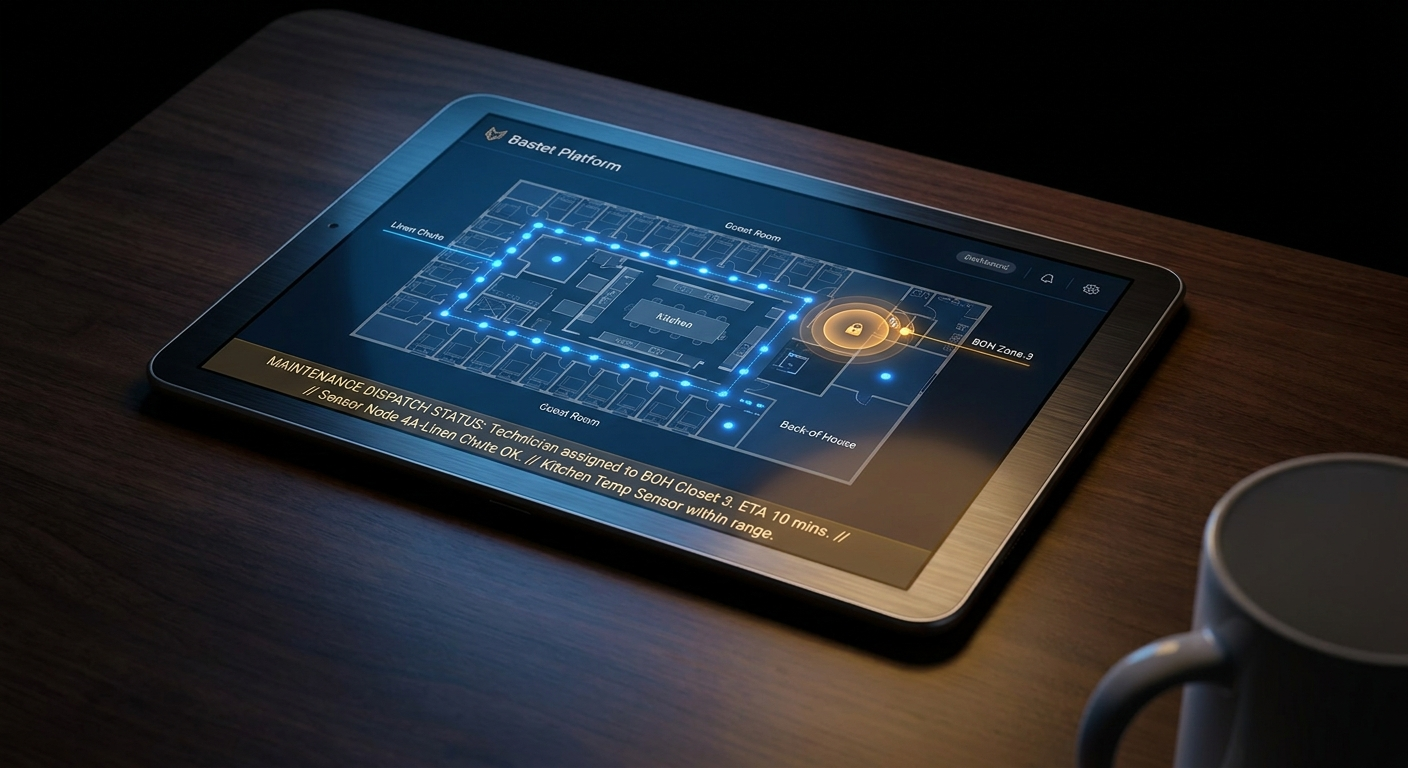
The Bastet Platform dashboard is the intelligence layer that transforms raw sensor data into actionable operational insight. For a luxury hotel group with 12 properties across 6 cities, the dashboard provides a single-pane-of-glass view of every sensor, every alert, and every trend across the entire portfolio.
Key dashboard features for hospitality operations:
- Interactive Facility Floor Plans: Each hotel property is displayed as a color-coded, interactive floor plan. Guest corridors, central kitchens, laundry chutes, receiving docks, dry-storage rooms, and mechanical spaces are individually mapped. Blue sensor-node dots pulse to indicate active, online devices. Green status indicates all-clear. Amber alerts indicate motion detected, pending review. Red alerts indicate AI-verified rodent activity requiring immediate response.
- Real-Time Alert Timeline: A scrolling chronological feed of every sensor event, AI-classified and false-alarm-filtered. Each entry includes: timestamp, sensor location (e.g., "Guest Wing B, Corridor Level 3, Laundry Chute Access Panel"), event type (motion/trap-trigger/camera-capture), AI confidence score, and recommended action.
- Rodent Activity Heat Maps: Aggregated historical data displayed as thermal-style overlays on facility floor plans, showing where rodent activity concentrates over time — enabling predictive resource allocation and targeted exclusion work.
- Automated Compliance Reports: One-click generation of audit-ready pest management reports formatted for Forbes Travel Guide, AAA, brand standards, and local health authority requirements. Each report includes: sensor coverage map, event log with timestamps, response-action documentation, and trend graphs. 85% reduction in administrative hours spent on audit preparation.
- Sensor Health Status Grid: A real-time connectivity map showing every sensor's battery level, signal strength (RSSI in dBm), last-heartbeat timestamp, and firmware version. Proactive alerts for low-battery or signal-degraded sensors ensure zero coverage gaps.
5.2 From Reactive to Predictive: What the Dashboard Sees Before You Do
The real power of the Bastet dashboard is its predictive capability. By analyzing historical rodent-activity patterns against environmental variables — seasonal rainfall, kitchen waste-collection schedules, exterior landscaping changes, nearby construction activity — the platform identifies emerging risk patterns weeks before a visible incident occurs. For a luxury beachfront resort in Phuket, for example, the dashboard might detect a 3.4× increase in exterior PIR sensor triggers during the monsoon-season transition and automatically recommend preemptive exclusion-sealing work on sea-facing service doors — preventing an infestation before it enters the building envelope.
6. Financial ROI: Quantifying the Cost of Rodent Incidents and the Savings of Prevention
6.1 The True Cost of a Single Incident
The financial impact of a rodent sighting in a luxury hotel extends far beyond the pest control call-out fee. Cornell Hotel Sustainability Benchmarking Index (2026) breaks down the total-cost-per-incident:
| Cost Category | Amount (USD) | Details |
|---|---|---|
| Guest Compensation | $45,000 | Room waivers, F&B credits, loyalty points, future-stay vouchers |
| Brand Damage Remediation | $95,000 | PR crisis management, social media monitoring, reputation-repair campaigns |
| Booking Displacement | $110,000 | Cancelled reservations, OTA ranking drop, reduced ADR for 30-60 days |
| Regulatory & Legal | $30,000 | Health authority inspections, potential fines, legal consultation |
| Total Per Incident | $280,000 | Equivalent to 520 room-nights at $538 ADR |
6.2 The ROI of the Bastet Platform for Luxury Hotels
Deploying the Bastet Platform across a 12-property luxury portfolio delivers quantifiable returns across four dimensions:
| ROI Dimension | Metric | Source |
|---|---|---|
| Incident Prevention | 87% reduction in rodent activity | Harvard T.H. Chan School of Public Health, 2025 |
| Audit Efficiency | 85% reduction in admin hours | Bastet Platform deployment data, 2026 |
| False-Positive Filtering | 98% reduction in false alerts | Bastet AI edge-vision model validation, 2026 |
| Pest Control Cost Reduction | 31% reduction in operational costs | BRCGS Global Standard for Food Safety, Issue 9 |
| Overall Platform ROI | 287% with 11-month payback | Aggregated deployment data, 2025-2026 |
| Chemical Pesticide Reduction | 40% reduction in usage | BRCGS-aligned certifications |
For a 12-property luxury portfolio with an average of 0.73 rodent incidents per property per year, the expected annual cost of incidents without IoT monitoring is approximately $2,452,800. With the Bastet Platform reducing incidents by 87%, the expected annual incident cost drops to $318,864 — a saving of $2,133,936 per year, against a total platform deployment cost of approximately $745,000, yielding a 287% ROI with an 11-month payback period.
7. Implementation: A Step-by-Step Deployment Blueprint for Hotel Portfolios
7.1 Phase 1: Risk Assessment and Sensor Mapping (Week 1-2)
Deployment begins with a comprehensive facility risk assessment conducted jointly by the Bastet engineering team and the hotel's director of engineering. Using architectural floor plans, historical pest-sighting logs, and on-site walkthroughs, the team identifies high-risk zones across the property:
- Tier 1 (Critical): Central kitchens, pastry kitchens, dry-goods storage, receiving docks, waste-compactor rooms, and laundry chutes — any zone where food, warmth, and concealment converge.
- Tier 2 (High): Guest floor corridors, service elevators, housekeeping closets, mechanical plant rooms, and ceiling plenums — rodent transit corridors between food sources and nesting sites.
- Tier 3 (Monitoring): Lobby back-of-house, spa treatment rooms, fitness center storage, and administrative offices — lower-risk but brand-visible zones.
Each zone receives a sensor-density recommendation: Tier 1 zones typically require 1 Bastet LoRa PIR Sensor per 150 square meters and 1 Bastet Sensing Camera per critical entry point; Tier 2 zones receive 1 PIR sensor per 300 square meters; Tier 3 zones receive 1 PIR sensor per 500 square meters.
7.2 Phase 2: Installation and Network Commissioning (Week 2-3)
Bastet sensors are designed for non-invasive installation — no structural drilling, no electrical wiring, no disruption to guest operations. Each sensor is battery-powered (3-year operational life with standard CR123A lithium cells) and attaches via industrial-grade VHB adhesive or magnetic mounts. The LoRa Gateway is ceiling-mounted in a central service riser and connects to the property's guest-network-isolated VLAN or a dedicated 4G cellular backhaul.
Installation for a 500-room luxury property is typically completed in 3-5 working days with zero guest-room access required and zero operational downtime. The Bastet Platform dashboard is provisioned remotely and accessible via any standard web browser — no on-premises server installation needed.
7.3 Phase 3: Staff Training and Standard Operating Procedures (Week 3-4)
Bastet provides a structured training program for hotel engineering teams, housekeeping supervisors, and regional facility directors:
- Module 1 — Dashboard Navigation: How to read facility maps, interpret alert timelines, acknowledge and resolve alerts, and generate compliance reports.
- Module 2 — Alert Response Protocols: Standard operating procedures for responding to amber (pending review) and red (AI-verified rodent) alerts, including physical inspection, trap deployment, and exclusion-sealing workflows.
- Module 3 — Data-Driven Decision Making: How to use historical heat maps and trend graphs to schedule preemptive exclusion work, adjust housekeeping protocols, and brief regional leadership during quarterly reviews.
7.4 Phase 4: Ongoing Optimization and Continuous Improvement (Ongoing)
Post-deployment, the Bastet Platform continuously learns from the facility's data patterns. The AI edge-vision model refines its detection accuracy based on the property's unique environmental characteristics (lighting conditions, staff traffic patterns, HVAC-induced vibrations). Monthly platform health checks ensure sensor battery levels, signal strength, and firmware versions remain optimal. Quarterly business reviews with Bastet's customer success team provide portfolio-wide trend analysis and ROI tracking against baseline metrics established during Phase 1.
8. Frequently Asked Questions (FAQ)
Q: How does the Bastet Platform detect rodents differently from traditional bait stations?
Traditional bait stations are passive — they wait for a rodent to enter and consume bait, which may take days or weeks. The Bastet Platform uses active IoT sensors: PIR motion detectors trigger within 3 seconds of rodent movement, smart trap sensors transmit instant trigger alerts, and edge-AI cameras visually confirm rodent identity with 98% false-positive filtering. The system detects activity at first entry, not after infestation. And it uses zero chemicals — entirely physical detection and physical exclusion.
Q: Can Bastet sensors operate in a luxury hotel without disrupting guest experience?
Yes. Bastet sensors are designed for invisible deployment. The matte black housing is compact (82mm × 54mm × 34mm) and mounts discreetly in back-of-house corridors, service areas, ceiling plenums, and mechanical rooms — zones guests never see. No guest-room installation is required. Sensor communication uses sub-gigahertz LoRa (920MHz), which does not interfere with guest Wi-Fi or Bluetooth. Guests experience the benefit — a rodent-free property — without ever knowing the technology exists.
Q: What happens when a rodent is detected? Who gets notified and how quickly?
When an edge-AI camera visually confirms a rodent, the system generates a red alert on the Bastet dashboard within 3 seconds of detection. Simultaneously, a push notification — including the sensor location, timestamp, and a captured image — is sent to designated mobile devices (engineering supervisor, pest management contractor, regional director). The on-duty engineering team follows the Standard Operating Procedure: physical inspection of the alert zone, deployment of connected traps if needed, and documentation of response actions directly in the dashboard for audit-trail completeness.
Q: How does the Bastet Platform help with brand compliance audits like Forbes Travel Guide?
The Bastet dashboard's automated compliance reporting generates a comprehensive pest management audit pack in a single click. The report includes: full sensor-coverage facility map, chronological event log with AI-classification details, response-action documentation with timestamps, 12-month trend analysis with heat maps, and sensor-health status certification. This replaces hours of manual logbook aggregation and is formatted to satisfy the pest-control evidence requirements of Forbes Travel Guide (FTG), AAA Five Diamond, and major global brand standards (Marriott, Four Seasons, IHG, Accor). Administrative hours spent on audit preparation are reduced by 85%.
Q: What is the ROI timeline for deploying Bastet across a multi-property luxury hotel portfolio?
Based on aggregated deployment data from 2025-2026, luxury hotel portfolios achieve a 287% ROI with an 11-month payback period. The primary savings drivers are: (1) incident prevention — 87% reduction in rodent activity eliminates the average $280,000 cost per incident; (2) operational efficiency — 31% reduction in pest control servicing costs by eliminating monthly bait-station technician visits; (3) audit efficiency — 85% reduction in administrative hours spent on compliance documentation; and (4) chemical elimination — 40% reduction in chemical pesticide procurement and hazardous-waste disposal costs.
9. Conclusion: Redefining Luxury Through Invisible Intelligence
The definition of luxury hospitality is evolving. In 2026, a five-star experience is not measured solely by thread-count and turndown service — it is measured by invisible operational excellence. A guest who never sees a pest, never smells a chemical, and never questions the integrity of their environment experiences the truest form of luxury: the peace of not having to think about what protects them.
The Bastet Platform delivers this invisible intelligence. By replacing monthly chemical bait-station servicing with a continuous, AI-powered IoT sensor network — and by unifying all pest intelligence into a single, real-time dashboard — luxury hotel portfolios achieve chemical-free rodent prevention, instant audit readiness, and quantifiable ROI that transforms pest management from a cost center into a brand-protection asset.
For hotel general managers, regional directors of engineering, and brand compliance leaders who are ready to move beyond the 30-day blind spot and the chemical paradigm, the path forward is clear. Continuous monitoring. Zero chemicals. One dashboard. Every property, every sensor, every alert — visible in real time.
Learn more at bastet-tech.ai or contact the Bastet team to schedule a portfolio risk assessment and dashboard demonstration.
References: Cornell Hotel Sustainability Benchmarking Index (2026) · Forbes Travel Guide Global Standards Manual (2026 Edition) · Building Owners and Managers Association — BOMA (2026) · Harvard T.H. Chan School of Public Health, IPM in Commercial Facilities Study (2025) · U.S. Environmental Protection Agency, Rodenticide Mitigation Measures Proposal (2026) · European Chemicals Agency — ECHA, Anticoagulant Rodenticide Restrictions (2025) · World Health Organization, Recommended Classification of Pesticides by Hazard (2025) · BRCGS Global Standard for Food Safety, Issue 9 · OSHA Hazard Communication Standard 29 CFR 1910.1200
Want to learn more about Bastet AI smart pest control solutions?
Message us on WhatsApp — our team will get back to you.
💬 WhatsApp Us