
AI Pest Control for ASRS Warehouses | Bastet AI
Key Takeaways
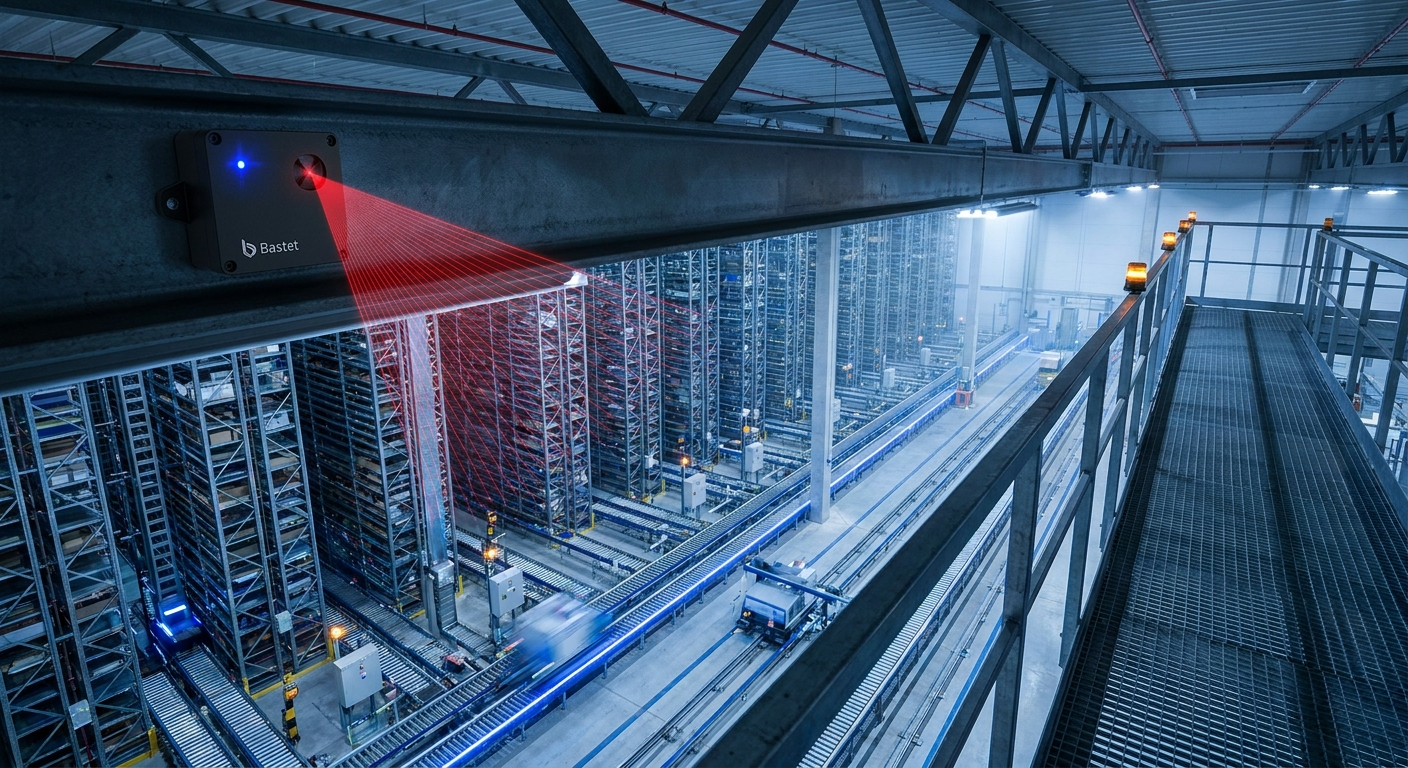
- ✔ The High-Density Vulnerability: Modern Automated Storage and Retrieval Systems (ASRS) feature dense steel racking grids and delicate robotic shuttles that are highly vulnerable to rodent damage, yet completely inaccessible to traditional manual pest inspections.
- ✔ The Sub-Gigahertz Advantage: Bastet AI's proprietary 920MHz sub-gigahertz LoRa WAN technology penetrates massive steel shelving structures and concrete columns up to 10 kilometers, bypassing the RF interference and signal dropouts that render standard 2.4GHz Wi-Fi and Bluetooth useless.
- ✔ Edge-AI Perimeter Defense: The Bastet Sensing Camera utilizes "AI in a Box" edge vision at loading bays and critical cable trays, delivering sub-3 second latency for rodent detection and filtering out 98% of false-positive alerts.
- ✔ Chemical-Free Preservation: Continuous IoT pest monitoring enables pesticide-free facilities management by shifting operations from reactive chemical spraying to real-time, targeted physical exclusion and automated trapping. This eliminates toxic dust that interferes with precision optical sensors and satisfies strict BRCGS, HACCP, and LEED standards.
Table of Contents
- 1. Introduction: The Vulnerability of High-Density ASRS Infrastructures
- 2. The High-Density Blind Spot: Why Traditional Pest Management Fails
- 3. The Threat to Robotics: Rodent Chew Damage and Optical Sensor Failure
- 4. Signal Penetration in Steel Jungles: Shifting to Sub-Gigahertz 920MHz LoRa WAN
- 5. Ingress Protection at the Perimeter: AI in a Box Edge Computer Vision
- 6. Automated Compliance & Dashboard Intelligence: Real-Time Operational Oversight
- 7. Financial ROI and Facility Value: How Preventive Monitoring Pays for Itself
- 8. Frequently Asked Questions (FAQ)
- 9. Conclusion & References
1. Introduction: The Vulnerability of High-Density ASRS Infrastructures
The rapid evolution of global logistics has driven modern distribution centers to transition from traditional flat-floor layouts to ultra-high-density Automated Storage and Retrieval Systems (ASRS). These towering, multi-story steel racking grids maximize spatial efficiency by packing thousands of inventory bins into tight, vertical configurations. However, this architectural shift introduces a critical operational vulnerability: the physical infrastructure is highly susceptible to rodent infestations that cannot be managed by legacy methods. To protect these multi-million-dollar investments, forward-thinking operators are adopting pesticide-free facilities management. By shifting to continuous, non-toxic IoT monitoring, facilities can achieve total operational visibility without introducing chemical hazards that threaten both automated machinery and human health.
Traditional pest control has long relied on a reactive, chemical-first approach. Technicians place bait stations containing rodenticides around the perimeter of a warehouse and inspect them on a bi-weekly or monthly schedule. In a high-density ASRS environment, this methodology is not only obsolete but actively dangerous. Chemical dust from rodenticide blocks can drift through the air, settling on precision optical sensors, laser-guided shuttle tracks, and sensitive electronic components. This chemical residue degrades sensor accuracy and leads to frequent, unexplained system faults. Furthermore, modern environmental standards, such as those championed by the U.S. Green Building Council (USGBC, 2026), strictly limit or prohibit the use of open chemical rodenticides inside high-density logistics hubs to protect indoor air quality and prevent product contamination.
To bridge the gap between high-density operational demands and environmental compliance, Bastet AI has engineered an integrated ecosystem of hardware and software designed specifically for automated logistics. By combining sub-gigahertz 920MHz LoRa WAN connectivity with edge-based artificial intelligence, Bastet AI makes the pest visible in real time. This technical deep dive explores how logistics operations directors and facilities managers can eliminate chemical dependencies, protect sensitive robotic components, and secure their physical infrastructure against rodent-induced downtime.
2. The High-Density Blind Spot: Why Traditional Pest Management Fails
The Inaccessibility of Vertical Racking
An ASRS is a dense, vertical labyrinth of structural steel, guide rails, and high-speed shuttle runways. These systems often reach heights of over 40 meters, with clearances between racking frames and storage totes measured in millimeters. For a human pest control technician, accessing the interior of these structures is physically impossible without shutting down entire aisles, deploying specialized scaffolding, or utilizing harness-rated cherry pickers. Consequently, the core of the ASRS becomes a massive blind spot. Rodents, which naturally seek out dark, undisturbed, and elevated nesting sites, can establish thriving colonies deep within the structural grid, completely shielded from human observation and traditional bait stations.
The Danger of the 14-to-30-Day Inspection Gap
Legacy pest control contracts typically dictate manual inspections every 14 to 30 days. In a high-throughput, automated fulfillment center, a single pregnant female rodent entering the facility can produce a litter of up to a dozen pups within three weeks, with those offspring reaching sexual maturity in just five weeks. A 30-day inspection gap allows multiple generations of rodents to colonize the interior of an ASRS before a technician ever checks a single perimeter trap. During this period of invisibility, rodents chew through wiring, contaminate inventory with urine and feces, and disrupt automated workflows. Relying on periodic manual checks in an era of sub-second logistics is an operational mismatch that invites catastrophic failure.
| Operational Vector | Traditional Manual Pest Control | Bastet AI Continuous IoT Platform |
|---|---|---|
| Inspection Frequency | Every 14 to 30 days (Manual) | Continuous, 24/7/365 real-time monitoring |
| Spatial Reach | Perimeter floors and accessible walkways only | Deep penetration into vertical steel racking grids |
| Chemical Footprint | High (Heavy reliance on toxic rodenticides) | Zero (100% pesticide-free physical monitoring) |
| Response Latency | Weeks (Discovered during scheduled visits) | Sub-3 second edge-AI alert notifications |
3. The Threat to Robotics: Rodent Chew Damage and Optical Sensor Failure
The 6mm Vulnerability and Cable Destruction
Rodents possess highly flexible skeletal structures, allowing them to squeeze through any opening larger than 6mm—roughly the width of a standard pencil. Once inside a warehouse, they seek out warm, enclosed spaces, which inevitably leads them to the electrical cabinets, cable raceways, and onboard battery compartments of ASRS shuttles. Because a rodent's incisors grow continuously throughout its life, it must constantly gnaw on hard materials to wear them down. The polymeric jackets of fiber-optic communication lines and high-voltage power cables contain soy-based plasticizers that emit an attractive scent to rodents, making these critical data and power lines prime targets for destructive chewing.
Sensor Interference and Electrostatic Discharge (ESD) Risks
Beyond direct cable destruction, rodents introduce subtle, hard-to-diagnose physical failures. Their nesting materials, urine, and dander accumulate on the optical sensors and laser rangefinders that ASRS shuttles use to align themselves with storage slots. Even a microscopic layer of organic dust can scatter laser beams, causing alignment errors, emergency shuttle stops, and system-wide recalibration cycles. Furthermore, when rodents chew through the protective shielding of grounding straps, they disrupt the static-safe grounding of the racking system. This increases the risk of Electrostatic Discharge (ESD), which can instantly fry sensitive microprocessors on automated shuttles, leading to expensive component replacements and prolonged operational delays.
"According to data published by the Uptime Institute (2025), the average cost of critical IT and automated infrastructure downtime in high-density logistics hubs has escalated to approximately $9,000 per minute. When a rodent chews through a primary fiber-optic trunk line deep within an ASRS grid, locating and splicing the damaged cable can take hours, resulting in catastrophic financial losses that far exceed the cost of preventive monitoring."
4. Signal Penetration in Steel Jungles: Shifting to Sub-Gigahertz 920MHz LoRa WAN
The Physics of RF Propagation: 920MHz vs. 2.4GHz
To establish a reliable wireless sensor network inside an ASRS, facilities must overcome extreme Radio Frequency (RF) challenges. Standard wireless protocols like 2.4GHz Wi-Fi, Bluetooth, and Zigbee operate on short wavelengths that are easily absorbed, reflected, and scattered by dense metal structures. An ASRS is essentially a giant Faraday cage composed of thousands of tons of structural steel, cross-bracing, and metal inventory totes. High-frequency signals cannot penetrate these barriers, resulting in severe signal attenuation, dead zones, and frequent sensor dropouts.
To solve this physical limitation, Bastet AI utilizes sub-gigahertz 920MHz LoRa (Long Range) technology. The physical properties of the 920MHz band feature significantly longer wavelengths (approximately 32.6 cm) compared to 2.4GHz (approximately 12.5 cm). These longer waves excel at diffracting around solid steel beams and concrete columns, allowing the signal to "bend" around obstacles rather than being blocked by them. This superior propagation capability ensures that sensors placed deep within the racking grid maintain a stable, uninterrupted connection to the central gateway.
RF Signal Penetration Comparison
2.4 GHz (Wi-Fi / Bluetooth): Short wavelength (~12.5cm). High attenuation. Easily blocked by steel racking, resulting in a maximum indoor range of less than 50 meters in dense industrial environments.
920 MHz Sub-GHz LoRa (Bastet AI): Long wavelength (~32.6cm). High diffraction. Penetrates dense steel grids and concrete panels, achieving an indoor range of up to 2 kilometers and an outdoor line-of-sight range of up to 10 kilometers.
The Bastet Hardware Ecosystem: Gateway, PIR, and Trap Sensors
The physical layer of the Bastet AI platform is built upon three core hardware components:
- Bastet LoRa Gateway: This industrial-grade central hub coordinates the entire sensor network. A single gateway can manage up to 1,000 connected devices across a 10-kilometer line-of-sight radius, consolidating data streams and transmitting them securely to the cloud via cellular backhaul or local Ethernet.
- Bastet LoRa PIR Sensor: Utilizing ultra-low-power Passive Infrared (PIR) technology, these compact, battery-operated sensors detect the heat signatures and motion of small rodents moving through dark racking channels. They operate continuously for up to 5 years on a single battery charge, providing constant vigilance in inaccessible areas.
- Bastet LoRa Trap Sensor: Designed to retrofit onto existing mechanical traps, these smart sensors instantly transmit an alert the moment a trap is triggered. This eliminates the need for manual trap inspections, allowing facilities to meet strict animal welfare standards by ensuring captured pests are removed immediately.
5. Ingress Protection at the Perimeter: AI in a Box Edge Computer Vision
The Bastet Sensing Camera and Edge Processing
While sub-gigahertz sensors monitor the interior of the racking system, the perimeter requires a proactive defense to stop rodents before they ever reach the automated core. The Bastet Sensing Camera serves as the first line of defense, positioned at high-risk ingress points such as loading docks, pedestrian doors, and utility penetrations. Unlike traditional security cameras that simply record video for forensic review, the Bastet Sensing Camera features "AI in a Box" edge processing capabilities.
Equipped with an onboard neural network accelerator, the camera analyzes video frames locally at the edge. This local processing eliminates the need to stream high-bandwidth video to the cloud, preserving local network bandwidth and ensuring continuous operation even during internet outages. The edge-AI model is trained on thousands of hours of rodent behavioral footage, allowing it to instantly distinguish between a scurrying mouse, a shifting shadow, a piece of blowing debris, or a human worker.
Sub-3 Second Latency and 98% False-Alarm Filtering
In automated logistics, speed is everything. When a rodent slips through an open loading dock door, facilities managers need to know immediately. The Bastet Sensing Camera operates with a sub-3 second latency for edge-AI detection and notification. Within three seconds of a rodent crossing a virtual perimeter line, the system processes the image, confirms the threat, and sends an actionable alert to the facility's maintenance team.
Crucially, the system achieves a 98% reduction in false-positive alerts compared to traditional motion-activated cameras. By filtering out non-pest movements—such as forklift headlights, dust motes, and falling leaves—the Bastet AI platform prevents "alert fatigue" among operations teams. This ensures that when an alert is triggered, staff respond immediately, knowing with near-certainty that an actual intrusion has occurred.
6. Automated Compliance & Dashboard Intelligence: Real-Time Operational Oversight
The Bastet Platform: Interactive Floor Plans and Heat Maps
The central nervous system of the entire ecosystem is the Bastet Platform, a cloud-based dashboard that aggregates data from every deployed sensor and camera. The platform translates raw telemetry into intuitive, interactive 3D floor plans of the facility. Operations directors can view the real-time status of every Bastet LoRa PIR Sensor, Trap Sensor, and Sensing Camera across multiple facilities from a single pane of glass.
As sensors collect data over time, the Bastet Platform generates historical heat maps that highlight rodent activity trends. By analyzing these spatial and temporal patterns, facilities managers can identify structural weaknesses—such as damaged weather stripping on a specific dock door or a gap in a utility conduit—and execute targeted physical exclusions. This data-driven approach shifts pest management from a continuous cycle of chemical application to a precise, preventive engineering discipline.
Streamlining Audits: BRCGS, HACCP, and LEED Compliance
For food, pharmaceutical, and high-value retail logistics hubs, maintaining compliance with international standards like BRCGS, HACCP, and LEED is a demanding task. Traditional manual pest control requires maintaining paper logs, physical maps, and manual signature sheets—a process prone to human error and administrative delays.
The Bastet Platform automates this entire compliance workflow. Every sensor trigger, trap activation, and maintenance action is digitally logged with a tamper-proof cryptographic timestamp. When an auditor requests pest control records, the platform generates comprehensive, audit-ready compliance reports with a single click. This digital transformation delivers an 85% reduction in administrative hours spent on audit preparation, freeing up valuable staff time and eliminating the risk of compliance failures.
7. Financial ROI and Facility Value: How Preventive Monitoring Pays for Itself
Quantifying the Economic Benefits
Investing in an advanced IoT and AI-driven pest monitoring platform is not just a risk-mitigation strategy; it is a highly profitable operational decision. By replacing manual, chemical-heavy pest control with the Bastet AI platform, facilities realize immediate and quantifiable cost savings across multiple operational vectors.
First, the transition to targeted, physical exclusion and smart trapping results in a 40% reduction in chemical pesticide usage. This reduction aligns facilities with modern environmental standards, such as the WELL Building Institute (IWBI, 2026) guidelines, which emphasize the elimination of indoor chemical toxins to improve worker health and cognitive function, as documented by the Harvard T.H. Chan School of Public Health (2025).
Second, by identifying pest entry points and nesting sites before infestations can establish, facilities achieve a 31% reduction in operational cleaning and maintenance costs. Maintenance teams no longer waste hours sanitizing contaminated racking zones or performing emergency cleanups of rodent droppings.
The ROI Calculation
When evaluating the total cost of ownership (TCO), the financial return is clear. Across a standard 50,000-square-meter automated distribution center, the deployment of the Bastet AI platform typically yields a 287% ROI achieved within an 11-month payback period. This rapid amortization is driven by the prevention of a single major downtime event, the reduction in manual labor costs, and the elimination of product loss due to rodent contamination.
Financial Impact Summary
40%Reduction in Chemical Pesticides31%Lower Cleaning & Maintenance Costs85%Reduction in Audit Prep Time{ "@context": "https://schema.org", "@type": "FAQPage", "mainEntity": [ { "@type": "Question", "name": "Why does traditional chemical pest control fail in high-density ASRS automated warehouses?", "acceptedAnswer": { "@type": "Answer", "text": "Traditional chemical pest control relies on manual inspection and visual checks, which cannot access the deep, multi-tiered steel racking crevices where rodents nest. Additionally, chemical rodenticides or bait dusts can drift onto robotic shuttle tracks, disrupting precision optical sensors and causing massive system calibration failures." } }, { "@type": "Question", "name": "How does Bastet's sub-gigahertz LoRa wireless signals penetrate high-density steel warehouse racks?", "acceptedAnswer": { "@type": "Answer", "text": "Unlike standard 2.4GHz Wi-Fi or Bluetooth, which suffer severe signal attenuation in metal-heavy environments, Bastet's hardware operates on the sub-gigahertz 920MHz LoRa frequency. This lower frequency allows waves to propagate easily through dense structural steel racks and reinforced concrete walls up to 10 kilometers away." } }, { "@type": "Question", "name": "What is the cost impact of a rodent breach in an automated logistics center?", "acceptedAnswer": { "@type": "Answer", "text": "Rodents entering through openings as small as 6mm chew through critical control cables, fiber-optic lines, and power links, causing catastrophic communication downtime. According to the Uptime Institute, critical infrastructure downtime can cost up to $9,000 per minute in delayed shipments and operational recovery expenses." } }, { "@type": "Question", "name": "What ROI can logistics operators expect from the Bastet Platform?", "acceptedAnswer": { "@type": "Answer", "text": "Logistics operators implementing the Bastet Platform achieve an average of 287% ROI within an 11-month payback period. This is driven by a 40% reduction in chemical pest footprint, a 31% reduction in manual facilities maintenance costs, and an 85% reduction in administrative time preparing for HACCP or BRCGS compliance audits." } } ] }
Want to learn more about Bastet AI smart pest control solutions?
Message us on WhatsApp — our team will get back to you.
💬 WhatsApp Us