
AI Pest Control for Meat Processing Plants | Bastet AI
AI pest control for meat processing plants is an automated, non-chemical biosecurity framework combining 24/7 sub-gigahertz IoT sensors
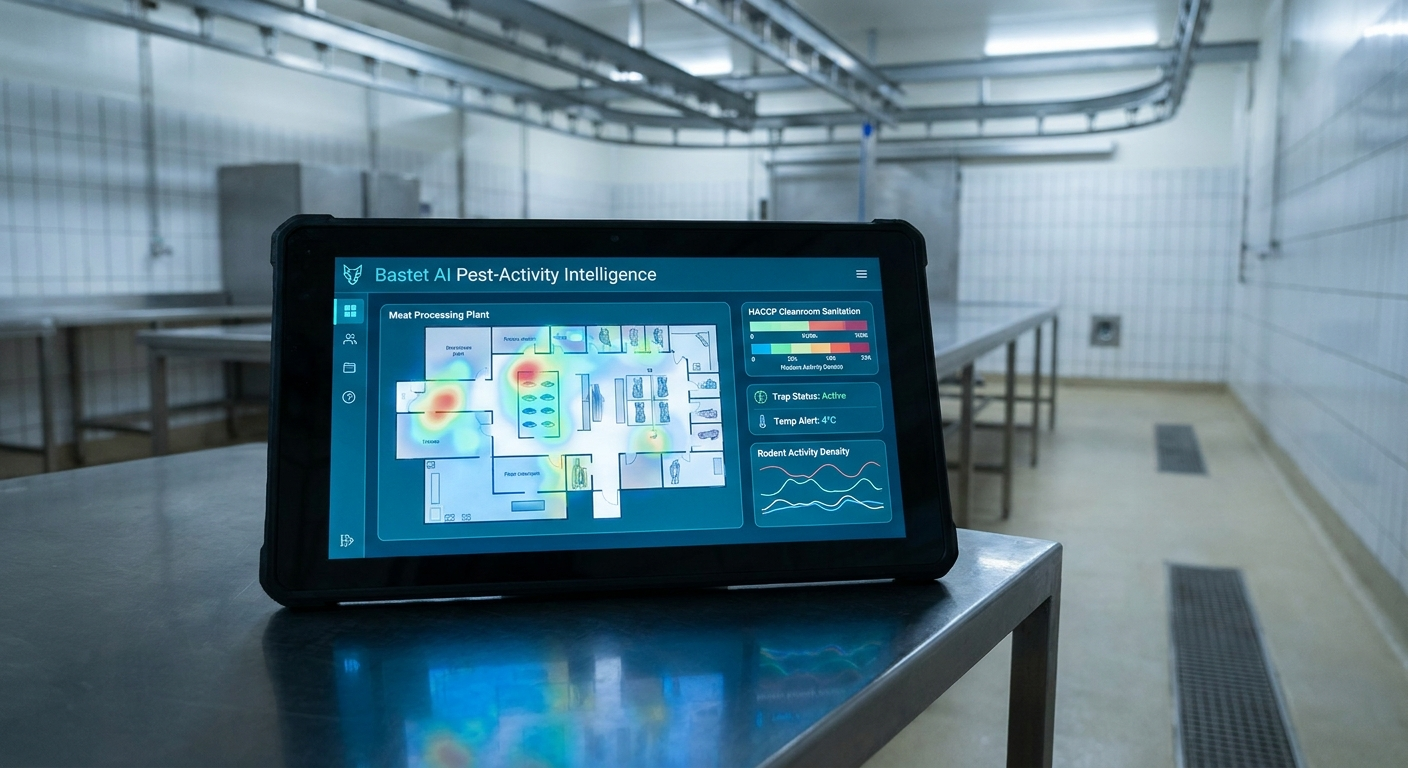
AI pest control for meat processing plants is an automated, non-chemical biosecurity framework combining 24/7 sub-gigahertz IoT sensors, edge computer vision, and predictive analytics to detect, verify, and intercept rodent activity in real time. Unlike traditional rodent management that relies on monthly manual trap inspections and hazardous chemical rodenticides, intelligent pest monitoring eliminates compliance blind spots, guarantees strict adherence to USDA FSIS and HACCP standards, and prevents catastrophic microbiological contamination in high-risk abattoir environments.
Key Takeaways for Processing Plant Directors
- Zero-Chemical Mandate: Eliminates toxic anticoagulant rodenticides from primary food production zones, satisfying USDA FSIS Directive 5000.1 and BRCGS Issue 9 Section 4.14.
- Sub-3 Second Ingress Verification: Edge computer vision and optical sensors filter false alarms with 98% accuracy and alert sanitation teams instantly via the Bastet Platform.
- Extreme Environment Resilience: Industrial-grade IP67 sealed enclosures operate reliably through high-pressure caustic chemical washdowns and sub-zero blast freezers (-40°C to +85°C).
- Sub-Gigahertz LoRa Penetration: 920MHz frequency penetrates dense reinforced concrete walls and heavy stainless steel walk-in refrigeration units up to 10 kilometers.
- Rapid Operational ROI: Reduces manual trap inspection labor by 75% and slashes audit documentation preparation time by 85% with automated tamper-proof logs.
Table of Contents
- 1. Critical Pest Vulnerabilities in Modern Meat Processing Facilities
- 2. Regulatory Mandates: USDA FSIS, HACCP, and BRCGS Issue 9
- 3. How AI-Driven IoT Architecture Solves Abattoir Biosecurity
- 4. Hardware Specifications & RF Physics in Industrial Wet Facilities
- 5. Traditional Bait Boxes vs. Bastet AI Smart Rodent IoT
- 6. Step-by-Step Implementation Blueprint for Processing Plants
- 7. Financial ROI, Contamination Mitigation, and Risk Management
- 8. Frequently Asked Questions (FAQ)
- 9. Regulatory References & Technical Citations
1. Critical Pest Vulnerabilities in Modern Meat Processing Facilities
Commercial meat processing plants, cold slaughterhouses, and abattoirs present unique biosecurity challenges that make them prime targets for rodent infiltration. Rodents (predominantly Rattus norvegicus and Mus musculus) are intensely drawn to meat processing corridors by rich organic attractants, including warm animal fat, blood residue in trench drains, bone meal dust, and protein fragments. Because rodents require only a microscopic opening—less than 6 millimeters (0.25 inches) for mice and 12 millimeters (0.5 inches) for rats—they exploit dock door seals, expansion joints, refrigeration pipe penetrations, and underground drainage channels to enter production corridors.
Once inside a meat fabrication facility, rodent presence introduces catastrophic microbiological risks. Rodents serve as primary vectors for severe foodborne pathogens, including Salmonella enterica, Listeria monocytogenes, pathogenic Escherichia coli (STEC), and Campylobacter jejuni. Furthermore, rodents harbor ectoparasites, urine droplet contamination, and fecal pellets containing up to 200,000 bacteria per gram. A single rodent incursion into a deboning, cutting, or secondary packaging area can contaminate entire production batches, resulting in mandatory product recalls, regulatory plant shutdowns, and irreparable brand erosion.
Beyond biological vectors, rodents exhibit continuous gnawing behavior to keep their open-rooted incisors trimmed. In modern automated processing plants, rodents target high-voltage power feeds, servo motor cables, hydraulic sensors, and optical sorting lines. According to the Uptime Institute, industrial production downtime averages over $9,000 per minute in highly automated processing hubs. A severed motor control cable in a primary carcass conveyor line can paralyze operations for 6 to 12 hours, stranding perishable meat at ambient temperatures and causing tens of thousands of dollars in spoiled product.
2. Regulatory Mandates: USDA FSIS, HACCP, and BRCGS Issue 9
Modern regulatory authorities enforce zero-tolerance thresholds for rodent activity in meat processing environments. Under USDA FSIS Directive 5000.1 and 9 CFR Part 416 (Sanitation Performance Standards), processors are legally obligated to maintain an operating environment free from vermin. The discovery of rodent droppings, gnaw marks, or nesting material in or around edible product departments triggers immediate issuance of a Noncompliance Record (NR), line stoppages, or suspension of the facility's Federal Inspection grant.
Simultaneously, global food safety audit frameworks, such as the British Retail Consortium Global Standard (BRCGS) Food Safety Issue 9 (Clause 4.14) and Safe Quality Food (SQF) Edition 9, have established rigorous restrictions regarding rodent control chemicals. The use of toxic anticoagulant baits (such as brodifacoum or bromadiolone) inside food processing buildings is strictly prohibited due to secondary poisoning risks and chemical contamination of food contact surfaces. Processors must rely exclusively on non-toxic, mechanical, and physical monitoring systems inside the building envelope.
However, legacy mechanical traps create severe audit vulnerabilities. Standard snap traps and glue boards provide zero operational transparency between manual service visits. In typical contract pest control contracts, technicians inspect traps every 14 or 30 days. If a rodent enters a facility on Day 2 of a 30-day inspection cycle, the carcass can decompose undetected inside a trap for 28 days, generating secondary fly infestations, putrefactive bacterial odors, and severe BRCGS audit non-conformances. Modern compliance demands continuous, 24/7 automated verification with immutable electronic audit trails.
3. How AI-Driven IoT Architecture Solves Abattoir Biosecurity
Bastet AI transforms reactive rodent extermination into an active, automated biosecurity perimeter. The Bastet Smart Rodent IoT ecosystem operates across three interconnected layers designed specifically for mission-critical food processing facilities: edge sensing, intelligent computer vision, and cloud analytics.
Sub-Gigahertz LoRa Sensor Grid
The foundation of the architecture consists of Bastet LoRa Trap Sensors and LoRa PIR Motion Sensors deployed along perimeter walls, false ceilings, and drainage gullies. Utilizing long-range, sub-gigahertz wireless protocols (920MHz in Asia-Pacific / 868MHz in Europe / 915MHz in North America), Bastet sensors bypass the severe RF attenuation caused by stainless steel machinery, blast freezer insulation, and corrugated steel structural columns. The sub-GHz signal penetrates heavy building materials over distances exceeding 10 kilometers in line-of-sight and up to 1.5 kilometers through complex industrial infrastructure.
AI in a Box & Computer Vision Verification
In high-traffic transit corridors, loading bays, and refrigeration vestibules, Bastet deploys "AI in a Box" edge vision units coupled with Bastet Sensing Cameras. Rather than sending continuous raw video streams over bandwidth-constrained industrial networks, AI in a Box runs localized deep-learning convolutional neural networks (CNNs) directly on the edge hardware. The computer vision model is specifically trained to differentiate between rodents, forklifts, shadows, water droplets, and sanitation personnel.
When movement is detected, the edge processor verifies the target in less than 3 seconds with a proven 98% false-alarm filtering rate. If rodent locomotion is confirmed, an encrypted instant alert is dispatched to facility sanitation managers via the Bastet Platform Mobile App and automated SMS/email webhook integrations.
4. Hardware Specifications & RF Physics in Industrial Wet Facilities
Operating IoT devices inside commercial abattoirs requires engineering capabilities far exceeding standard commercial electronics. Meat processing facilities undergo daily, intensive chemical sanitation procedures involving hot water washdowns at pressures up to 1,000 PSI and caustic alkaline foam detergents (pH 11-13) or peracetic acid sanitizers.
Bastet hardware is engineered specifically to survive these extreme conditions:
- IP67/IP69K Hermetic Sealing: Bastet LoRa sensors are encased in ultrasonic-welded, food-grade polycarbonate housings with double O-ring silicone seals, completely preventing moisture ingress during high-pressure hose-downs.
- Extreme Thermal Range: Meat plants transition rapidly from 4°C carcass deboning rooms to -40°C blast freezers and 45°C washdown environments. Bastet sensors utilize industrial-grade lithium-thionyl chloride (Li-SOCl2) chemistry, ensuring stable battery discharge curves and 5+ years of autonomous operating life even at continuous sub-zero temperatures.
- Anti-Static & Food-Grade Housing: Exterior surfaces are non-shedding, chemical-resistant, and free from protruding crevices that could harbor bacterial bio-films or food debris.
- Sub-GHz Signal Diffraction: The 920MHz wavelength (approx. 33 cm) diffracts around large stainless steel mixing vats and carcass chillers where 2.4GHz Wi-Fi and Bluetooth signals suffer extreme multipath fading and complete absorption by wet organic tissues.
5. Traditional Bait Boxes vs. Bastet AI Smart Rodent IoT
To understand the operational and financial impact of deploying intelligent pest monitoring in meat processing plants, facility executives must evaluate the systemic differences between legacy manual pest control and automated IoT platforms:
| Feature / Dimension | Traditional Manual Pest Control | Bastet AI Smart Rodent IoT Platform |
|---|---|---|
| Monitoring Cadence | Bi-weekly or monthly manual inspections (99% blind time) | 24/7/365 real-time continuous active surveillance |
| Chemical Usage | Relies on anticoagulant rodenticides (toxic hazard) | 100% zero-chemical non-toxic mechanical and optical monitoring |
| Notification Latency | 14 to 30 days before discovery of trapped carcass | Sub-3 second instant alert to mobile app upon trigger |
| False Alarm Rate | High nuisance trips from water spray or vibrations | 98% false-alarm filtering via edge computer vision |
| Audit Compliance | Manual paper binder logs prone to human error and falsification | Automated, cryptographic electronic audit trail for USDA/BRCGS |
| Coverage in Cold Storage | Batteries fail in sub-zero freezers; manual checks avoided | Certified down to -40°C with 5-year battery autonomy |
6. Step-by-Step Implementation Blueprint for Processing Plants
Deploying smart rodent monitoring in a meat processing environment requires strict alignment with HACCP zoning protocols to ensure zero disruption to production lines and maximum interception efficiency:
Phase 1: Facility Ingress Audit & Environmental Mapping
Certified Bastet integration engineers conduct a complete physical assessment of the processing plant. Ingress points are prioritized based on thermal, olfactory, and physical vulnerability:
- Receiving & Loading Docks: Roll-up doors with rubber astragal seals, hydraulic dock leveler pits, and trash compactor vestibules are designated as Tier 1 Ingress Zones. Bastet Sensing Cameras and LoRa PIR sensors are mounted at 2.4 meters overlooking bay openings.
- Sub-Floor Drainage Trenches: Deep grease-interceptor channels and slaughter floor drain lines are mapped. Moisture-sealed Bastet LoRa Trap Sensors are installed adjacent to gully traps where rodents seek water and protein residues.
- Under-Ceiling Cable Trays: Elevated cable raceways carrying high-voltage distribution lines are demarcated. Sensors are secured directly to tray side-rails every 15 meters to intercept runway travel.
Phase 2: Gateway Installation & Sub-GHz Network Validation
Bastet LoRa Gateways are positioned at strategic high-elevation structural points, typically above central electrical rooms or administrative mezzanines. A single Bastet LoRa Gateway provides full signal coverage across facilities up to 250,000 square feet, even through heavily shielded blast-chill chambers. Signal strength (RSSI) is validated at each sensor location, ensuring minimum link margins of -110 dBm for bulletproof data transmission.
Phase 3: Integration into Sanitation Standard Operating Procedures (SSOP)
Sensors are registered to the digital floor plan within the Bastet Platform Mobile App. The system is integrated into the facility's daily Sanitation Standard Operating Procedures (SSOP). When an alert fires, the system automatically creates a geolocated dispatch ticket directing on-duty sanitation personnel to the exact coordinates, enabling carcass removal within minutes rather than weeks.
7. Financial ROI, Contamination Mitigation, and Risk Management
The business case for adopting Bastet AI pest control in meat processing extends far beyond operational convenience. It represents a vital balance-sheet risk mitigation strategy across four core financial pillars:
1. Elimination of Product Recall Catastrophes
According to the Food Marketing Institute (FMI) and Grocery Manufacturers Association (GMA), the direct average cost of a commercial food recall in the meat and poultry sector exceeds $10 million in direct expenses, including product destruction, customer reimbursement, federal regulatory fines, and legal defense. Brand damage and stock valuation declines frequently triple this figure. By continuously maintaining a zero-rodent production environment, Bastet provides an indispensable insurance layer against cross-contamination.
2. Reduction of Contractor Labor Overhead
Traditional pest control contractors spend over 80% of their billable hours physically unlocking, inspecting, and documenting empty rodent bait stations. In a 150,000 sq ft meat packing plant with 300 trap stations, this labor demands 20 to 30 technician hours per month. Bastet automates inspection verification, allowing facilities to renegotiate pest control contracts into high-value remediation services rather than passive box-checking, yielding direct contractor fee savings of 30% to 50%.
3. Regulatory Audit Automation
Preparing documentation for unannounced USDA FSIS inspections and annual BRCGS Global Standard for Food Safety Issue 9 audits typically demands 150 to 200 administrative man-hours annually per plant. Facility QA teams must compile trap logs, trend graphs, and corrective action reports manually. The Bastet Platform compiles historical capture trends, sensor uptime statistics, and timestamped corrective actions automatically, exporting audit-ready PDF packages in seconds and cutting administrative overhead by 85%.
4. Physical Plant Uptime Protection
Rodents chewing through automated servo motor power cables or PLC sensor lines in automated packaging sections trigger catastrophic unscheduled line stoppages. With downtime valued at $9,000 per minute by the Uptime Institute, preventing a single 90-minute downtime incident saves over $810,000 in lost throughput and labor stagnation.
8. Frequently Asked Questions (FAQ)
Q: How do Bastet sensors survive daily high-pressure chemical washdowns in an abattoir?
A: Bastet sensors are certified to IP67 and IP69K standards. They feature ultrasonically welded polycarbonate housings, chemical-resistant silicone O-rings, and potted internal electronics capable of withstanding 1,000 PSI washdowns with caustic alkaline foam sanitizers and chlorinated degreasers without moisture ingress.
Q: Can sub-gigahertz LoRa signals penetrate heavy walk-in blast freezers?
A: Yes. Unlike 2.4GHz Wi-Fi or Bluetooth signals which are severely attenuated and reflected by dense polyurethane insulated metal panels (IMPs) and stainless steel freezer doors, sub-gigahertz 920MHz radio waves possess superior penetration and diffraction characteristics. Bastet LoRa sensors reliably communicate through insulated cold storage envelopes over hundreds of meters.
Q: Why is chemical rodenticide prohibited in meat processing plants?
A: Regulatory standards, including USDA FSIS 9 CFR Part 416 and BRCGS Issue 9 Clause 4.14, strictly prohibit toxic anticoagulant rodenticide baits inside food production, handling, and storage areas. This ban eliminates the risk of toxic chemicals contaminating food contact surfaces and prevents poisoned rodents from dying and decomposing in inaccessible machine voids.
Q: How does Bastet computer vision avoid false alarms from steam and forklifts?
A: Bastet's "AI in a Box" edge vision system utilizes custom-trained convolutional neural networks optimized for meat processing environments. The model processes video frames locally in real time, filtering out steam plumes, caustic fog, forklift silhouettes, insect flights, and human foot traffic, achieving a proven 98% false-alarm filtering accuracy with sub-3 second alert latency.
Q: What is the battery lifespan of Bastet sensors in sub-zero cold storage?
A: Bastet sensors utilize industrial-grade lithium-thionyl chloride (Li-SOCl2) batteries engineered for extreme temperature ranges (-40°C to +85°C). Due to the ultra-low power consumption of the sub-GHz LoRaWAN protocol, sensors maintain an autonomous operating lifespan of 5 to 7 years without battery replacement, even inside -25°C blast freezers.
Want to learn more? 想了解方案?
9. Regulatory References & Technical Citations
- USDA Food Safety and Inspection Service (FSIS): Directive 5000.1, Verifying an Establishment's Food Safety System and Sanitation Performance Standards (9 CFR Part 416).
- British Retail Consortium Global Standards (BRCGS): Global Standard for Food Safety Issue 9, Clause 4.14: Pest Management and Ingress Control.
- Codex Alimentarius: CXC 1-1969, General Principles of Food Hygiene (Revised 2020), Section 5: Establishment Maintenance and Sanitation.
- Uptime Institute: Annual Outage Analysis 2025: Economic Impact and Downtime Costs in Automated Industrial Infrastructure ($9,000/minute baseline).
- Safe Quality Food Institute (SQFI): SQF Food Safety Code: Food Manufacturing, Edition 9, Module 11: Good Manufacturing Practices for Processing of Food Products.
- Centers for Disease Control and Prevention (CDC): Rodent-Borne Pathogens in Food Production Environments: Salmonella, STEC, and Leptospira Risks (2025 Review).