AI Pest Control for Hotel Banquet Kitchens | Bastet AI
Key Takeaways
- High-Stakes Vulnerability: Hotel banquet kitchens operate under extreme production pressures, preparing 500 to 3,000+ covers simultaneously. A single rodent sighting during a gala or wedding can inflict millions in brand damage and immediate public health closure.
- Chemical-Free Food Safety: Toxic chemical rodenticides and bait blocks are strictly prohibited near commercial food contact surfaces under HACCP, ISO 22000, and local health regulations. Smart IoT non-toxic trapping delivers 100% compliance.
- 24/7 Continuous Autonomous Protection: Bastet sub-GHz 920MHz LoRa sensors monitor blind spots—false ceilings, dishwashing drainage pits, and cold-room insulation cavities—with sub-3-second alert latency.
- Edge AI Verification ("AI in a Box"): High-speed Sensing Cameras utilize convolutional neural networks to classify rodent activity with 98% false-alarm filtering, preventing unnecessary kitchen evacuations or false alarms.
- Digital Audit Readiness: Automated, immutable digital logs replace unreliable manual paper inspection sheets, slashing hotel hygiene audit prep time by 85%.
Table of Contents
- 1. The Operational Reality of Luxury Hotel Banquet Kitchens
- 2. Structural Vulnerabilities: Why Traditional Pest Control Fails in Large Kitchens
- 3. How Bastet AI Pest Control Operates in High-End Hospitality
- 4. Regulatory Compliance & Food Safety: HACCP, ISO 22000, and Five-Star Audits
- 5. Total Cost of Ownership (TCO) & Reputational ROI Analysis
- 6. Multi-Zone Implementation Blueprint for Hotel F&B Facilities
- 7. Frequently Asked Questions (FAQ)
- 8. Conclusion & Hospitality Next Steps
- 9. Authoritative References
1. The Operational Reality of Luxury Hotel Banquet Kitchens
In five-star hotels, luxury integrated resorts, and premier convention properties, the central banquet kitchen serves as the beating commercial heart of the food and beverage (F&B) operation. Unlike boutique restaurant kitchens that manage steady, predictable table turns, banquet kitchens operate under cyclical extremes. A single evening service may require plating 1,500 filet mignons, holding hundreds of delicate desserts at precise temperatures, and maintaining continuous production across prep lines spanning thousands of square meters.
Behind the polished presentation and stainless steel finishes, banquet kitchens represent the ideal biological ecosystem for urban rodents—primarily the Norway rat (Rattus norvegicus), roof rat (Rattus rattus), and house mouse (Mus musculus). These massive commercial kitchens provide constant thermal warmth from commercial combi-ovens, dishwashing steam tunnels, and refrigeration compressors; boundless caloric nutrition from bulk dry stores and organic waste; and labyrinthine harborage networks within false ceilings, floor drains, and drywall partitions.
In the hospitality industry, pest contamination is not merely an operational inconvenience; it is an existential business crisis. A single guest sighting of a rodent in a ballroom dining area or a social media video capturing pest activity can immediately destroy decades of accumulated luxury brand equity. Furthermore, health inspection authorities in major international hospitality hubs—such as Hong Kong, Singapore, London, and New York—enforce immediate suspension orders upon detecting rodent droppings in commercial food preparation areas. The resulting direct revenue losses from cancelled corporate galas, forfeited wedding deposits, and regulatory fines easily exceed $250,000 to $1,000,000 within days.
Modern luxury hospitality demands an uncompromising, zero-tolerance standard of pest management. Passive wooden snap traps and monthly contractor inspections are fundamentally obsolete in high-throughput food preparation environments. To guarantee five-star hygiene and satisfy rigorous international food safety frameworks, hotel operators are deploying 24/7 AI-driven rodent detection and IoT smart monitoring infrastructure.
2. Structural Vulnerabilities: Why Traditional Pest Control Fails in Large Kitchens
Traditional pest control methodologies rely almost entirely on bi-weekly or monthly visual inspections conducted by contracted third-party pest control operators (PCOs). While this reactive model remains standard in many commercial properties, it introduces critical vulnerabilities within high-volume hotel banquet kitchens.
1. The 720-Hour Visibility Void
When a PCO visits a hotel on the first day of the month, they inspect bait boxes, record findings on paper clipboard logs, and exit. If an aggressive rodent breaches loading dock weather seals on day two, that animal operates undetected for up to 28 days—over 670 hours—before the next scheduled inspection. During this period, a single pregnant female can birth a litter of 8 to 12 pups, while actively contaminating prep surfaces, stainless steel shelving, and dry food inventory with pathogens including Salmonella enterica, Listeria monocytogenes, and Leptospira.
2. The Chemical Bait Prohibition Paradox
Anticoagulant rodenticides (SGARs) represent the primary tool of conventional pest extermination. However, under strict food safety regulations—including Hazard Analysis Critical Control Points (HACCP), ISO 22000, and FDA Food Safety Modernization Act (FSMA) standards—the placement of toxic chemical bait blocks inside food production, cooking, and plating areas is strictly prohibited. The risk of toxic contamination of food contact equipment or secondary transport by rodents onto plating counters makes poisons completely unusable inside banquet kitchens. Consequently, conventional PCOs are restricted to placing unmonitored mechanical snap traps and sticky glue boards in dark corners, which quickly become covered in airborne kitchen grease, flour dust, and moisture, losing all trapping efficacy within days.
3. Hidden Utility Void Harbors
Large hotel kitchens are traversed by complex overhead and underfloor engineering infrastructure: suspended grease-exhaust ducts, insulated chilled-water lines, power conduits, and drainage trenches. Rodents travel predominantly within these enclosed plenums, completely out of sight of human staff. Traditional traps placed on floor perimeters fail to monitor vertical utility risers and ceiling voids where 80% of kitchen rodent transit actually occurs.
3. How Bastet AI Pest Control Operates in High-End Hospitality
Bastet AI transforms hotel kitchen pest defense from a passive, periodic guessing game into an active, continuous, and intelligent monitoring grid. By combining sub-gigahertz wireless IoT sensors, optical computer vision, and edge neural networks, Bastet provides complete visibility across every critical F&B zone.
Sub-GHz 920MHz LoRaWAN Penetration
Commercial kitchens are heavily shielded RF environments, surrounded by stainless steel workbenches, walk-in freezer insulation panels, and heavy concrete partition walls that completely obstruct standard 2.4 GHz Wi-Fi and Bluetooth signals. Bastet IoT hardware utilizes sub-gigahertz 920 MHz LoRaWAN communication. A single central Bastet LoRa Gateway easily penetrates multiple floors, concrete risers, and dense industrial refrigeration equipment up to 10 kilometers line-of-sight and over 2 kilometers throughout complex hotel back-of-house structures.
Hardware Ecosystem: LoRa Trap & PIR Sensors
The monitoring network deploys low-profile, non-toxic hardware designed specifically for wet, commercial kitchen environments:
- Bastet LoRa Trap Sensor: Fitted directly to heavy-duty, enclosed mechanical snap traps placed along perimeter runways, false ceilings, and dry stores. When a rodent trips the mechanical catch, a micro-switch triggers an instant wireless pulse.
- Bastet LoRa PIR Sensor: Sealed in IP65 water-resistant industrial polymer, these passive infrared units detect mammalian heat signatures and directional motion along pipe racks, drainage chases, and loading dock ingress points.
- Ultra-Low Power Efficiency: Powered by industrial lithium-thionyl chloride battery cells, Bastet sensors operate continuously for 3 to 5 years without maintenance, eliminating battery-swap downtime.
Edge Computer Vision: "AI in a Box" & Sensing Cameras
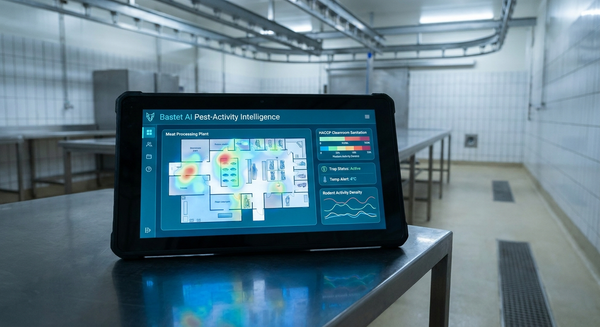
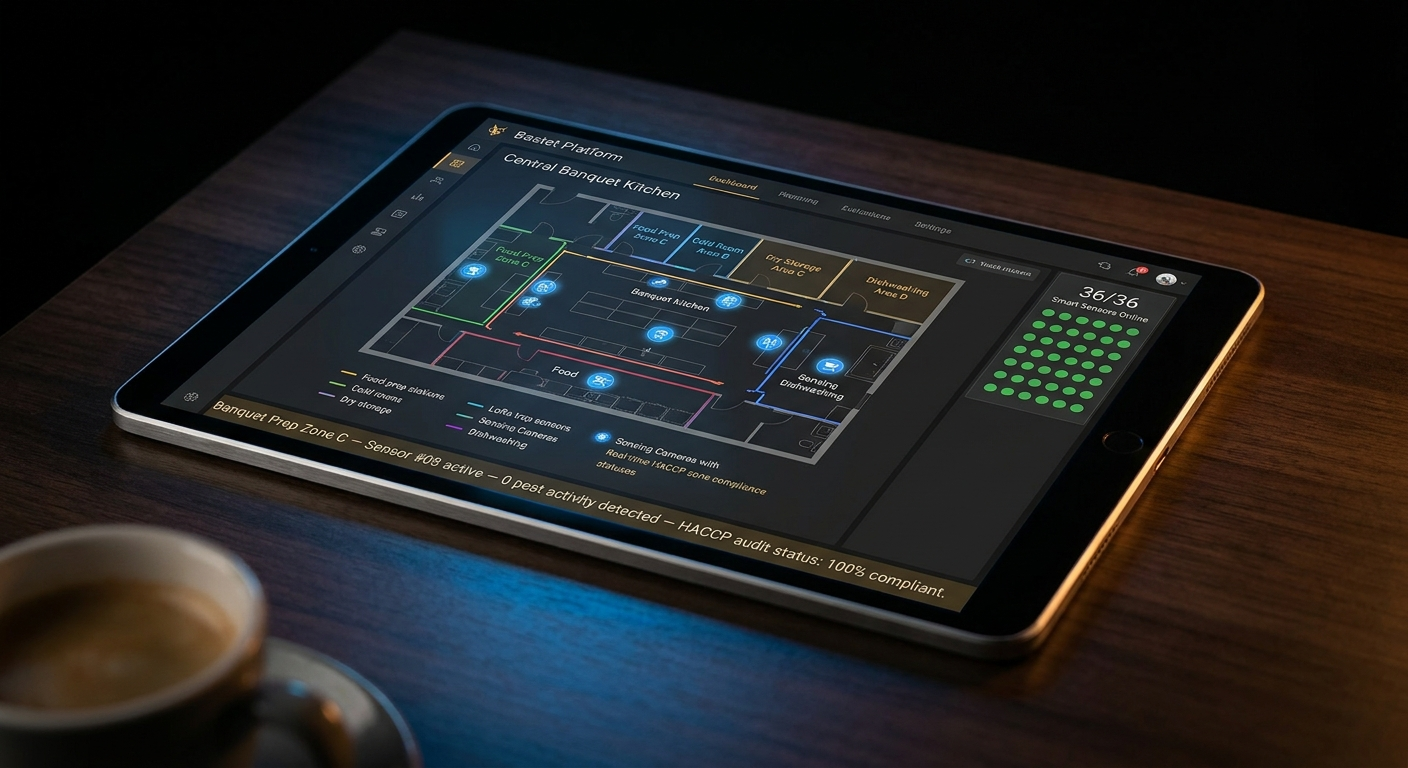
To eliminate false alarms that disrupt kitchen workflows, Bastet deploys edge-computed computer vision. When motion is detected in a primary risk area, the Bastet Sensing Camera captures high-speed burst frames. The on-premise AI in a Box edge processor analyzes target silhouette, locomotion, and tail dynamics against deep-learning neural models in less than 3 seconds. The system filters out 98% of false alarms caused by shifting dish towels, steam vapors, or kitchen insects. Once verified, instant push notifications are dispatched to executive chefs, hygiene managers, and engineering teams via the Bastet Platform Mobile App.
4. Regulatory Compliance & Food Safety: HACCP, ISO 22000, and Five-Star Audits
For international luxury hotel brands (such as Marriott, Hyatt, Four Seasons, and Mandarin Oriental), food safety audit standards are non-negotiable. Independent third-party auditors and government health inspectors conduct rigorous inspections evaluating hygiene integrity.
Automating HACCP Verification (Critical Control Points)
Under HACCP guidelines, pest management represents a foundational prerequisite program (PRP). When auditors request proof of pest control compliance, traditional hotel hygiene managers must manually retrieve paper logbooks filled with handwritten contractor signatures. Bastet eliminates this administrative vulnerability by generating automated, cryptographically timestamped digital audit trails. Every sensor trip, alert dispatch, and technician trap-reset action is logged in real time. Hotel hygiene officers can generate comprehensive, audit-ready compliance reports in single-click PDF formats, reducing audit preparation labor by over 85%.
Supporting ESG and Green Hospitality Benchmarks
Five-star hotel groups are aggressively pursuing Environmental, Social, and Governance (ESG) targets, as well as LEED O+M (Existing Buildings) and EarthCheck certifications. Conventional pest control contracts that rely on recurring rodenticide baiting contaminate urban runoff and wildlife food chains. By transitioning to Bastet's non-toxic, sensor-driven trapping infrastructure, hotels achieve a verified 40% to 100% reduction in chemical rodenticides. This tangible reduction directly earns credits under LEED Indoor Environmental Quality (EQ) integrated pest management criteria.
5. Total Cost of Ownership (TCO) & Reputational ROI Analysis
A rigorous financial appraisal of smart pest monitoring reveals that the technology delivers immediate operational savings while providing priceless brand insurance against catastrophic reputational disasters.
Direct Operational Cost Savings
- PCO Contract Renegotiation: By shifting pest control operators from expensive routine monthly physical walk-throughs to an "on-demand surgical response" model, hotels reduce baseline pest control contractor expenditures by 30% to 45%.
- Eliminating Food Inventory Spoilage: In a central banquet facility, bulk ingredients—imported wagyu beef, prime seafood, dry truffles, and gourmet grains—represent hundreds of thousands of dollars in open inventory. Eliminating rodent chewing and contamination prevents costly inventory write-offs.
- Protecting Critical Electrical and Kitchen Assets: Rats must continuously chew hard substrates to manage teeth growth. Chewed wiring on walk-in refrigeration compressors or central fire alarm loops leads to costly emergency service calls and food spoilage. Bastet's instant alert latency isolates rodent activity before wiring is compromised.
Financial ROI Model: Luxury 600-Room Hotel Central Banquet Kitchen & F&B Hub
Deployment Scope: 60 LoRa Trap Sensors | 1 LoRa Industrial Gateway | 4 AI Sensing Cameras
- Annual Traditional Pest Control Contract & Emergency Callouts: $24,000 USD
- Post-IoT Renegotiated Service Contract: $13,200 USD (45% direct reduction)
- Avoided Food Ingredient Spoilage & Packaging Loss: $14,500 USD
- Total Annual Direct Cost Savings: $25,300 USD
- Initial Bastet IoT Hardware & Platform Setup: ~$12,800 USD
- Net Financial Payback: 6.1 Months | 3-Year ROI: 295%
- Plus: 100% protection against brand-destroying public health shutdowns and viral social media exposure.
6. Multi-Zone Implementation Blueprint for Hotel F&B Facilities
Deploying Bastet AI within a operating hotel kitchen requires zero disruption to active culinary services. The hardware is wireless, battery-operated, and mounted within hours during scheduled sanitation windows.
Zone 1: The Perimeter Loading Dock & Waste Compactor Bay
The primary vector for rodent ingress is the back-of-house delivery dock where food trucks arrive daily. Bastet Sensing Cameras with edge "AI in a Box" vision monitor roll-up shutter thresholds, while LoRa PIR sensors track exterior trash compactor rooms. Intruding pests are detected the second they cross the threshold, long before reaching kitchen prep corridors.
Zone 2: Bulk Dry Stores and Beverage Cellars
Flour rooms, grain racks, and ambient beverage storerooms are fitted with Bastet LoRa Trap Sensors along baseboard perimeters and behind shelving racks. Non-toxic mechanical snap traps are continuously monitored, ensuring that any inquisitive rodent is captured instantly without chemical contamination risks.
Zone 3: Overhead Ceiling Plenums and Drainage Chases
Engineering teams place wireless LoRa PIR motion nodes and trap sensors inside false acoustic ceilings directly above cooking islands and along stainless steel grease extraction ducts. This closes the historical blind spot where rodents travel unobserved above culinary staff.
Zone 4: Central Banquet Plating & Dishwashing Lines
Enclosed trap sensors are deployed beneath high-throughput flight dishwashers, pot-wash stations, and under-counter refrigeration units. Real-time moisture-tolerant sensors ensure wet sanitation cycles do not trigger false alarms or damage internal electronics.
7. Frequently Asked Questions (FAQ)
Q1: Can Bastet AI sensors withstand high-pressure water washdowns and kitchen steam?
Yes. Bastet commercial kitchen sensors are manufactured with industrial IP65- and IP67-rated enclosures, ultrasonic weld seals, and food-grade silicone gaskets. They operate flawlessly during nightly high-pressure sanitation washdowns and resist continuous steam exposure up to 95% relative humidity.
Q2: Does deploying cameras in hotel kitchens compromise staff privacy or union agreements?
No. Bastet Sensing Cameras and "AI in a Box" edge vision processors operate under strict privacy-by-design standards. The computer vision model processes visual data locally at the edge, detecting and classifying only non-human pest silhouettes. No facial recognition, staff monitoring, or continuous video feeds are recorded or uploaded to the cloud, ensuring full compliance with union agreements and GDPR privacy regulations.
Q3: How quickly are culinary managers notified when a rodent is detected?
Notification latency from the moment a trap trips or a camera verifies rodent motion is under 3 seconds. Instant alerts with device ID and location mapping are transmitted via SMS, email, and the Bastet Platform Mobile App directly to on-duty hygiene managers and engineering staff.
Q4: How does smart rodent monitoring satisfy hotel brand hygiene audits?
International luxury hotel brands require comprehensive audit trails demonstrating proactive Integrated Pest Management (IPM). Bastet replaces paper binders with automated, tamper-proof cloud logs tracking detection events, response times, and trap reset timestamps. These records are exported into audit-ready PDF reports conforming to HACCP, ISO 22000, and corporate five-star brand standards.
Q5: Is an active Wi-Fi connection required for each kitchen sensor?
No. Bastet sensors do not connect to hotel Wi-Fi networks. They communicate via sub-gigahertz 920 MHz LoRaWAN to a dedicated industrial Bastet LoRa Gateway, requiring zero Wi-Fi bandwidth, zero IT firewall openings, and zero cabling infrastructure.
8. Conclusion & Hospitality Next Steps
For executive chefs, hotel general managers, and corporate F&B directors, protecting the culinary reputation of a luxury property is paramount. Relying on outdated manual traps and monthly exterminator visits leaves dangerous visibility voids that modern hospitality cannot afford.
Bastet AI Smart Rodent IoT delivers continuous 24/7 autonomous protection, eliminates 98% of false alarms, provides effortless HACCP compliance data, and guarantees a pristine, chemical-free kitchen environment. Elevate your property's food safety standards to match the excellence of your cuisine.
9. Authoritative References
- BRCGS Global Standard Food Safety Issue 9 (2022): Section 4.14 Pest Management protocols and continuous digital verification guidelines.
- HACCP Food Safety Management Systems: Principles and application guidelines for commercial food service and banquet kitchens (FAO/WHO Codex Alimentarius).
- ISO 22000:2018: Food Safety Management Systems — Requirements for any organization in the food chain.
- U.S. Food and Drug Administration (FDA): 2022 Food Code — Chapter 6 Physical Facilities and Integrated Pest Management requirements.
- U.S. Green Building Council (USGBC): LEED v4.1 for Operations and Maintenance (O+M) — Integrated Pest Management Credit Standards.
Want to learn more? 想了解方案?