AI Pest Control for Grain and Flour Mills | Bastet AI
AI pest control for grain and flour mills is an advanced, automated biosecurity framework combining 24/7 sub-gigahertz IoT sensors, edge computer vision

AI pest control for grain and flour mills is an advanced, automated biosecurity framework combining 24/7 sub-gigahertz IoT sensors, edge computer vision, and continuous predictive analytics to detect, verify, and intercept rodent activity in real time. In massive commercial grain storage, grain elevators, and high-throughput dry flour milling facilities, traditional pest control methods that rely on toxic anticoagulant rodenticides and sporadic monthly trap checks create severe regulatory liabilities and product contamination risks. Intelligent pest monitoring eliminates structural blind spots, ensures strict compliance with FDA FSMA, BRCGS Issue 9, and HACCP standards, and delivers complete, non-chemical grain protection across processing lines.
Key Takeaways for Mill Operations & Quality Assurance Directors
- Zero-Chemical Ingress Barrier: Eliminates toxic chemical rodenticide baits from dry processing and bulk storage zones, satisfying FDA 21 CFR Part 117 and BRCGS Issue 9 Section 4.14 mandates.
- Sub-3 Second Ingress Verification: Edge computer vision and optical sensors filter false alarms with 98% accuracy, instantly dispatching alerts to sanitation teams via the Bastet Platform Mobile App.
- Combustible Dust & Environmental Durability: Engineered with hermetically sealed IP67/IP69K enclosures and intrinsically safe low-power circuitry, operating safely in NFPA 652 combustible flour dust zones.
- Sub-Gigahertz LoRa Penetration: 920MHz RF waves penetrate dense corrugated steel silos, concrete grain elevator headhouses, and reinforced masonry over distances up to 10 kilometers.
- Measurable Financial ROI: Reduces manual trap logging labor by over 75%, slashes audit documentation time by 85%, and prevents catastrophic electrical downtime averaging $9,000 per minute.
Table of Contents
- 1. Severe Pest Vulnerabilities in Grain Storage and Flour Milling Facilities
- 2. Regulatory Mandates: FDA FSMA, USDA GIPSA, and BRCGS Issue 9
- 3. Architectural Overview: How Bastet AI Solves Dry Grain Biosecurity
- 4. RF Physics & Hardware Engineering in High-Dust Milling Environments
- 5. Traditional Manual Inspections vs. Bastet AI Smart Rodent IoT
- 6. Step-by-Step Deployment Blueprint for Commercial Milling Plants
- 7. Financial ROI, Audit Streamlining, and Downtime Risk Management
- 8. Frequently Asked Questions (FAQ)
- 9. Regulatory References & Technical Citations
1. Severe Pest Vulnerabilities in Grain Storage and Flour Milling Facilities
Commercial flour mills, feed manufacturing plants, and bulk grain elevators represent some of the most challenging environments in the global food supply chain. A typical modern industrial milling complex processes hundreds of metric tons of wheat, corn, barley, or oats daily, maintaining vast concrete silos, enclosed bucket elevator legs, pneumatic transfer tubes, roller mills, plansifters, and bulk packing lines. Because grain and grain by-products are naturally nutrient-dense, dry, and sheltered, these facilities act as irresistible attractants for synanthropic rodents—primarily the Norway rat (Rattus norvegicus), roof rat (Rattus rattus), and house mouse (Mus musculus).
Rodents infiltrate milling facilities through vulnerable receiving pits, grain intake hoppers, railcar discharge sheds, and expansion joints in concrete foundations. Mice require an aperture of only 6 millimeters (0.25 inches), while rats can squeeze through openings as narrow as 12 millimeters (0.5 inches). Once inside the facility envelope, rodents exploit vertical wall voids, false ceilings, cable raceways, and elevator boots as travel highways, bypassing standard ground-level exterior baiting traps.
The biological consequences of rodent presence in grain processing are catastrophic. A single adult rat produces up to 25,000 fecal pellets and excretes roughly 5.5 liters of urine annually, shedding hundreds of thousands of hairs. Rodents are primary biological vectors for virulent foodborne pathogens, including Salmonella enterica (such as Salmonella enterica serotype Typhimurium), pathogenic Escherichia coli (STEC), and Leptospira species. Unlike wet food manufacturing where thermal cooking or chemical sanitation steps may occur, raw flour is frequently consumed in uncooked baking doughs or sold as bulk ingredients where pathogen cross-contamination results in nationwide product recalls, multi-million-dollar inventory write-offs, and devastating regulatory penalties.
Beyond biological contamination, rodents present an acute physical threat to automated milling operations. Rodents must continually chew hard surfaces to wear down their continuously growing incisors, which grow at an astonishing rate of 10 to 12 centimeters per year. In modern computerized flour mills, rodents chew through high-voltage electrical conduits, rubber conveyor skirting, pneumatic pressure lines, and optical sorting cables. According to the Uptime Institute, unscheduled industrial downtime averages $9,000 per minute in highly automated processing hubs. A severed motor feeder cable powering a central plansifter or roller mill bank can cause catastrophic operational paralysis, stranding tons of unground grain, creating immense backpressure jams in pneumatic ducting, and costing tens of thousands of dollars in emergency labor.
2. Regulatory Mandates: FDA FSMA, USDA GIPSA, and BRCGS Issue 9
Modern regulatory and third-party audit standards enforce an uncompromising zero-tolerance policy regarding rodent activity in grain handling and flour manufacturing facilities. Under the United States Food and Drug Administration (FDA) Food Safety Modernization Act (FSMA) Preventive Controls for Human Food (21 CFR Part 117), mill operators must formulate and validate a comprehensive Hazard Analysis and Risk-Based Preventive Controls (HARPC) plan. Section 117.35 explicitly mandates that buildings, fixtures, and physical facilities must be maintained in a clean and sanitary condition and kept in good repair to prevent pests from entering and harboring within edible product zones.
Similarly, the United States Department of Agriculture Federal Grain Inspection Service (USDA FGIS / GIPSA) enforces rigorous cleanliness grading criteria. The discovery of rodent excreta pellets in bulk grain automatically downgrades grain lots to "U.S. Sample Grade"—the lowest marketable classification—instantly wiping out commercial margins and triggering mandatory grain rejection or emergency fumigation protocols.
On the commercial audit front, global standards including the British Retail Consortium Global Standard (BRCGS) Food Safety Issue 9 (Clause 4.14) and Safe Quality Food (SQF) Edition 9 place severe restrictions on chemical rodenticide deployment. Anticoagulant rodenticide baits (such as brodifacoum, bromadiolone, or difenacoum) are strictly prohibited inside production buildings, dry grain warehouses, and packing halls. The risk of chemical cross-contamination—where rodenticides or poisoned rodent carcasses contaminate bulk flour streams—is classified as a Critical Non-Conformance that can immediately revoke a mill's GFSI certification.
However, legacy mechanical traps create massive blind spots. In typical service agreements, external pest management contractors inspect snap traps or glue boards once every 14 to 30 days. In a complex milling facility spanning 300,000 square feet, a rodent that enters on Day 2 of a 30-day inspection cycle remains undetected for 28 days. During this period, the carcass decomposes inside the trap, generating severe fly infestations, unpleasant odors, and secondary beetle proliferation. Modern compliance frameworks demand continuous, 24/7 automated monitoring that verifies trap status and rodent locomotion with verifiable, immutable electronic audit trails.
3. Architectural Overview: How Bastet AI Solves Dry Grain Biosecurity
Bastet AI replaces obsolete, periodic manual pest checks with an intelligent, continuous biosecurity network engineered specifically for demanding industrial milling and grain handling environments. The Bastet Smart Rodent IoT architecture integrates three complementary technological layers: edge wireless sensing, localized computer vision verification, and automated enterprise reporting.
Sub-Gigahertz LoRa Sensor Grid
At the physical sensor layer, Bastet deploys long-range, sub-gigahertz (sub-GHz) wireless sensors across critical transit corridors, grain intake pits, headhouses, and packaging lines. Bastet LoRa Trap Sensors attach directly to tamper-resistant mechanical kill traps, instantly detecting jaw release or mechanical displacement. Simultaneously, Bastet LoRa PIR Motion Sensors provide wide-angle volumetric motion detection along wall perimeters, false ceiling chases, and subterranean conveyor tunnels. Operating on dedicated 920MHz (Asia-Pacific) and 868MHz / 915MHz frequencies, Bastet's sub-GHz signals penetrate thick concrete grain silos and heavy steel elevator legs that completely block standard high-frequency Wi-Fi or Bluetooth protocols.
Edge Computer Vision: AI in a Box
In critical ingress areas—such as bulk rail receiving sheds, truck unloading bays, and packaging staging corridors—Bastet deploys "AI in a Box" edge vision processors coupled with Bastet Sensing Cameras. Rather than streaming high-bandwidth raw video across industrial local area networks (LANs), AI in a Box processes video frames locally on edge neural processing units (NPUs). The integrated deep-learning convolutional neural network (CNN) is rigorously trained to detect and classify rodent body geometry, tail movements, and locomotion patterns.
The edge vision system processes frames in under 3 seconds, achieving a proven 98% false-alarm filtering rate. Floating flour dust clouds, moving conveyor belts, vibrating machinery, and human milling personnel are automatically distinguished and filtered out. When a verified rodent ingress occurs, the system triggers an immediate push notification via the Bastet Platform Mobile App and dispatches automated webhook alerts to the mill's maintenance management software.
Unified Cloud Analytics & Audit Logging
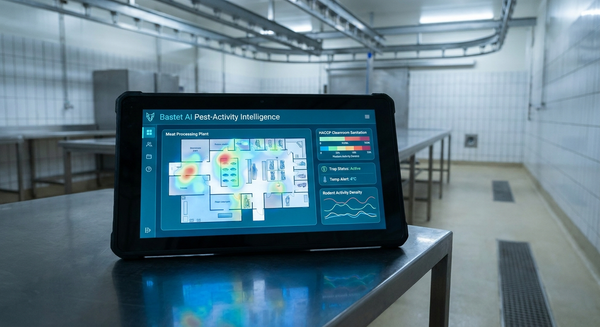
All telemetry data captured by the sensor network is aggregated by the on-site Bastet LoRa Gateway and transmitted to the Bastet Platform. Facility QA managers gain an interactive, real-time spatial heatmap displaying sensor connectivity, battery levels, trap engagement status, and historical activity trends. Every detection event is cryptographically timestamped and logged, creating a tamper-proof digital audit trail that can be exported into formal PDF compliance reports with a single click during unannounced FDA or BRCGS inspections.
4. RF Physics & Hardware Engineering in High-Dust Milling Environments
Flour mills and grain processing hubs present some of the harshest physical operating conditions in manufacturing. Industrial flour milling produces substantial quantities of airborne combustible organic flour dust. Under National Fire Protection Association standards (NFPA 652 and NFPA 654) and OSHA regulations (29 CFR 1910.399), milling interiors are classified as Class II, Division 1 or Division 2 hazardous locations (or ATEX Zone 21 / Zone 22). Standard off-the-shelf consumer electronic sensors or unsealed Wi-Fi devices pose severe dust-ignition and explosion hazards.
Bastet hardware is engineered specifically to exceed these stringent industrial operating and safety requirements:
- Intrinsically Safe, Low-Power Circuitry: Bastet sensors operate on ultra-low voltage and low current micro-circuitry designed to eliminate electrical sparking, thermal hot spots, or surface temperature build-up, ensuring safe operation within combustible dust environments.
- Hermetic IP67 / IP69K Polycarbonate Enclosures: Sensor housings are molded from high-impact, non-static food-grade polycarbonate and ultrasonically sealed with double-lip silicone gaskets. This completely prevents fine flour particles (typically 10 to 100 microns in diameter) from infiltrating internal circuitry or sensor optics.
- Industrial Lithium-Thionyl Chloride (Li-SOCl2) Power: While consumer alkaline and lithium-ion batteries degrade rapidly under industrial thermal fluctuations, Bastet sensors utilize industrial-grade Li-SOCl2 battery cells rated for operating temperatures from -40°C to +85°C. Due to the extreme efficiency of the LoRaWAN transmission protocol, sensors achieve an autonomous field lifespan of 5 to 7 years without maintenance.
- Superior RF Penetration Physics: Standard 2.4GHz Wi-Fi and Bluetooth signals suffer intense attenuation when passing through dry bulk grain and dense reinforced concrete silos—losing up to 20 dB per meter of penetration. In contrast, Bastet's 920MHz sub-GHz signal exhibits exceptional diffraction characteristics, effortlessly bending around massive cylindrical grain bins and propagating through multi-story concrete structures over distances exceeding 1.5 kilometers indoors and up to 10 kilometers line-of-sight.
5. Traditional Manual Inspections vs. Bastet AI Smart Rodent IoT
To evaluate the operational, safety, and financial benefits of transitioning from manual pest management to automated IoT surveillance, mill directors can review the comparative operational matrix below:
| Operational Dimension | Traditional Manual Pest Control | Bastet AI Smart Rodent IoT Platform |
|---|---|---|
| Surveillance Coverage | Periodic manual walk-throughs (14 to 30 day gaps; 99% unmonitored) | 24/7/365 continuous real-time perimeter & interior active monitoring |
| Chemical Hazard Exposure | Anticoagulant rodenticide baits risk toxic cross-contamination | 100% zero-chemical mechanical & edge-AI optical detection |
| Alert Notification Speed | Lag time of 2 to 4 weeks before a captured carcass is identified | Sub-3 second instant mobile push notification and email alert |
| Combustible Dust Suitability | Unrated plastic boxes accumulate dust and harbor secondary insects | IP67 hermetic enclosures designed for NFPA 652 flour dust zones |
| False Positive Handling | High false trigger rate from machine vibrations and falling debris | 98% false-alarm filtering via edge-based convolutional neural networks |
| Audit Compliance Reporting | Handwritten logbooks prone to illegibility, loss, and audit failure | Automated, timestamped cryptographic reports for FDA/BRCGS |
6. Step-by-Step Deployment Blueprint for Commercial Milling Plants
Deploying smart rodent biosecurity in an active, dust-controlled milling facility requires careful alignment with food safety HACCP protocols and structural engineering realities. Bastet utilizes a proven, three-phase deployment framework:
Phase 1: Facility Ingress Audit & Environmental Risk Mapping
A certified Bastet IoT field engineer collaborates with the facility's Quality Assurance and Sanitation directors to conduct a comprehensive structural and biological vulnerability audit. Sensor zones are categorized by ingress probability and product exposure risk:
- Zone 1: Raw Grain Intake & Bulk Receiving: Rail discharge sheds, truck unloading hoppers, and grain intake conveyor pits are classified as primary ingress corridors. Bastet Sensing Cameras and LoRa PIR sensors are deployed overlooking receiving pit aprons and hydraulic lift gates at a mounting height of 2.8 meters.
- Zone 2: Grain Elevators & Silo Headhouses: Vertical bucket elevator casings, conveyor galleries, and silo distributor floors are designated as high-risk transit highways. Bastet LoRa Trap Sensors are installed along conveyor curbs and wall bases every 15 to 20 meters.
- Zone 3: Milling Corridors & Packing Rooms: Primary roller mill floors, plansifter halls, and automated multi-wall bag packing lines represent critical product-contact zones. Hermetically sealed Bastet LoRa Trap Sensors are positioned in enclosed false ceilings, electrical sub-distribution rooms, and bag staging areas.
Phase 2: LoRa Gateway Placement & RF Validation
Bastet LoRa Gateways are positioned at high structural elevations—typically on top of administrative mezzanines, MCC electrical rooms, or structural silo headhouses. Utilizing sub-GHz 920MHz frequencies, a single Bastet LoRa Gateway provides complete RF coverage across a 350,000-square-foot milling complex, including subterranean utility tunnels and concrete silo corridors. The deployment team validates signal strength (RSSI) at every sensor node, ensuring link margins exceed -115 dBm to guarantee 99.99% packet delivery reliability.
Phase 3: Integration with Sanitation Standard Operating Procedures (SSOP)
All deployed sensors are mapped to the facility's digital layout within the Bastet Platform Mobile App. The system integrates directly with internal Sanitation Standard Operating Procedures (SSOP). When a sensor triggers, an automated, geolocated ticket is generated, alerting designated on-duty sanitation technicians to the exact trap coordinates. Carcass retrieval occurs within minutes, preventing decomposition, insect breeding, and audit liabilities.
7. Financial ROI, Audit Streamlining, and Downtime Risk Management
Implementing Bastet AI smart rodent monitoring in commercial grain milling facilities delivers an immediate, quantifiable return on investment across multiple operational vectors:
1. Prevention of Catastrophic Raw Material Loss & Product Recalls
In high-capacity commercial flour mills, a single 1,000-metric-ton grain silo contaminated by rodent urine or fecal pellets represents a direct raw material loss exceeding $350,000. Furthermore, if contaminated flour reaches commercial bakeries or retail packaging, the average cost of a nationwide food recall in the United States exceeds $10 million in direct expenses according to the Grocery Manufacturers Association (GMA) and Food Marketing Institute (FMI). Continuous IoT surveillance provides an active barrier against undetected silo ingress.
2. Reduction in Pest Contractor Labor Costs
In large milling facilities, external pest control technicians spend roughly 70% to 80% of their billable on-site hours performing non-productive manual checks—unlocking, inspecting, and re-locking empty mechanical traps. In a mill with 250 trap stations, this consumes 25 to 35 labor hours per month. By automating trap monitoring, facilities eliminate passive inspections, refocusing contractor budgets on proactive exclusion and structural proofing, reducing annual pest control contracting costs by 35% to 50%.
3. Elimination of Administrative Audit Preparation Overhead
Preparing documentation for unannounced FDA FSMA inspections, state agricultural audits, and annual BRCGS Global Standard for Food Safety Issue 9 certifications consumes 180 to 220 administrative man-hours annually per mill. Quality assurance managers must manually cross-reference paper trap sheets, compile trend charts, and file corrective action reports. The Bastet Platform automatically records capture timestamps, sensor battery health, and resolution logs, generating comprehensive audit-ready compliance packages in seconds and slashing administrative audit preparation by 85%.
4. Critical Electrical Infrastructure Protection
Modern computerized mills depend on thousands of meters of sensitive low-voltage instrumentation wiring, motor control circuits, and optical sorting lines. Rodents chew wiring insulation to trim their teeth, triggering short-circuits and emergency motor shutdowns. With the Uptime Institute estimating industrial downtime costs at $9,000 per minute, preventing a single 2-hour electrical outage in an automated milling line saves upwards of $1,080,000 in lost production capacity and equipment repairs.
8. Frequently Asked Questions (FAQ)
Q: How do Bastet IoT sensors withstand combustible flour dust without creating explosion risks?
A: Bastet sensors are certified to IP67 and IP69K ingress standards and feature hermetically sealed, non-conductive polycarbonate enclosures with double O-ring silicone seals. The internal electronics operate on intrinsically safe, ultra-low-voltage micro-current circuitry that generates zero electrical arcing or surface thermal rise, making them fully compliant with NFPA 652 and NFPA 654 standards for combustible dust locations.
Q: Can sub-gigahertz LoRa signals penetrate dense concrete grain silos and corrugated metal elevator legs?
A: Yes. Unlike high-frequency 2.4GHz Wi-Fi or Bluetooth signals, which suffer rapid attenuation and multipath signal cancellation when encountering heavy concrete structures and metal shielding, Bastet's sub-GHz 920MHz radio protocol possesses exceptional diffraction and penetration characteristics. A single Bastet LoRa Gateway penetrates dense silo batteries and multi-story headhouses over distances exceeding 1.5 kilometers indoors.
Q: Why is chemical rodenticide prohibited inside commercial grain milling facilities?
A: Global food safety regulations, including FDA FSMA (21 CFR Part 117), BRCGS Food Safety Issue 9 (Clause 4.14), and SQF Edition 9, strictly forbid the use of toxic chemical anticoagulant rodenticides within food storage, milling, and packaging buildings. This ban prevents chemical contamination of bulk grain and eliminates the hazard of poisoned rodents decomposing in inaccessible machinery voids or product streams.
Q: How does Bastet computer vision avoid false alarms caused by floating flour dust or machinery vibrations?
A: Bastet's "AI in a Box" edge vision processors utilize specialized deep-learning convolutional neural networks (CNNs) trained specifically on industrial milling environments. The model processes video frames locally in real time, accurately filtering out airborne dust clouds, vibrating equipment, forklift movement, and human operators, delivering a proven 98% false-alarm reduction with sub-3 second alert latency.
Q: What is the expected battery operating lifespan of Bastet sensors in unheated grain elevators?
A: Bastet sensors utilize industrial-grade lithium-thionyl chloride (Li-SOCl2) battery cells rated for operating temperatures from -40°C to +85°C. Combined with the ultra-low-power sleep architecture of the LoRaWAN communication protocol, Bastet sensors maintain continuous autonomous operation for 5 to 7 years without battery replacement, even in unheated, harsh winter conditions.
Want to learn more? 想了解方案?
9. Regulatory References & Technical Citations
- U.S. Food and Drug Administration (FDA): 21 CFR Part 117: Current Good Manufacturing Practice, Hazard Analysis, and Risk-Based Preventive Controls for Human Food (FSMA).
- British Retail Consortium Global Standards (BRCGS): Global Standard for Food Safety Issue 9, Clause 4.14: Pest Management and Ingress Control.
- National Fire Protection Association (NFPA): NFPA 652: Standard on the Fundamentals of Combustible Dust and NFPA 654: Standard for the Prevention of Fire and Dust Explosions from the Manufacturing, Processing, and Handling of Combustible Particulate Solids.
- United States Department of Agriculture (USDA FGIS / GIPSA): Grain Inspection Handbook, Book II: Grain Grading Procedures, Excreta Tolerances and Defect Categories.
- Uptime Institute: Annual Industrial Infrastructure Outage Analysis 2025: Economic Impact and Financial Downtime Metrics in Automated Facilities ($9,000/minute baseline).
- Safe Quality Food Institute (SQFI): SQF Food Safety Code: Food Manufacturing, Edition 9, Module 11: Good Manufacturing Practices for Processing of Food Products.