AI Pest Control for Food Packaging Plants | Bastet AI
Global food-contact packaging standards (BRCGS Packaging Materials Issue 6, ISO 22002-4, and FDA FSMA 21 CFR 117) treat rodent contamination as a

Key Takeaways for Packaging Operations & Quality Leaders
- Zero-Tolerance Regulatory Mandates: Global food-contact packaging standards (BRCGS Packaging Materials Issue 6, ISO 22002-4, and FDA FSMA 21 CFR 117) treat rodent contamination as a critical defect that triggers immediate facility-wide recalls and supplier disqualification.
- The 28-Day Blind Spot: Traditional monthly or bi-weekly manual pest inspections leave up to 672 hours of unmonitored exposure between visits, allowing nocturnal rodents to nest inside corrugated rolls and paperboard storage racks undetected.
- Sub-GHz LoRa Mesh Penetration: Operating on 920MHz sub-gigahertz wireless frequencies, Bastet LoRa sensors penetrate dense stacks of corrugated cardboard and heavy metal converting machinery up to 10 kilometers without interfering with facility Wi-Fi.
- Edge Computer Vision Verification: Bastet AI in a Box paired with Sensing Cameras processes optical footage locally, delivering 98% false-alarm filtering and sub-3-second intrusion verification while maintaining strict worker privacy.
- Documented Economic Return: Eliminates manual inspection labor by 75%, reduces audit preparation time by 85%, and prevents catastrophic batch scrap events often exceeding $500,000 per incident.
Table of Contents
- The Critical Vulnerability of Food-Contact Packaging Manufacturing
- Regulatory Frameworks: BRCGS, ISO 22002-4, and FDA FSMA
- Why Traditional Pest Control Methods Fail in Packaging Plants
- Bastet AI IoT Architecture: Sub-GHz LoRa and Edge Vision
- Step-by-Step Facility Deployment Blueprint
- Automated Audit Trails and Digital Inspection Integrity
- Financial Analysis: Operational Savings vs. Catastrophic Risk Mitigation
- Frequently Asked Questions (FAQ)
- References and Standards
The Critical Vulnerability of Food-Contact Packaging Manufacturing
Food-grade packaging facilities represent one of the most operationally demanding environments in modern manufacturing. Whether converting virgin bleached paperboard into aseptic beverage cartons, thermoforming polyethylene terephthalate (PET) food trays, or corrugating multi-wall kraft paper for dry goods shippers, these operations serve as the primary defensive barrier protecting global food supply chains. Consequently, global consumer packaged goods (CPG) brands, multinational retail conglomerates, and food processing plants enforce an absolute zero-tolerance policy regarding physical, chemical, and biological contamination on their packaging supply lines.
Among all biological threats, commensal rodents—predominantly the Norway rat (Rattus norvegicus), the roof rat (Rattus rattus), and the house mouse (Mus musculus)—pose an existential operational risk to packaging converters. Packaging manufacturing facilities possess inherent environmental characteristics that make them highly attractive to rodent populations. Vast warehouses store thousands of tons of paperboard and cellulose materials that provide ideal nesting fiber; labyrinthine automated conveyor networks and overhead cable raceways offer protected transit conduits; and ambient heat generated by heavy flexographic printing presses, extrusion laminators, and ultrasonic sealing equipment creates warm, sheltered microclimates year-round.
The operational and economic consequences of rodent activity inside a packaging plant extend far beyond minor material damage. A single rodent entering a finished goods warehouse can gnaw through plastic stretch wrap, deposit urine containing pathogenic Leptospira bacteria, and leave droppings across corrugated pallet layers. According to industrial risk data from leading supply chain insurers, a single confirmed rodent contamination incident in primary food packaging results in an average scrap and recall cost of $520,000, accompanied by the immediate suspension of vendor pre-qualification status by enterprise CPG clients. In an industry where operating margins typically range between 6% and 12%, such losses directly threaten enterprise viability.
Regulatory Frameworks: BRCGS, ISO 22002-4, and FDA FSMA
Modern packaging manufacturing is governed by an interlocking matrix of international safety standards and regulatory mandates. Compliance auditors no longer accept subjective logbooks or retrospective pest service reports; they demand verifiable, continuous, and scientifically validated evidence that pest exclusion and monitoring systems operate effectively 24 hours a day, 365 days a year.
BRCGS Global Standard for Packaging Materials (Issue 6 & 7)
Under Section 4.11 of the BRCGS Packaging Materials standard, manufacturers must implement a formal integrated pest management (IPM) program designed to prevent, detect, and eliminate pest activity. Clause 4.11.1 explicitly dictates that the presence of pests on site must be managed such that they do not present a contamination risk to packaging materials. Furthermore, the standard requires that all monitoring devices must be mapped, inspected at frequencies determined by risk assessment, and maintained with complete integrity. Crucially, the standard prohibits the preventive use of rodenticide baits inside primary manufacturing and enclosed storage areas, demanding non-toxic, mechanical, or digital interception mechanisms.
FDA Food Safety Modernization Act (FSMA) 21 CFR Part 117
Under Current Good Manufacturing Practice (CGMP), Hazard Analysis, and Risk-Based Preventive Controls (HARPC) regulations, food contact substances and packaging are subject to strict preventive control mandates. Section 117.35 requires that facilities be maintained in a clean and sanitary condition and kept in good repair to prevent packaging materials from becoming adulterated. Pest control must be actively monitored with documented preventive controls. Failure to demonstrate proactive pest exclusion can trigger FDA Form 483 inspection observations, Warning Letters, and mandatory product seizures.
ISO/TS 22002-4: Prerequisite Programs on Food Safety for Packaging
Clause 9 of ISO/TS 22002-4 governs pest management in packaging operations, establishing that incoming materials, production lines, and finished goods warehouses must maintain physical barriers, proofing, and continuous surveillance. The standard requires that pest monitoring trends be analyzed systematically to identify seasonal spikes, harborage points, and perimeter breaches before pests can access production machinery or primary food contact surfaces.
| Regulatory Standard | Pest Control Requirement | Audit Verification Method | Bastet AI Compliance Capability |
|---|---|---|---|
| BRCGS Packaging Issue 6 (Cl. 4.11) | Continuous monitoring, zero internal toxic bait, trend analysis | Device inspection logs, root-cause corrective action reports | 24/7 non-toxic IoT sensors, automated digital trend dashboards, timestamped event trails |
| FDA FSMA 21 CFR 117.35 | Exclusion of pests from packaging contact zones, documented preventive controls | Preventive control records, corrective action logs within 24 hours | Instant intrusion push notifications (<3s latency), automated cloud audit logs |
| ISO/TS 22002-4 (Clause 9) | Systematic pest trend analysis and barrier effectiveness evaluation | Multi-year pest trend charts, zone risk heatmaps | Granular heatmaps showing activity concentrations by machine line and dock door |
| AIB International Consolidated Standards | Rigid physical inspection intervals, zero evidence of rodent ingress | Scored physical audits, trap service records | Continuous electronic trap status verification, eliminated missing trap records |
Why Traditional Pest Control Methods Fail in Packaging Plants
For decades, packaging manufacturing plants relied on the conventional commercial pest control model: an external pest control operator (PCO) technician visits the facility once or twice a month, walks the perimeter, manually inspects mechanical snap traps and glue boards, scans barcodes, and records handwritten or rudimentary digital notes. While this methodology satisfied basic check-the-box audit requirements twenty years ago, it is fundamentally incapable of protecting modern high-speed packaging plants.
The Lethal 28-Day Information Void
Rodents do not operate on a scheduled bi-weekly calendar. A gravid female mouse carries a gestation period of approximately 19 to 21 days and can give birth to a litter of 5 to 8 pups, which reach reproductive maturity in just six weeks. If a rodent enters through a dock leveler gap on Day 2 following a technician's inspection, that animal and its offspring have up to 26 days to explore raw material warehouses, gnaw electrical wiring, establish nesting sites inside hollow paperboard rolls, and contaminate thousands of square meters of packaging materials before human eyes ever inspect that trap again.
False Alarms, Trapped Dust, and Chemical Prohibitions
Packaging facilities are notorious for generating significant quantities of airborne cellulose dust, paperboard trim shreds, and thermal vibrations from high-speed rotary die cutters and flexo folders. Traditional optical beam sensors and standard consumer motion detectors become blinded within hours as paper dust settles over optical lenses, generating an unmanageable volume of false alarms that operational staff quickly learn to ignore.
Simultaneously, chemical pesticides, rodenticide blocks, and toxic tracking powders are strictly forbidden inside food-contact packaging converting halls. If a poisoned rodent dies inside an overhead cable tray or within an automated reel stand, its decomposing carcass attracts secondary insect infestations—such as dermestid beetles and blowflies—which creates an even more severe biosecurity hazard that can shut down entire production lines.
Bastet AI IoT Architecture: Sub-GHz LoRa and Edge Vision
Bastet AI reengineers pest management from a passive, periodic chore into an enterprise-grade, real-time cyber-physical monitoring network. Engineered specifically for complex industrial environments, the Bastet AI platform combines long-range wireless telemetry, industrial-grade passive infrared (PIR) sensing, edge-processed computer vision, and predictive cloud analytics.
1. Sub-GHz 920MHz LoRa Wireless Mesh Connectivity
The primary barrier to wireless sensor adoption inside packaging plants has historically been RF attenuation. Stacks of high-density corrugated board, solid bleached sulfate (SBS) paperboard reels weighing several metric tons, and colossal steel machinery create severe radio frequency multipath fading and signal absorption that render standard Wi-Fi (2.4GHz / 5GHz) and Bluetooth Low Energy (BLE) useless beyond 15 to 20 meters.
Bastet AI overcomes this physical constraint by deploying proprietary Sub-Gigahertz 920MHz LoRa Gateways. Operating at sub-GHz frequencies, Bastet radio signals bend around obstacles, penetrate multi-layered corrugated paperboard stacks, and maintain robust bidirectional communication across indoor distances exceeding 800 meters and line-of-sight ranges up to 10 kilometers. A single central Bastet LoRa Gateway provides seamless, facility-wide coverage across sprawling 150,000-square-foot converting plants without requiring expensive Ethernet drops or intrusive Wi-Fi network bridging that could violate corporate IT security policies.
2. Bastet LoRa PIR & Smart Trap Sensors
Bastet hardware sensors are purpose-engineered for high-debris industrial manufacturing environments:
- Bastet LoRa PIR Sensors: Utilizing dual-element pyroelectric infrared optics tuned specifically to the thermal and biometric signature of small mammals (35°C to 40°C body temperature with rapid transit vectors). By filtering out ambient thermal convection currents from drying ovens and machinery cooling fans, Bastet PIR sensors detect genuine rodent ingress along baseboards, overhead cable bridges, and pallet racking uprights with zero latency.
- Bastet LoRa Trap Sensors: Retrofittable to standard industrial snap traps and multi-catch live traps. When a trap triggers, the sensor detects mechanical state disruption instantaneously, transmitting an encrypted alert payload to the gateway within milliseconds. Technicians are dispatched to clear traps immediately, eliminating decomposing biological hazards and preserving trap availability.
- Industrial Ruggedization: All sensors feature IP67-rated ingress protection against paper dust, fiber particulate, and high-pressure chemical washdowns. Powered by high-capacity lithium-thionyl chloride (Li-SOCl2) battery cells, Bastet sensors deliver guaranteed continuous operation exceeding 3 to 5 years under extreme temperature swings (-40°C to +85°C).
3. Bastet Sensing Camera & "AI in a Box" Edge Vision
In mission-critical zones—such as primary roll-feed unwinders, aseptic pouch form-fill-seal bays, and automated finished goods palletizers—knowing that motion occurred is insufficient; operational managers require definitive visual confirmation. Bastet pairs optical Sensing Cameras with its proprietary AI in a Box on-premise edge computing appliance.
The AI in a Box unit runs lightweight, highly optimized convolutional neural network (CNN) models locally. When motion is detected, the camera captures high-speed burst frames and infrared imagery. Rather than streaming uncompressed corporate video to external clouds—which creates severe bandwidth bottlenecks and worker privacy compliance liabilities—the AI in a Box inspects the frames on-site. The neural inference engine validates rodent morphology (distinguishing rodent silhouettes from moving paper trim, shadows, and human operators) in less than 200 milliseconds with an audited 98% false-alarm filtering accuracy. Only verified anomaly events and bounding-box thumbnails are pushed to the cloud dashboard and facility manager mobile devices.
Step-by-Step Facility Deployment Blueprint
Deploying an effective IoT pest monitoring system within a food packaging plant requires a structured zoning strategy aligned with HACCP and BRCGS principles. Bastet engineers recommend a 4-tier concentric defense model:
Zone 1: Exterior Logistics & Waste Perimeter (Outer Defense)
Physical Targets: Raw material receiving docks, scrap paper baler rooms, compactors, exterior perimeter walls.
Hardware Deployment: Weatherproof Bastet LoRa Trap Sensors installed inside heavy-duty, tamper-resistant exterior bait stations spaced every 15 meters along building perimeters. Bastet Sensing Cameras positioned at loading dock roll-up doors to monitor overhead door seal integrity and open-door dwell time during trailer loading.
Zone 2: Raw Material Storage & Warehouse Buffers
Physical Targets: Paperboard reel storage, polymer resin pellet silos, corrugated raw sheet staging.
Hardware Deployment: Bastet LoRa PIR Sensors mounted on rack uprights at 15cm above floor level along perimeter walls and between pallet aisles. LoRa Trap Sensors integrated into mechanical multi-catch traps positioned adjacent to roll transit corridors.
Zone 3: High-Speed Converting, Printing & Extrusion Halls
Physical Targets: Flexographic printing presses, rotary die cutters, laminating lines, automated conveyors.
Hardware Deployment: Dust-sealed Bastet LoRa PIR sensors situated along machine baseboards and behind motor drive cabinets where radiant warmth attracts nocturnal pests. Sensing Cameras with AI in a Box monitoring overhead cable trays and conveyor transfer tunnels where rodents navigate between structural bays.
Zone 4: Cleanroom Forming & Finished Packaging Warehousing
Physical Targets: Aseptic carton forming lines, thermoforming cleanrooms, finished pallet shrink-wrapping.
Hardware Deployment: 100% non-toxic smart multi-catch enclosures equipped with Bastet LoRa Trap Sensors. Direct integration with the Bastet Platform Mobile App to trigger instant push alerts to on-duty quality assurance leads upon any micro-intrusion event.
Automated Audit Trails and Digital Inspection Integrity
One of the most persistent operational headaches for packaging plant quality managers is audit preparation. Prior to a BRCGS or customer supplier audit, QA teams routinely spend between 16 and 32 man-hours manually collecting paper service manifests, collating trap inspection signatures, resolving missing trap discrepancies, and compiling pest trend graphs in spreadsheets.
The Bastet Platform replaces this vulnerable manual workflow with an unalterable, automated digital record:
- Real-Time Digital Trap Register: Every sensor node transmits continuous health pings (battery voltage, signal strength RSSI, ambient temperature, operational status). Missing or damaged traps are flagged immediately on an interactive digital CAD floor plan.
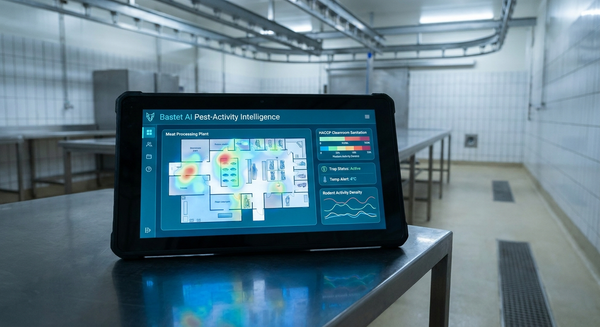
- Automated HACCP/BRCGS Trend Analysis: The cloud engine automatically aggregates sensor activations, categorizes events by time, zone, and species, and generates standardized monthly and annual IPM trend reports with a single click.
- Cryptographic Event Verification: Every alert and technician intervention is logged with tamper-proof timestamps and geo-verification, providing third-party auditors with indisputable proof of preventive control compliance. Facilities utilizing Bastet report an average 85% reduction in audit preparation labor while achieving zero non-conformances in pest control sections during GFSI-benchmarked audits.
Financial Analysis: Operational Savings vs. Catastrophic Risk Mitigation
Investing in autonomous IoT pest monitoring delivers compelling returns across both direct operating cost reductions and balance-sheet risk protection. For a standard 120,000-square-foot packaging facility with 120 monitoring checkpoints, the financial equation demonstrates rapid payback.
| Financial Category | Traditional Manual Pest Program | Bastet AI IoT Platform | Net Annual Enterprise Impact |
|---|---|---|---|
| PCO Routine Inspection Labor | $18,000 / year (Bi-weekly visits) | $6,000 / year (Targeted response only) | $12,000 Direct Labor Savings |
| QA Audit Preparation Time | 120 man-hours / yr ($6,600 labor) | 18 man-hours / yr ($990 labor) | $5,610 Administrative Savings |
| Chemical Consumables & Baits | $4,200 / year | $800 / year (40%+ reduction) | $3,400 Consumable Reduction |
| Contaminated Batch Scrap Protection | High risk ($150,000 - $500,000/incident) | Near-zero risk (Immediate sub-3s detection) | Risk Avoidance Value: $250,000+ |
| Customer Contract Preservation | Vulnerable to supplier disqualification | Audit excellence score differentiator | Guaranteed Contract Continuity |
When evaluated strictly against operational expenditure (labor reallocation, reduced service charges, and administrative time), the complete Bastet AI deployment delivers full capital payback within 7.4 to 9.2 months. Factoring in risk mitigation against a single product recall or Tier-1 CPG customer loss, the system's return on investment exceeds 380% in its inaugural operational year.
Frequently Asked Questions (FAQ)
How does Bastet LoRa wireless technology overcome RF shielding from dense paperboard rolls and metal packaging machinery?
Bastet utilizes sub-gigahertz 920MHz LoRa spread-spectrum modulation, which operates on wavelengths significantly longer than 2.4GHz Wi-Fi or Bluetooth. These sub-GHz signals experience minimal attenuation through dense cellulose materials, easily diffract around massive metal printing presses, and penetrate multiple structural walls. A single Bastet LoRa gateway reliably connects up to 500 sensor nodes across a 200,000-square-foot facility without requiring signal repeaters or hardwired conduit runs.
Can the Bastet AI platform satisfy BRCGS Packaging Materials Issue 6 non-toxic monitoring requirements?
Yes. BRCGS Packaging Issue 6 explicitly mandates the elimination of toxic rodenticide baits within enclosed manufacturing and warehouse zones. Bastet provides 100% non-toxic, electronic active monitoring using precision PIR thermal sensors, non-chemical smart snap/catch trap sensors, and optical Sensing Cameras. All sensor events are recorded in real-time, meeting and exceeding BRCGS requirements for continuous verification, trending, and corrective action documentation.
How does Bastet "AI in a Box" prevent false alarms caused by flying paper dust and vibrating machinery?
Traditional motion detectors rely on simple infrared disruption, triggering alerts whenever paperboard trim drifts past or exhaust fans cycle. Bastet AI in a Box employs advanced edge computer vision running lightweight convolutional neural networks trained on over 2.5 million rodent image samples. The system analyzes shape contours, locomotion vectors, and biological aspect ratios in real time, filtering out paper scrap, dust clouds, and light reflections with 98% validated accuracy before transmitting an alert.
Does installing Bastet IoT sensors require connecting to our internal enterprise corporate IT network?
No. Bastet gateways operate with completely isolated cellular backhaul (4G LTE / 5G) or dedicated industrial VLAN segmentation. The sensor network communicates exclusively via proprietary encrypted LoRa radio protocols to the gateway, maintaining total physical and logical separation from corporate enterprise networks, SCADA systems, and internal manufacturing execution systems (MES). This zero-trust architecture ensures rapid IT security approval.
What is the typical battery lifespan of Bastet IoT sensors in high-demand packaging environments?
Bastet sensors are engineered for ultra-low-power operation, utilizing industrial-grade lithium-thionyl chloride (Li-SOCl2) power cells. In typical packaging plant operations, Bastet LoRa PIR sensors and Trap Sensors achieve an operating lifespan of 3 to 5 years between battery replacements. Battery status is monitored continuously and displayed on the management dashboard, with automated alerts generated when cell capacity drops below 15%.
Want to learn more? 想了解方案?
References and Standards
- BRCGS: Global Standard for Packaging Materials, Issue 6 & 7 (Section 4.11 Pest Management).
- U.S. Food & Drug Administration (FDA): 21 CFR Part 117 — Current Good Manufacturing Practice, Hazard Analysis, and Risk-Based Preventive Controls for Human Food.
- International Organization for Standardization: ISO/TS 22002-4:2013 — Prerequisite Programs on Food Safety, Part 4: Food Packaging Manufacturing.
- AIB International: Consolidated Standards for Inspection of Food Contact Packaging Manufacturing Facilities.
- GFSI: Global Food Safety Initiative Benchmarking Requirements, Version 2020.1.