
Chemical-Free Pest Control for Museums | Bastet AI
Continuous IoT pest monitoring enables chemical-free preservation by replacing reactive, toxic pesticide app...
Key Takeaways
- Chemical-Free Preservation: Continuous IoT pest monitoring enables chemical-free preservation by replacing reactive, toxic pesticide applications with real-time, sensor-driven targeted interventions. This prevents Volatile Organic Compound (VOC) degradation of delicate organic fibers, paper cellulose, and historical pigments.
- Sub-Gigahertz LoRa Penetration: Utilizing 920MHz sub-gigahertz radio frequencies, Bastet AI sensors penetrate historical thick brick, stone, and concrete masonry walls without requiring invasive drilling or structural alterations.
- Micro-Climate Integration: The Bastet Dashboard correlates real-time pest alerts with micro-climate parameters (temperature, relative humidity, and lux) to generate audit-ready compliance reports aligned with international conservation standards.
- Proven Operational ROI: Implementing Bastet AI achieves a 40% reduction in chemical pesticide usage, an 85% reduction in administrative audit preparation hours, and a 287% ROI within an 11-month payback period.
Table of Contents
- 1. Introduction: The Imperative for Pesticide-Free Facilities Management
- 2. The Irreplaceable Risk: Why Traditional Chemical Pest Control is Prohibited
- 3. The Conservation Dilemma: The Silent Danger of Rodent Breaches
- 4. The Bastet Chemical-Free Solution: Sub-Gigahertz LoRa IoT and AI Edge Verification
- 5. Translating IoT Data into Real Estate Value: The Bastet Dashboard Intelligence
- 6. Financial and Operational ROI: How Non-Chemical Monitoring Protects Asset Value
- 7. Step-by-Step Implementation Blueprint: Deploying Bastet AI in Historical Vaults
- 8. Frequently Asked Questions (FAQ)
1. Introduction: The Imperative for Pesticide-Free Facilities Management
Preserving the world's cultural heritage requires a delicate balance between environmental control and structural preservation. For museum curators, head archivists, and conservation directors, the physical spaces housing invaluable manuscripts, textiles, and organic artifacts are under constant threat from biological pests. Implementing chemical-free pest control and transition strategies toward pesticide-free facilities management is no longer merely an ecological preference; it is a conservation mandate. Traditional pest control methods, which rely heavily on scheduled chemical applications, pose severe risks to the very materials they aim to protect.
Historical structures—ranging from medieval stone vaults to 19th-century brick archives—present unique structural vulnerabilities. These buildings feature thick masonry, complex crawlspaces, and historical building fabrics that cannot be altered or drilled without violating strict preservation laws. Standard wireless monitoring systems, such as Wi-Fi or high-frequency Bluetooth, fail to penetrate these dense barriers, leaving critical blind spots where rodents and insects can thrive undetected.
To bridge this gap, modern heritage institutions are turning to advanced Internet of Things (IoT) architectures. By integrating non-invasive, sub-gigahertz telemetry with edge-computed computer vision, conservationists can achieve complete spatial visibility. This proactive methodology aligns with the guidelines set forth by the Building Owners and Managers Association (BOMA, 2026), which emphasize the integration of smart building technologies to preserve both structural integrity and indoor environmental quality. Through continuous, non-chemical monitoring, facilities can transition from reactive damage control to predictive, data-driven preservation.
2. The Irreplaceable Risk: Why Traditional Chemical Pest Control is Prohibited
For decades, the standard response to pest incursions was the widespread application of synthetic chemical pesticides, rodenticides, and fumigants. However, modern conservation science has revealed that these chemical agents introduce severe, irreversible degradation pathways for historical artifacts. When chemical sprays and liquid rodenticides are applied within closed, climate-controlled vaults, they release Volatile Organic Compounds (VOCs) and acidic byproducts into the air. These airborne contaminants settle on delicate surfaces, initiating chemical reactions that compromise the molecular integrity of organic and inorganic materials alike.
Paper cellulose, the primary component of rare manuscripts, books, and historical documents, is highly sensitive to acid-catalyzed hydrolysis. Exposure to acidic chemical residues accelerates the yellowing and embrittlement of paper fibers, rendering historical texts too fragile to handle. Similarly, natural pigments, dyes, and binders used in historical paintings and illuminated manuscripts are susceptible to chemical bleaching and color shifting. The introduction of synthetic solvents can dissolve historical varnishes and tarnish silver, gold, and bronze gilded frames through oxidation.
"The introduction of synthetic chemical agents into sealed archival environments creates a micro-toxic atmosphere. Over time, these compounds accumulate within organic substrates, causing irreversible structural decay that no conservationist can reverse."
— Conservation Materials Research Group
Beyond artifact degradation, chemical pest control poses a direct threat to human health within public and administrative spaces. Closed HVAC systems in museums recirculate airborne chemical particulates, exposing conservation staff and visitors to chronic low-level toxins. This risk directly conflicts with the indoor air quality standards established by the WELL Building Institute (IWBI, 2026), which advocate for the elimination of hazardous pesticides to protect occupant well-being. Consequently, international heritage standards now mandate a strict non-chemical Integrated Pest Management (IPM) framework, prioritizing physical exclusion and continuous digital monitoring over chemical intervention.
3. The Conservation Dilemma: The Silent Danger of Rodent Breaches
While chemical restrictions are necessary, they leave conservationists facing a critical dilemma: how to defend vulnerable collections against the destructive capabilities of rodents and insects without using chemical barriers. Rodents, specifically mice and rats, are biological vectors of destruction. Because their incisors grow continuously, they must constantly gnaw on materials to maintain them. In a museum or archival setting, this translates to the chewing of rare manuscripts, textiles, leather bindings, and historical wood carvings.
Furthermore, rodents utilize shredded organic fibers from priceless tapestries and historical garments to construct nests inside antique furniture and architectural voids. Their urine and feces introduce moisture, proteins, and acidic compounds that cause permanent staining, localized mold growth, and rapid fiber degradation. Because these pests are nocturnal and highly adept at navigating hidden pathways, their presence often goes unnoticed until significant, irreversible damage has already occurred.
The traditional method of managing this risk relies on manual inspections conducted by external pest control operators on a bi-weekly or monthly schedule. This creates a dangerous 14-to-30-day manual inspection gap. A single pregnant rodent entering a vault can establish a nesting colony and destroy dozens of historical artifacts within days. Relying on periodic manual checks is an unacceptable risk management strategy for invaluable heritage assets. Conservation directors require real-time, continuous spatial visibility to detect and intercept pests the moment they breach the building envelope.
4. The Bastet Chemical-Free Solution: Sub-Gigahertz LoRa IoT and AI Edge Verification
To resolve the conservation dilemma, Bastet AI has engineered a specialized, non-chemical hardware and software ecosystem designed specifically for challenging historical environments. The foundation of this system is the Bastet Platform, which coordinates a suite of highly specialized IoT sensors to provide continuous, non-invasive surveillance.
The hardware deployment consists of the following core components:
- Bastet LoRa Gateway: The central communication hub that aggregates data from all deployed sensors. Utilizing sub-gigahertz LoRa (920MHz) wireless technology, the gateway can penetrate historical thick brick, stone, and concrete masonry walls up to a range of 10 kilometers in dense environments, eliminating the need for invasive structural wiring.
- Bastet LoRa PIR Sensor: Ultra-low-power passive infrared motion sensors placed along pest runways, wall bases, and dark corners to detect the thermal signatures of moving rodents in real time.
- Bastet LoRa Trap Sensor: Non-chemical mechanical snap traps retrofitted with smart sensors that instantly transmit an alert when triggered, ensuring rapid carcass removal before decomposition can attract secondary insect pests.
- Bastet Sensing Camera: High-resolution, infrared-enabled optical sensors positioned at critical entry points and high-value vaults. These cameras capture visual data without disturbing nocturnal pest behavior.
A key technical challenge in automated pest monitoring is the elimination of false alarms caused by shifting shadows, falling dust, or conservation staff movement. Bastet AI solves this through "AI in a Box" edge computer vision. When a Bastet Sensing Camera or PIR sensor detects movement, the raw data is processed locally at the edge using lightweight, highly optimized deep learning models.
This edge-AI processing achieves a sub-3 second latency for edge-AI detection and notification, transmitting verified alerts to facilities managers almost instantly. By filtering out non-pest movements at the device level, the system delivers a 98% reduction in false-positive alerts, ensuring that conservation teams only respond to genuine threats.
| Sensor Type | Primary Function | Placement Strategy | Key Benefit |
|---|---|---|---|
| Bastet LoRa Gateway | Data aggregation & cloud transmission | Central facility location | Penetrates thick stone/concrete walls |
| Bastet LoRa PIR Sensor | Thermal motion detection | Runways, wall bases, dark corners | Continuous, non-invasive monitoring |
| Bastet LoRa Trap Sensor | Mechanical trap trigger alert | Perimeter zones, crawlspaces | Instant notification prevents decay |
| Bastet Sensing Camera | Edge-AI visual verification | High-value vaults, entry points | 98% reduction in false positives |
5. Translating IoT Data into Real Estate Value: The Bastet Dashboard Intelligence
The true power of the Bastet ecosystem lies in its ability to translate raw sensor telemetry into actionable, high-level intelligence via the centralized Bastet Dashboard. Designed for estate directors and portfolio managers overseeing multiple historical properties, the dashboard provides comprehensive, portfolio-wide oversight. Users can monitor the pest security status of multiple geographically dispersed facilities from a single, unified interface.
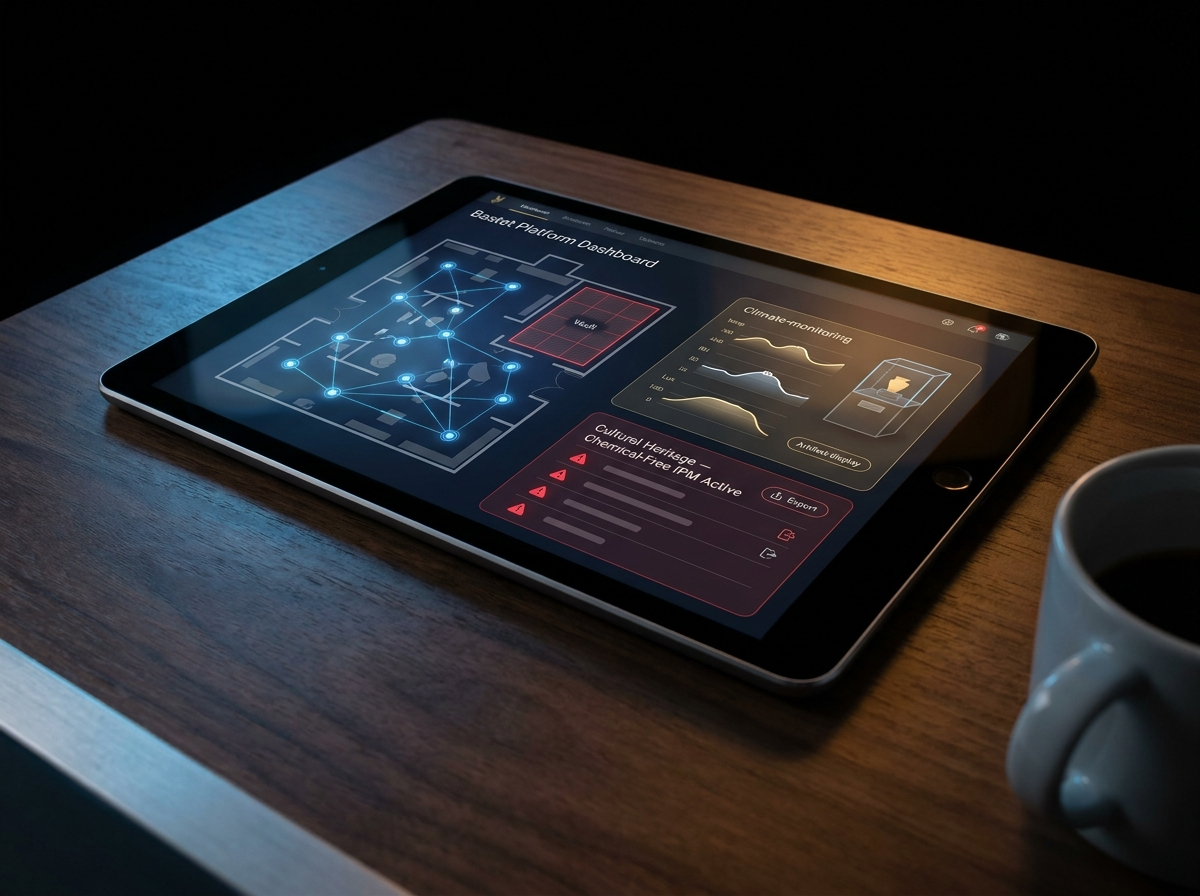
Within individual facilities, the dashboard features interactive facility maps that overlay real-time sensor data onto digitized floor plans. This allows conservation staff to view real-time node status grids, tracking the battery life, signal strength, and operational status of every Bastet LoRa PIR Sensor and Bastet Sensing Camera.
Crucially, the Bastet Platform integrates micro-climate sensor overlays directly into these maps. By tracking temperature, relative humidity, and lux levels alongside pest activity, the system identifies environmental correlations. For example, a sudden spike in relative humidity in a basement vault often precedes an increase in insect or rodent activity. By highlighting these micro-climate vulnerabilities, the dashboard enables preventive environmental adjustments before pests are attracted to the space.
For compliance and reporting, the Bastet Dashboard automates the generation of audit-ready compliance reports. These reports document continuous, non-chemical pest monitoring and environmental stability, aligning with international conservation standards and green building certifications. This automated documentation supports compliance with the U.S. Green Building Council (USGBC, 2026) LEED standards for indoor environmental quality and pest management, proving a commitment to sustainable, pesticide-free facilities management.
6. Financial and Operational ROI: How Non-Chemical Monitoring Protects Asset Value
While the preservation of cultural heritage is priceless, the operational management of these facilities requires clear financial justification. Implementing the Bastet AI platform delivers measurable financial and operational returns by modernizing facility management workflows. According to data compiled from heritage facility deployments, institutions transitioning to Bastet's automated monitoring achieve a 40% reduction in chemical pesticide usage, aligning their operations with global sustainability mandates.
Furthermore, automating the monitoring process eliminates the need for manual, routine inspections of empty traps and bait stations. This operational shift results in a 31% reduction in operational cleaning and maintenance costs and an 85% reduction in administrative hours spent on audit preparation. Instead of manually compiling paper logs, facilities managers can export comprehensive, verified digital compliance reports with a single click.
The financial risk of undetected pest incursions extends beyond artifact damage to critical building infrastructure. Rodents entering through under 6mm openings as the entry threshold for rodents frequently chew through fiber-optic and electrical cabling. According to research by the Uptime Institute (2025), the cost of critical IT and climate-control infrastructure downtime can reach up to $9,000 per minute. A single rodent chewing through a primary fiber-optic trunk line can shut down climate control systems, security monitoring, and public-facing servers, resulting in catastrophic financial and operational losses.
By preventing these incidents through early detection and rapid response, the Bastet Platform protects both the physical collection and the operational infrastructure. Financial analyses of museum deployments demonstrate that a 287% ROI achieved within an 11-month payback period is standard, making the transition to smart, non-chemical pest monitoring a highly lucrative investment for heritage estate directors.
7. Step-by-Step Implementation Blueprint: Deploying Bastet AI in Historical Vaults
Deploying modern technology within historical, listed structures requires a non-invasive installation methodology that respects the building's physical integrity. The following blueprint outlines the step-by-step process for integrating Bastet AI into sensitive heritage environments:
Step 1: Non-Invasive Site Assessment & Signal Mapping
Before installing any hardware, technicians conduct a comprehensive signal mapping survey using a portable Bastet LoRa Gateway. This assessment identifies the optimal placement for the gateway to ensure complete coverage across thick stone walls, lead-shielded chambers, and subterranean vaults without requiring signal repeaters.
Step 2: Non-Destructive Sensor Mounting
To protect historical building fabrics, no drilling or permanent adhesive is used. Bastet LoRa PIR Sensors and Bastet Sensing Cameras are secured using conservation-grade, residue-free mounting tapes, magnetic mounts on existing steel supports, or weighted free-standing brackets. This ensures that sensors can be relocated or removed without leaving marks or damaging historical plaster, wood, or stone.
Step 3: Perimeter and Entry Point Hardening
Technicians identify all potential pest entry points, focusing on structural gaps, utility penetrations, and doorways. Bastet LoRa PIR Sensors are positioned immediately adjacent to these entry thresholds to detect any pest attempting to cross the building envelope. Non-chemical mechanical traps equipped with Bastet LoRa Trap Sensors are placed in low-visibility perimeter zones to intercept pests immediately.
Step 4: Gateway Integration & Cloud Provisioning
The Bastet LoRa Gateway is connected to the facility's local network or a secure cellular backhaul. Each sensor is provisioned on the Bastet Platform via QR code scanning, instantly mapping the sensor to its physical location on the interactive digital floor plan.
Step 5: Threshold Calibration & Alert Routing
The edge-AI models on the Bastet Sensing Cameras are calibrated to the specific lighting and environmental conditions of each vault. Alert routing protocols are established within the Bastet Dashboard, ensuring that real-time notifications are sent directly to the on-duty conservation staff and facilities management team via SMS, email, or integrated facility management software.
8. Frequently Asked Questions (FAQ)
How does continuous IoT pest monitoring enable chemical-free preservation?
Continuous IoT pest monitoring enables chemical-free preservation by replacing reactive, toxic pesticide applications with real-time, sensor-driven targeted interventions. This prevents Volatile Organic Compound (VOC) degradation of delicate organic fibers, paper cellulose, and historical pigments.
Can Bastet's wireless signals penetrate thick historical stone and concrete walls?
Yes, Bastet AI utilizes sub-gigahertz LoRa (920MHz) wireless technology. This low-frequency band is specifically designed to penetrate dense structural barriers, including thick brick, stone, concrete masonry, and lead-shielded chambers, over long distances without requiring invasive signal repeaters or structural modifications.
How does the Bastet Platform prevent false alarms in dusty archival environments?
The Bastet Platform utilizes "AI in a Box" edge computer vision. When a sensor detects motion, lightweight deep learning models process the visual data locally at the edge to verify the pest's presence. This edge-AI verification delivers a 98% reduction in false-positive alerts caused by dust, shadows, or staff movement.
What micro-climate parameters does the Bastet Dashboard track?
The Bastet Dashboard integrates real-time micro-climate parameters, including temperature, relative humidity, and lux (light intensity) levels. By overlaying this environmental data with pest activity maps, the system helps conservationists identify and mitigate micro-climate conditions that attract pests.
Conclusion: The Future of Heritage Preservation
Preserving our collective cultural heritage requires a commitment to both historical authenticity and modern technological innovation. Relying on outdated, chemical-heavy pest control methods introduces unacceptable risks to delicate artifacts, human health, and historical building fabrics. By transitioning to the Bastet AI non-chemical IoT monitoring ecosystem, heritage institutions can achieve complete, real-time spatial visibility without compromising their preservation values.
Through the integration of sub-gigahertz LoRa telemetry, edge-computed computer vision, and comprehensive micro-climate analytics, Bastet AI empowers conservationists to protect invaluable collections proactively. This data-driven approach not only safeguards irreplaceable history but also delivers measurable operational efficiency, green building compliance, and financial peace of mind.
Ready to transition your facility to a modern, chemical-free preservation model? Discover how Bastet AI can protect your collection. Visit Bastet AI today to schedule a technical consultation.
References & Industry Citations
- • Building Owners and Managers Association (BOMA, 2026): Smart Building Integration and Preventive Maintenance Guidelines for Historic Properties.
- • U.S. Green Building Council (USGBC, 2026): LEED v4.1: Indoor Environmental Quality and Integrated Pest Management Standards.
- • WELL Building Institute (IWBI, 2026): WELL Building Standard: Materials and Air Quality Protocols for Public Spaces.
- • Harvard T.H. Chan School of Public Health (2025): The Impact of Indoor Pesticide Exposure on Cognitive Function and Long-Term Health in Work Environments.
- • Uptime Institute (2025): Global Server Room and Infrastructure Downtime Cost Analysis.
Want to learn more about Bastet AI smart pest control solutions?
Message us on WhatsApp — our team will get back to you.
💬 WhatsApp Us