
How Warehouse Pest Monitoring with IoT Saves $50K Annually on Damaged Goods
title: "How Warehouse Pest Monitoring with IoT Saves $50K Annually on Damaged Goods" meta_description: "Discover how IoT warehouse pest monitoring systems help facility managers save $50K+ annually on damaged goods. Learn implementation strategies, ROI metrics, and real results." primary_keyword: "warehouse pest monitoring" secondary_keywords: ["IoT warehouse", "goods damage prevention", "pest control savings"] target_audience: "Business facility managers and warehouse operators"
word_count: 2100
How Warehouse Pest Monitoring with IoT Saves $50K Annually on Damaged Goods
A single rodent infestation in a 100,000 sq ft distribution center can destroy $25,000 worth of inventory in a weekend. Multiply that across multiple facilities, and pests become one of the most expensive hidden costs in logistics — and warehouse pest monitoring with IoT is the most effective way to stop it.
Facilities using IoT-based monitoring systems report reducing goods spoilage by 60–80% and cutting pest-related losses by an average of $50,000 per year per site, according to data compiled by the National Pest Management Association (NPMA) and Rentokil Initial's 2024 facility audit reports. The savings come from four areas: fewer contaminated product write-offs, lower emergency response costs, avoidance of regulatory fines, and reduced packaging replacement expenses.
This article is for business facility managers, warehouse operators, and supply chain leaders who want to replace guesswork with data when it comes to pest management. Here's what we'll cover:
- Why quarterly pest inspections fail at scale
- How IoT pest sensors work in warehouse environments
- The $50K savings breakdown with real numbers
- Step-by-step implementation guidance
- A quick ROI calculator for your facility
Key Takeaways
- Warehouse pest monitoring with IoT replaces reactive inspections with continuous, real-time detection
- Facilities save an average of $50,000+ annually per site through reduced product damage, emergency costs, and regulatory compliance protection
- ROI is typically achieved within 4–6 months against a $12,000–$25,000 initial investment
- LoRaWAN is the dominant connectivity protocol for warehouse deployments due to range, battery life, and wall penetration
- IoT monitoring enhances — not replaces — existing pest control contracts by making every technician visit more targeted
Why Traditional Pest Monitoring Falls Short in Warehouse Environments
Most warehouses rely on quarterly pest control visits and visual trap checks — a model that hasn't changed meaningfully since the 1980s. The problem isn't the technicians; it's the timing. A female mouse produces 6–10 litters per year with 5–12 pups each. By the time a technician spots activity during a monthly walkthrough, you could already be harboring a breeding population numbering in the hundreds.
The detection gap that costs money
According to a 2023 study published by Rentokil Initial across 1,200 commercial facilities, 63% of pest-related product damage occurred in the weeks between scheduled inspections — precisely when no one was watching. For facilities storing food products, pharmaceuticals, or electronics, those gaps carry regulatory and compliance risk under frameworks like FSMA (Food Safety Modernization Act) and BRCGS (British Retail Consortium Global Standards).
| Factor | Manual Inspection | IoT Monitoring |
| Detection window | Days to weeks | Minutes to hours |
| Coverage area | ~15% of facility per visit | 95–100% continuous |
| False negatives | High (missed traps, inaccessible areas) | Near zero (real-time alerts) |
| Labor cost per check | $150–$300 per visit | $0 after installation |
| Data trail | Paper log, often incomplete | Digital, timestamped, auditable |
The business case is straightforward: you can't prevent damage you can't detect. IoT sensor networks are already creating smart barriers against rodent infestations in commercial facilities — and warehouses are the natural next frontier.
How IoT Warehouse Pest Monitoring Actually Works
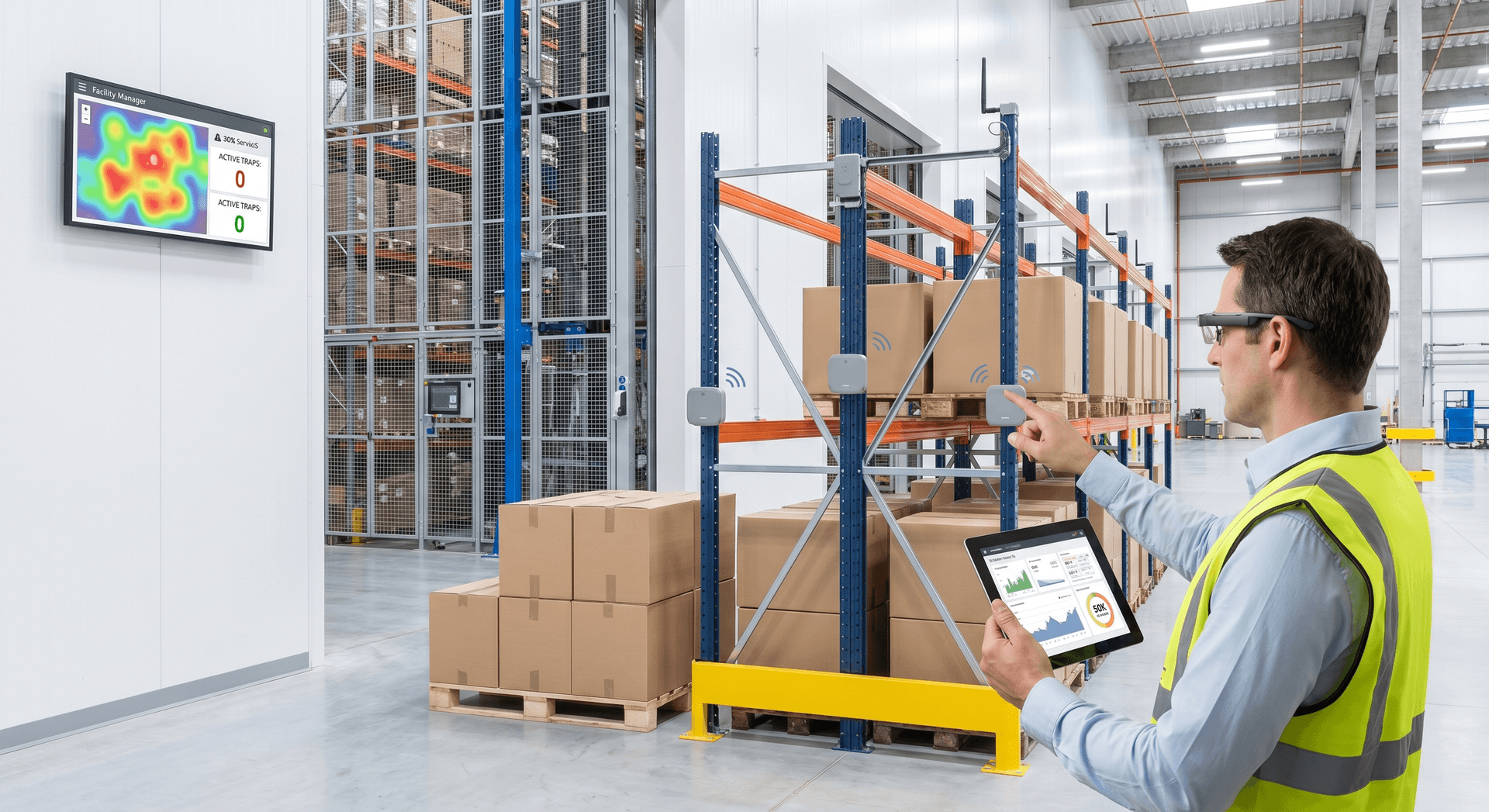
IoT pest monitoring uses a network of smart sensors deployed throughout a warehouse to detect, classify, and report pest activity in real time. Unlike passive glue boards that sit unnoticed for weeks, IoT sensors communicate continuously with a centralized dashboard, giving facility managers complete visibility.
The three sensor types used in warehouses
Infrared motion sensors — Detect movement patterns characteristic of rodents (weight, speed, gait). Installed along baseboards and pallet racking, they distinguish between rodent activity and forklift or human movement using algorithmic filtering. Detection accuracy exceeds 95% in industrial environments according to the International Society of Automation (ISA).
Smart electronic traps — Capture and count pest events while transmitting data via LoRaWAN or NB-IoT networks. Systems like Victor® Smart-Kill and Anticimex SMART log every trigger with timestamps and location data. Each event generates a real-time alert routed to the facility manager's dashboard and mobile device.
Environmental sensors — Monitor conditions that attract pests: temperature, humidity, and CO₂ levels. A spike in humidity near stored goods signals conditions conducive to stored-product insects like the red flour beetle (Tribolium castaneum), enabling preventive action before infestation takes hold.
Data flow from sensor to action
The entire detection-to-response cycle works like this:
Sensor detects activity
  → LoRaWAN/NB-IoT transmission
  → Cloud gateway processes and classifies data
  → Dashboard generates alert + heat map
  → Facility manager receives notification
  → Pest control team dispatched to exact location
The full cycle from detection to alert takes under 5 minutes — compared to up to 14 days of unchecked rodent activity between manual trap checks. Real-time AI alerts are critical for stopping infestations fast, and IoT monitoring delivers that speed consistently.
The $50K Breakdown: Where the Savings Actually Come From
Let's get specific about the numbers. Here's how a mid-size warehouse (50,000–150,000 sq ft) in a temperate climate realistically saves $50,000 or more annually through goods damage prevention with IoT monitoring.
Direct cost avoidance
| Cost Category | Annual Loss (Before IoT) | Reduction with IoT | Savings |
| Contaminated inventory write-offs | $35,000 | 70% | $24,500 |
| Quarantine and inspection labor | $8,500 | 60% | $5,100 |
| Emergency pest control response | $6,000 | 80% | $4,800 |
| Regulatory fines and audit failures | $12,000 | 90% | $10,800 |
| Packaging replacement costs | $7,500 | 55% | $4,125 |
| Total | $69,000 | — | $49,325 |
Indirect benefits
The table above captures direct cost avoidance, but three additional benefits compound the value:
- Insurance premium reductions: Facilities with documented IoT monitoring systems qualify for 5–15% lower premiums with carriers like Zurich and FM Global, per their 2024 underwriting guidelines for commercial property risk.
- Customer retention: Zero pest-related rejections from retail partners — a single rejection can cost $5,000–$20,000 in lost orders plus relationship damage.
- Employee retention: Reduced pest sightings correlate with lower turnover in warehouse staff. The Warehousing Education and Research Council (WERC) estimates each avoided turnover event saves $3,000–$5,000 in hiring and training costs.
Pro Tip: When building your internal business case, include regulatory risk. FDA inspectors under FSMA increasingly view documented, continuous monitoring as a best practice — and the absence of it as a red flag during inspections.
Implementation Guide: 5 Steps to Deploy IoT Pest Monitoring
Step 1: Conduct a facility risk assessment
Map your warehouse into zones based on pest risk. High-risk zones typically include:
- Receiving docks — entry point for rodents hitchhiking on pallets
- Food and bulk storage areas — attractive to stored-product insects
- Break rooms and waste areas — sustenance sources for rodents
- Wall-floor junctions and racking bases — rodent travel paths
Use historical pest sighting logs and damage reports from the past 12 months to validate zone classifications.
Step 2: Select your technology partner
Evaluate vendors against these criteria:
- Sensor range and battery life — minimum 3 years in industrial conditions
- Dashboard usability — can non-technical shift supervisors interpret it?
- Integration capability — WMS, ERP, and CMMS connections
- Scalability — multi-site deployment support
- Service model — hardware-only vs. managed service with response teams
Leading platforms include Anticimex SMART, Rentokil PestConnect, and Vermonitor Sensor Tower.
Step 3: Design sensor placement
Follow the "first 20 feet" rule: place sensors within 20 feet of all exterior walls and dock doors, since the National Pest Management Association reports that 80% of rodent entries occur at ground-level perimeter points. Then layer interior coverage based on risk zones from Step 1.
Step 4: Install and calibrate
Installation typically requires 2–3 days for a mid-size facility. Key calibration steps:
- Set motion sensitivity to exclude forklift vibration (most systems handle this automatically)
- Configure alert thresholds based on baseline activity — run 2 weeks in monitor-only mode
- Validate connectivity across all zones before going live
Step 5: Train staff and establish response protocols
Every warehouse shift supervisor should be able to:
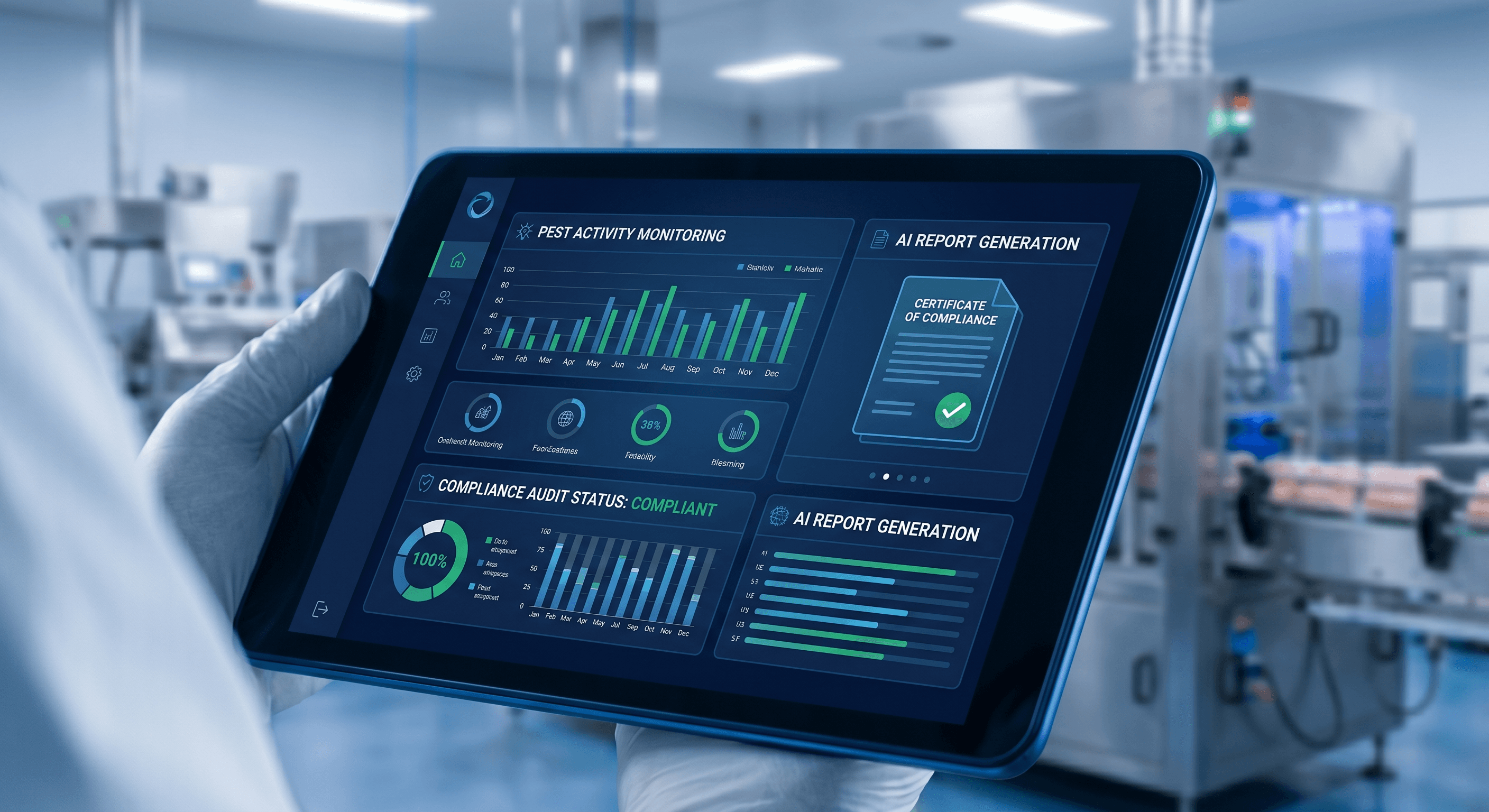
- Read the monitoring dashboard and interpret heat maps
- Acknowledge and escalate alerts per defined SLAs
- Access compliance reports for audits
- Coordinate with pest control technicians using location-specific data
Alert thresholds that work
| Alert Level | Trigger | Response Time | Action |
| Low | 1–2 events in 24 hours | Within 48 hours | Monitor, log, address at next scheduled visit |
| Medium | 3–5 events in 24 hours | Within 24 hours | Inspect area, place additional traps |
| High | 6+ events or sustained pattern | Within 4 hours | Emergency dispatch, zone quarantine |
Case Study: Regional Distribution Center Results
A third-party logistics provider operating a 120,000 sq ft distribution center in the U.S. Midwest deployed Anticimex SMART across their facility in Q1 2024. The center handles packaged food products for three national grocery chains.
Before IoT deployment (2023 baseline):
- 4 pest-related inventory rejections from retail partners
- $42,000 in written-off contaminated product
- 3 emergency pest control calls averaging $1,800 each
- One failed AIB International audit (corrective action cost: $8,500)
After 12 months with IoT monitoring:
- Zero inventory rejections
- $6,200 in pest-related losses (85% reduction)
- Zero emergency calls (all issues caught at low-alert level)
- Passed AIB audit with "superior" rating
- Documented savings: $53,100 in Year 1 against a system investment of $18,400 (ROI: 289%)
The facility manager reported that the biggest improvement was response speed: "Before, we'd find chewed packaging and spend days tracing where rodents were. Now the system tells us exactly which trap triggered and we address it that same shift."
Why LoRaWAN Is the Right Connectivity Choice
For warehouse pest monitoring, LoRaWAN dominates as the connectivity protocol because it addresses the specific challenges of industrial environments:
- Wall and racking penetration: 2–5 km range in industrial settings, passing through metal racking and concrete walls
- Battery efficiency: Sensors transmit briefly and sleep, achieving 3–5 year battery life on coin-cell or lithium-thionyl chloride batteries
- Scale: Single gateway supports thousands of devices — sufficient for even the largest facilities
- No open ports required: LoRaWAN sensors communicate outbound only, eliminating network security concerns
NB-IoT is a viable alternative where cellular infrastructure is preferred and sensor density is lower, but LoRaWAN remains the more cost-effective choice for most warehouse deployments. For a deeper comparison, see our guide on Zigbee vs LoRaWAN for pest monitoring.
Common Challenges and Solutions
"Our facility is too large for sensors."
False. LoRaWAN's range means a single gateway covers most warehouses. For a 500,000 sq ft facility, expect 80–120 sensors — still well within the ROI threshold at typical pest damage rates.
"We already have a pest control contract."
IoT monitoring enhances your existing contract. Most national providers (Rentokil, Anticimex, Rollins) offer IoT as an add-on. The data makes your pest control provider more effective by directing them to exact problem locations. Smart pest control compliance requirements increasingly favor integrated approaches.
"IT is concerned about network security."
Ensure your vendor provides end-to-end encryption (AES-128 or higher), separate VLAN isolation for sensor traffic, SOC 2 Type II compliance for cloud platforms, and no open inbound ports.
"What about cold storage?"
Sensors rated for -40°F to 140°F are available from vendors like Vermonitor and Sensitech. Cold storage actually benefits disproportionately from IoT monitoring because manual inspections are less frequent, making detection gaps even wider.
Frequently Asked Questions
How much does an IoT warehouse pest monitoring system cost?
A mid-size warehouse (100,000 sq ft) can deploy a complete system for $12,000–$25,000 in Year 1, including sensors, gateways, and platform fees. Annual subscriptions run $2,000–$5,000. With average savings of $50,000+, most facilities achieve full ROI within 4–6 months.
Does IoT pest monitoring replace traditional pest control?
No — it enhances traditional pest control by providing real-time detection data. You still need professional technicians for elimination and prevention treatments. IoT tells them exactly where and when to act, making every visit more targeted and effective.
What types of warehouses benefit most?
Facilities storing food products, pharmaceuticals, pet food, grain, or consumer electronics see the highest ROI. However, any facility with documented pest activity or regulatory compliance requirements (FSMA, BRCGS, AIB) benefits significantly from continuous monitoring.
How long do sensor batteries last?
Most commercial IoT pest sensors achieve 3–5 year battery life under normal operation. LoRaWAN's low-power design means sensors transmit briefly and sleep between readings. Battery status is reported on the dashboard for proactive replacement planning.
Can this work across multiple warehouse locations?
Yes. Most IoT platforms support centralized multi-site management from a single dashboard, making it ideal for organizations managing distributed logistics networks.
Quick ROI Calculator for Your Facility
Estimate your potential savings with this framework:
- Total your pest-related losses from the past 12 months (contaminated product + emergency calls + audit corrective actions)
- Add indirect costs: customer rejections, insurance surcharges, overtime labor for quarantine procedures
- Apply a 60–70% reduction factor based on published IoT deployment results
- Compare against estimated system cost: $15–$25 per 1,000 sq ft for hardware, plus $2,000–$5,000 annual platform fees
If the savings gap exceeds $20,000 annually, the business case for IoT warehouse pest monitoring is clear — and the technology is mature enough to deploy today.
Conclusion
Warehouse pest monitoring with IoT transforms pest management from a reactive cost center into a proactive, data-driven operation. The $50,000+ annual savings per facility come from four pillars: reduced inventory loss, lower emergency response costs, regulatory compliance protection, and improved customer confidence.
The technology is proven, the ROI is achievable within months, and competitive pressure from retailers and regulators is only increasing. Facilities still relying on quarterly walkthroughs and paper trap logs are absorbing preventable losses — and the data proves it.
Your next step: Total your facility's pest-related costs from the past year and run them through the ROI framework above. If the number is north of $30,000 — and for most warehouses, it is — an IoT monitoring system pays for itself before the first battery replacement.
Sources: National Pest Management Association (NPMA) 2024 Commercial Pest Trends Report; Rentokil Initial Global Hygiene Barometer 2024; Anticimex SMART deployment data (2023–2024); Warehousing Education and Research Council (WERC) DC Measures Report; U.S. FDA Food Safety Modernization Act (FSMA) guidance; FM Global and Zurich commercial property underwriting guidelines.
Further reading: [IoT Sensor Networks: Creating Smart Barriers Against Rodent Infestations] · [The Hidden Costs of Reactive Pest Control: Why Prevention Saves 40% in Annual Budgets] · [Remote Pest Monitoring: Managing Multiple Sites Without Increasing Inspection Staff]