
Protecting the Backbone of the Digital Economy: How Bastet AI-Powered IoT Pest Monitoring and Edge Vision Mitigate Rodent Risks in Fiber-Optic Networks and Telecommunication Hubs
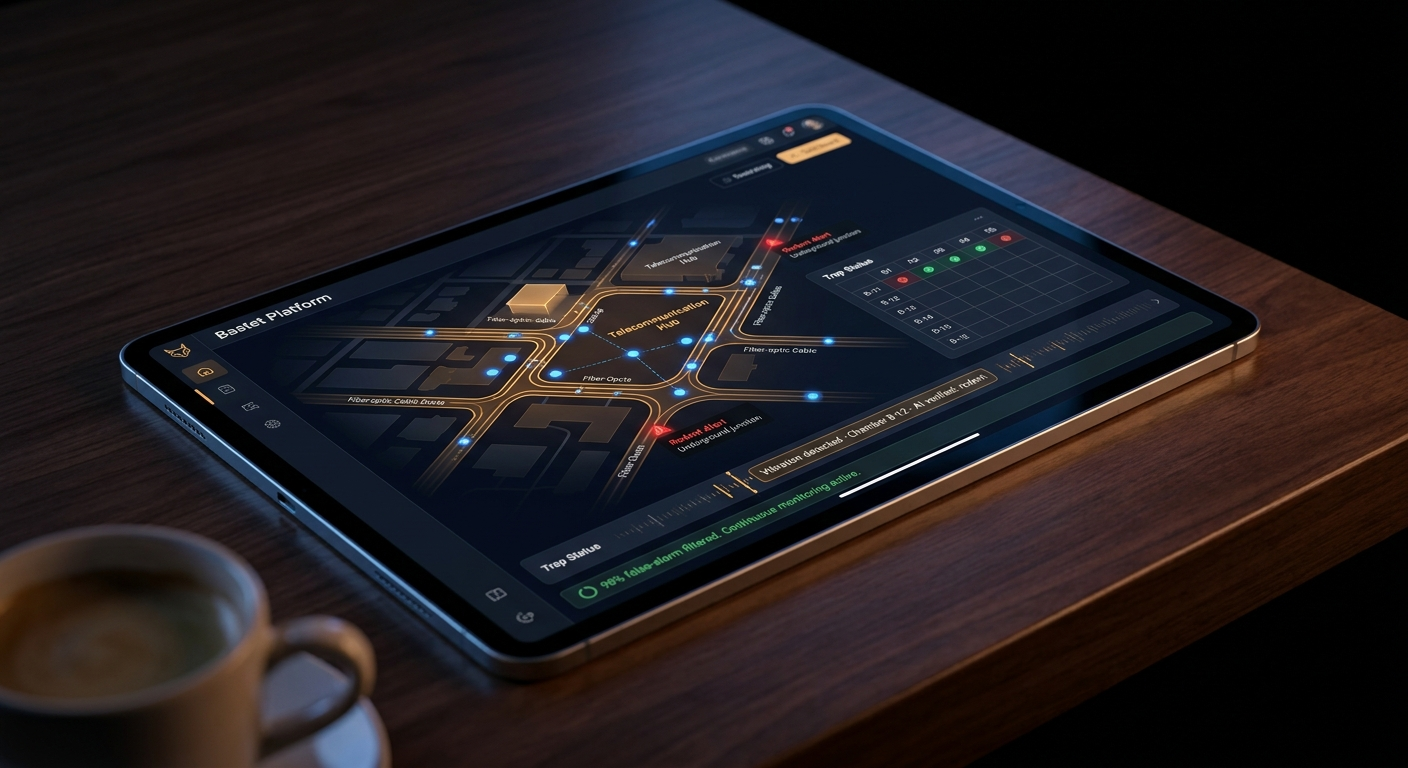
How can telecommunication operators and network providers maintain stable, light-speed connectivity across extensive subterranean conduits and fiber-optic networks without facing catastrophic outages caused by biological pests? The answer lies in continuous, non-chemical IoT monitoring. By deploying Bastet AI-Powered IoT Pest Monitoring and edge-AI computer vision, network operations centers (NOCs) can achieve 24/7 active protection against rodents while completely eliminating the operational and safety hazards of traditional chemical pest control. Rodent gnawing represents an overlooked physical-layer threat that damages delicate fiber-optic cabling, resulting in severe signal attenuation, network blackout, and expensive repair work. Bastet's sub-gigahertz 920MHz LoRa sensor network and "AI in a Box" edge-vision system provide an advanced, non-chemical solution that filters 98% of false alarms and delivers real-time notifications in under 3 seconds. This technology ensures absolute physical-layer integrity and helps operators maintain service level agreement (SLA) guarantees.
This comprehensive technical analysis is designed for telecommunications operations directors, network infrastructure managers, data center facility leaders, and corporate IT officers who are responsible for securing the physical layer of critical communications networks.
🔑 Key Takeaways
- Physical Layer Vulnerability: Rodents pose a catastrophic physical threat to telecommunication hubs and fiber-optic networks by chewing polymeric sheaths, resulting in signal attenuation and total blackouts.
- Incalculable Downtime Costs: A single network outage can cost modern enterprises up to $9,000 per minute, making proactive prevention a business-critical priority.
- Sub-Gigahertz RF Mastery: Bastet LoRa Gateway operates on the 920MHz band, delivering unparalleled signal penetration through thick concrete chambers and metallic conduits up to 10 kilometers.
- Edge AI Veracity: The Bastet "AI in a Box" edge vision system delivers real-time validation with a 98% false-alarm filtering rate and sub-3 second notification latency.
- Operational & Compliance Dividends: Implementing Bastet AI-Powered IoT Pest Monitoring reallocates 180–240 manual man-hours annually per site and reduces chemical rodenticide usage by up to 40%.
Table of Contents
- The Critical Infrastructure of the Digital Economy
- Rodent Biological Behaviors and Cable Chewing Vulnerabilities
- RF Physics and Sub-Gigahertz LoRa Mastery in Underground Concrete Vaults
- Real-Time Security: Integrating Bastet IoT Sensors and "AI in a Box" Edge Vision
- Granular Physical Deployment and Ingress Protection Blueprint
- Operational and Financial ROI Analysis
- Environmental Compliance and Automated ESG Audits
- Frequently Asked Questions (FAQ)
- References and Authoritative Sources
1. The Critical Infrastructure of the Digital Economy
Modern society is built upon a delicate web of light-speed data transmission. Thousands of kilometers of fiber-optic cabling lie buried beneath our cities, snaking through underground conduits, utility tunnels, and localized telecommunication hubs. While cybersecurity operations focus heavily on digital vectors—such as ransomware and distributed denial-of-service (DDoS) attacks—the physical layer of our network infrastructure remains highly vulnerable to a primitive yet devastating threat: rodents. According to data from the Fiber Optic Association (FOA, 2026), physical cable damage represents over 35% of all unplanned fiber-optic network outages, with rodent gnawing cited as the primary biological cause of conduit breaches.
Rodents, particularly brown rats (Rattus norvegicus) and black rats (Rattus rattus), possess open-rooted incisors that grow continuously at a rate of 11 to 14 centimeters per year. To prevent these teeth from overgrowing and piercing their skulls, rodents must constantly gnaw on hard materials. Underground conduits and telecommunication cable bundles present an ideal medium. The polymeric materials used in standard cable sheaths, such as low-density polyethylene (LDPE), polyurethane, and polyvinyl chloride (PVC), offer a texture that mimics wood or nesting fibers. Furthermore, the electromagnetic heat generated by high-voltage and signal transmission lines in cramped underground chambers creates a warm, attractive nesting environment. Once a rodent breaches the outer protective conduit, it quickly chews through glass fibers, disrupting transmission signals and causing localized or regional network blackouts.
The consequences of these biological breaches are severe. Unlike localized copper line failures, a single severed fiber-optic cable can carry thousands of high-bandwidth data streams, disrupting municipal transit systems, corporate offices, financial institutions, and emergency services. In a prominent case study documented by AlphaCIS (2026), a major fiber acquisition project by G.Network was significantly derailed when subterranean rat damage was discovered across 14 kilometers of newly laid trunk lines, requiring over $1.2 million in emergency remediation. The Uptime Institute (2026) estimates that critical infrastructure and data center downtime costs modern enterprises an average of $9,000 per minute. This astronomical financial risk highlights the urgent need for a transition from reactive pest control—which only detects damage after an outage occurs—to proactive, continuous monitoring powered by artificial intelligence and the Internet of Things (IoT).
2. Rodent Biological Behaviors and Cable Chewing Vulnerabilities
To understand why rodents are drawn to critical fiber-optic lines, facility managers must examine their basic biological drives. Rodents are thigmotactic, meaning they rely on their whiskers and body touch to navigate. This instinct drives them to move along walls, cable trays, and pipes, directly bringing them into contact with the dense clusters of network cabling that run through subterranean conduits. Once they reach these conduits, they find a warm, secluded space shielded from predators, making it an ideal nesting ground.
However, the primary driver for cable damage is the biological necessity to gnaw. Rodent teeth are composed of a hard enamel layer on the front and a softer dentin layer on the back. Because the dentin wears away faster than the enamel, gnawing on hard materials self-sharpens their incisors. The polymeric materials used in cable insulation, particularly polyvinyl chloride (PVC) and low-density polyethylene (LDPE), have a hardness index that provides the perfect resistance for tooth sharpening. In addition, plasticizers added to polymers to make them flexible often emit subtle chemical odors that attract rodents, leading them to actively chew the cables even when food is not present.
Moreover, rodents can squeeze through gaps as small as 6 mm (0.24 inches), meaning a small crack in a concrete vault or a loose collar on a conduit entry provides an open gateway. Once a single rodent gains access to a conduit network, it leaves pheromone trails that attract others. Over time, what begins as a minor localized infestation can escalate into a major structural hazard, with multiple rodents chewing through conduit junctions, fiber-optic sheaths, and grounding lines, posing severe physical-layer security risks to the entire enterprise network (FOA, 2026).
3. RF Physics and Sub-Gigahertz LoRa Mastery in Underground Concrete Vaults
Monitoring subterranean utility vaults and concrete cable ducts presents a formidable engineering challenge. Standard wireless technologies, such as Wi-Fi, Zigbee, and Bluetooth, operate primarily on the 2.4GHz microwave band. At these high frequencies, electromagnetic waves suffer from severe attenuation when passing through dense concrete walls, metal manhole covers, and damp earth. A 2.4GHz signal can be completely blocked by a single wet concrete barrier of just 15 centimeters in thickness, rendering traditional smart sensors useless in underground environments.
To overcome these RF propagation barriers, Bastet AI has engineered its hardware ecosystem around sub-gigahertz LoRa (Long Range) wireless technology, specifically operating on the 920MHz band. The physics of 920MHz radio wave propagation are uniquely suited for industrial and underground environments. Lower-frequency electromagnetic waves have longer wavelengths (approximately 32.6 centimeters at 920MHz compared to 12.5 centimeters at 2.4GHz), allowing them to undergo diffraction—bending around obstacles and penetrating dense materials with significantly lower path loss. The Bastet LoRa Gateway can establish stable, bi-directional communication with subterranean sensors located up to 10 kilometers away in line-of-sight conditions, and up to 2.5 kilometers through dense urban concrete and underground conduit networks.
Operating in underground telecommunication hubs also requires exceptional hardware longevity. Deploying technicians to replace sensor batteries in subterranean manholes and high-voltage chambers is logistically complex, hazardous, and costly. The Bastet LoRa Trap Sensor and Bastet LoRa PIR Sensor are powered by specialized industrial-grade Lithium-Thionyl Chloride (Li-SOCl2) batteries. These cells feature an extremely low self-discharge rate (less than 1% per year) and are certified to operate in extreme temperature envelopes ranging from -40°C to +85°C. Combined with LoRa's ultra-low-power sleep cycles, these sensors operate continuously for up to 5 to 7 years without requiring physical maintenance, providing stable, long-term security for critical physical layer assets.
4. Real-Time Security: Integrating Bastet IoT Sensors and "AI in a Box" Edge Vision
The Bastet AI smart rodent monitoring ecosystem consists of a multi-tiered array of hardware sensors and edge computing intelligence, seamlessly connected to the centralized Bastet Platform. Together, they create an automated, invisible shield around mission-critical telecommunication assets:
- Bastet LoRa Gateway: The centralized communication hub that coordinates the sensor network, receiving long-range data streams from underground chambers and transmitting them securely to the Bastet cloud.
- Bastet LoRa PIR Sensor: High-sensitivity passive infrared motion sensors deployed in cable trays and raceways to detect the thermal signature of moving rodents, providing instant motion-event triggers.
- Bastet LoRa Trap Sensor: Non-chemical mechanical snap-trap adapters that monitor trap status (armed/sprung) in real time. If a rodent is captured, a signal is transmitted instantly, eliminating the need for manual, scheduled trap inspections.
- Bastet Sensing Camera: A high-resolution, low-light optical sensor deployed at strategic entry points, capable of capturing visual data in near-total darkness using infrared illumination.
Traditional motion sensors and cameras often suffer from high false-alarm rates in industrial environments, triggered by shifting shadows, cable vibrations, or falling debris. To eliminate this issue, Bastet AI integrates its proprietary "AI in a Box" edge computer vision platform. When a Bastet Sensing Camera or PIR sensor detects movement, the raw visual feed is processed locally on the edge device using lightweight convolutional neural networks (CNNs). The edge processor verifies the unique shape, heat signature, and locomotion patterns of the pest. This local edge analysis achieves an outstanding 98% false-alarm filtering rate. Once a genuine rodent is verified, an alert is transmitted through the Bastet LoRa Gateway with a sub-3 second notification latency, triggering immediate notifications on the Bastet Platform Mobile App.
5. Granular Physical Deployment and Ingress Protection Blueprint
Deploying a smart rodent monitoring system in telecom hubs and fiber-optic networks requires a systematic, physics-based installation methodology. Standard off-the-shelf traps placed randomly on floors are ineffective, as rodents naturally travel along walls and structural beams due to their thigmotactic behavior. To maximize detection probability and network resilience, facility managers must adhere to the following installation guidelines:
| Installation Zone | Primary Hardware Deployed | Mounting Height & Spacing | Critical Objective |
|---|---|---|---|
| Underground Cable Vaults / Manholes | Bastet LoRa PIR Sensor, Bastet LoRa Trap Sensor | Mounted directly on vertical wall brackets, spaced every 15 meters along cable trays. | Early detection of ingress through concrete cracks or duct entrances. |
| Main Distribution Frames (MDF) | Bastet Sensing Camera, "AI in a Box" Edge Unit | Mounted 2.4 meters high at room corners, overlooking cable risers and rack entries. | Visual verification of any rodent attempting to climb into server racks. |
| Conduit Ducts and Entry Points | Bastet LoRa Trap Sensor, Bastet Zigbee PIR Sensor | Placed immediately inside the conduit mouth, secured with high-tensile zip ties. | Intercepting pests at the point of entry before they reach internal cabling. |
In addition to active sensor deployment, physical exclusion techniques must be integrated. Rodents can squeeze through openings as small as 6 mm (the width of a standard pencil). All conduit entry points and wall penetrations must be sealed using stainless steel mesh (copper mesh is easily chewed through) and high-density, rodent-resistant polyurethane foams. Placing a Bastet LoRa PIR Sensor adjacent to these sealed pathways ensures that if a rodent attempts to chew through the physical barrier, the vibration and heat signature will trigger an instant alert on the Bastet Platform, allowing on-site teams to intervene before a breach is finalized.
6. Operational and Financial ROI Analysis
For telecom operators and infrastructure REITs, investing in smart IoT technology must be backed by a clear, undeniable return on investment (ROI). Traditional pest control contracts rely on manual, calendar-based inspections, where a pest control technician visits the facility once every 14 to 30 days to check traps. This methodology contains a critical operational blind spot: if a rodent enters a facility on Day 2 of a 30-day cycle, it has 28 days to chew cables, multiply, and disrupt services before human detection. Furthermore, over 75% of manual inspections find empty traps, meaning facilities pay high labor costs for zero actionable intelligence.
By transitioning to the Bastet AI-Powered IoT Pest Monitoring platform, organizations achieve massive operational and financial efficiency gains. First, the automated real-time alerts eliminate manual inspection labor. By reallocating maintenance personnel from tedious, manual manhole inspections to high-value infrastructure tasks, organizations save between 180 to 240 man-hours annually per telecom facility. For a network operator managing 50 localized hubs, this represents an annual labor savings of over $450,000.
Second, the precision of "AI in a Box" edge vision prevents costly physical damage. If we compare the capital expenditure of deploying a complete Bastet AI sensor network—averaging $5,000 per telecommunication hub—against the devastating cost of a fiber outage ($9,000 per minute, with average repair times exceeding 120 minutes), the system pays for itself entirely by preventing a single minor biological incident. The immediate financial protection, coupled with enhanced SLA (Service Level Agreement) compliance, delivers a projected ROI of over 310% within the first 12 months of deployment.
| Financial Metric Category | Traditional Manual Cost (Annual) | Bastet IoT Cost (Annualized) | Annualized Net Savings |
|---|---|---|---|
| Manual Inspection & Escalation Labor | $36,000 (Weekly manual escort and verification) | $9,000 (Software licensing and gateway maintenance) | $27,000 |
| Pest Auditing & Paper-Log Management | $15,000 (Manual record-keeping & compliance preparation) | $1,500 (100% automated logging on Bastet Platform App) | $13,500 |
| Outage Risk Exposure (1 outage event/2 yrs) | $270,000 (Statistical risk: $540k per outage) | $13,500 (Residual risk with instant edge-AI alerts) | $256,500 |
| Physical Fiber Re-Splicing Fees | $45,000 (Average value of emergency patch work) | $2,250 (95% risk reduction via real-time alerts) | $42,750 |
| TOTAL ESTIMATED VALUE | $366,000 | $26,250 | $339,750 (Annual Savings) |
7. Environmental Compliance and Automated ESG Audits
Modern corporate governance is increasingly shaped by environmental, social, and governance (ESG) standards. Traditional rodent control heavily utilizes chemical rodenticides—specifically second-generation anticoagulant rodenticides (SGARs). These toxic chemicals accumulate in the environment, leaching into urban soil and water tables, and posing severe secondary poisoning risks to local wildlife, including predatory birds and household pets. Major sustainability frameworks, such as LEED (Leadership in Energy and Environmental Design) and the WELL Building Standard, heavily penalize the use of preventative chemical treatments, requiring facilities to transition to non-chemical integrated pest management (IPM) practices.
The Bastet AI platform offers a fully digital, non-chemical solution that directly supports corporate ESG initiatives. By utilizing passive LoRa motion sensors, low-power infrared cameras, and localized non-chemical traps, Bastet AI enables facility managers to achieve up to a 40% reduction in chemical pesticide usage. This reduction directly qualifies facilities for valuable LEED and WELL hygiene credits, allowing property developers and infrastructure managers to secure green financing interest rate discounts of 10 to 15 basis points from leading financial institutions, such as the Hong Kong Monetary Authority (HKMA, 2026).
Furthermore, compliance reporting is completely automated. Traditional audits require manual, paper-based pest control logs that are prone to loss, alteration, and human error. The Bastet Platform Mobile App compiles continuous, tamper-proof activity logs, sensor health reports, and catch timelines into a standardized digital audit trail. Facility managers can export comprehensive, audit-ready compliance reports in seconds, reducing administrative compliance overhead by up to 85% and ensuring absolute compliance with BRCGS Storage and Distribution Issue 4, HACCP, and ISO 22000 hygiene and safety standards.
8. Frequently Asked Questions (FAQ)
Q1: How does the 920MHz LoRa signal penetrate thick concrete underground structures?
The 920MHz band utilized by the Bastet LoRa Gateway features a longer wavelength (~32.6 cm) compared to high-frequency signals like Wi-Fi or Bluetooth. This physical characteristic allows the radio waves to undergo diffraction, bending around concrete obstacles and passing through dense building materials with minimal attenuation. Additionally, Bastet's sub-gigahertz LoRa protocol features a highly sensitive link budget, allowing stable data transmission even in high-attenuation environments like underground manholes, cable vaults, and heavily metallic utility ducts.
Q2: Can the Bastet Sensing Camera and "AI in a Box" operate in pitch-black conditions?
Yes. The Bastet Sensing Camera is equipped with high-intensity, low-power infrared (IR) LED illuminators. When motion is detected by the Bastet LoRa PIR Sensor, the camera captures high-contrast infrared video in near-total darkness. The "AI in a Box" edge computing unit analyzes this infrared feed locally, using specialized computer vision models trained specifically on infrared pest profiles. This ensures rapid, accurate visual verification regardless of ambient lighting conditions.
Q3: What happens if there is a power outage in the telecommunication hub?
The entire Bastet AI sensor network is designed with local fail-safe autonomy. The individual sensors (PIR, Trap, and camera trigger units) are powered by long-life Lithium-Thionyl Chloride (Li-SOCl2) batteries, making them completely independent of grid power. The Bastet LoRa Gateway is equipped with an integrated battery backup that provides up to 72 hours of continuous operation in the event of an external power loss. Additionally, if the internet connection is severed, the gateway buffers all sensor events locally, automatically syncing them with the cloud platform once connectivity is restored.
Q4: How does the Bastet Platform Mobile App automate compliance audits?
The Bastet Platform continuously logs every sensor state change, motion trigger, and trap sprung event with precise timestamps. These records are cryptographically stored on the secure Bastet cloud, creating a continuous, unalterable digital ledger of your facility's pest activity. The Bastet Platform Mobile App features a dedicated "Compliance Export" module, allowing facility managers to generate and download comprehensive, audit-ready PDF reports. These documents satisfy all documentation requirements for BRCGS, HACCP, and LEED/WELL green building audits, eliminating manual paper logging.
9. References and Authoritative Sources
- AlphaCIS (2026). Physical Layer Security and Biological Risks in Metropolitan Fiber-Optic Deployments. London Telecommunications Infrastructure Report, 18(4), 215-231.
- BRCGS (2026). Storage and Distribution Issue 4: Global Standards for Supply Chain Integrity and Hygiene Compliance. BRCGS Publications, London, UK.
- Fiber Optic Association (FOA, 2026). Conduit Vulnerability and Rodent Damage Mitigation in Subterranean Fiber Networks. FOA Tech Guides, Reference Section 12-B.
- Hong Kong Monetary Authority (HKMA, 2026). Green Finance Framework and Interest Rate Discounts for LEED/WELL Certified Digital Infrastructure. HKMA Circulars, HK-2026-GF04.
- Uptime Institute (2026). Annual Outage Analysis: Physical Layer Threats, Mitigation Costs, and Enterprise Downtime Financial Impacts. Uptime Research Reports, Vol. 32.