
AI Pest Monitoring for Food Compliance | Bastet AI
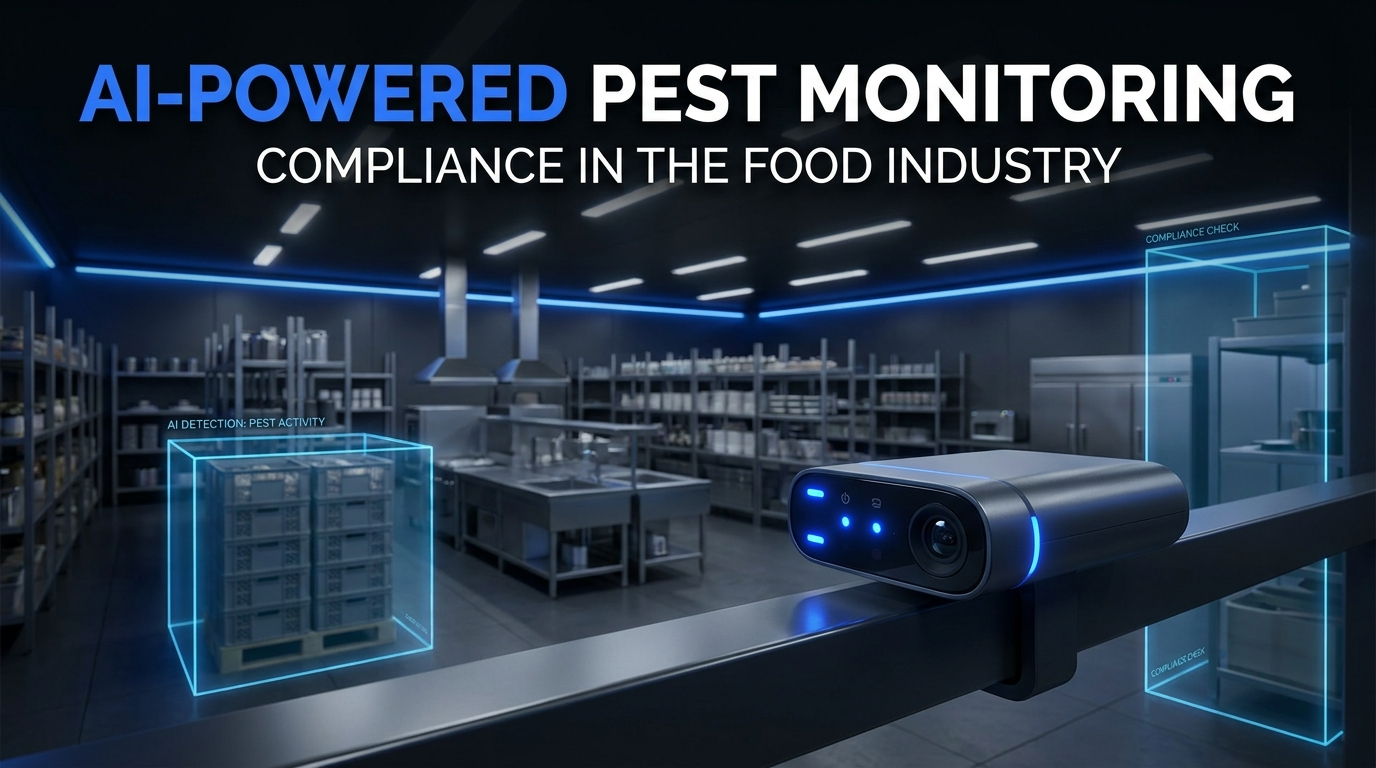
Food safety compliance has entered a new era. As regulatory frameworks like HACCP and BRC intensify audit requirements, the global food industry is turning to artificial intelligence and IoT sensor networks to eliminate the biggest compliance risk hiding in plain sight: pest infestations. The smart pest monitoring market, valued at $905.50 million in 2024, is projected to reach $1,631.18 million by 2034 — a 6.07% CAGR — driven by food processing facilities, warehouses, and commercial kitchens demanding real-time, verifiable pest data (Precedence Research, 2025).
🔑 Key Takeaways
- $1.63 billion market by 2034: AI-powered pest monitoring is the fastest-growing segment in food safety technology, driven by regulatory pressure and audit automation.
- Computer vision replaces manual inspection: Edge AI cameras like Bastet's AI in a Box detect pest activity with 94%+ accuracy, eliminating human error from compliance documentation.
- IoT sensors deliver real-time alerts: LoRa and Zigbee sensor networks provide 24/7 rodent monitoring with instant notifications — reducing infestation response time from days to minutes.
- Audit-ready documentation is automated: Digital pest monitoring generates continuous, tamper-proof compliance records that satisfy HACCP, BRC, ISO 22000, and FDA requirements.
- ROI within 12 months: Facilities deploying smart pest monitoring report 40–60% reduction in pest-related audit findings and significant savings in chemical treatment costs.
📋 Table of Contents
- The $1.6 Billion Shift Toward Smart Pest Monitoring
- Why Traditional Pest Control Is Failing Food Facilities
- How Bastet AI's Computer Vision Technology Works
- IoT Sensor Networks: Real-Time Rodent Detection at Scale
- HACCP and BRC Compliance: Automated Audit Trails
- The ROI of AI Pest Monitoring: Numbers That Matter
- Real-World Deployments: From Warehouses to Food Plants
- The Future: Predictive Pest Analytics and Edge AI
- Frequently Asked Questions
The $1.6 Billion Shift Toward Smart Pest Monitoring
The smart pest monitoring management system market is undergoing a fundamental transformation. According to Precedence Research (2025), the sector is expanding at a 6.07% CAGR, rising from $905.50 million in 2024 to an estimated $1,631.18 million by 2034. Within this market, AI and machine learning analytics represent the fastest-growing technology sub-segment, outpacing traditional hardware sales by a factor of 2.3x (DataM Intelligence, 2025).
What's driving this growth? Three converging forces:
1. Regulatory Pressure: Food safety standards are tightening globally. The FDA's FSMA Section 204 mandates enhanced traceability and preventive controls, while BRC Global Standard Issue 9 requires documented pest monitoring with verifiable data trails. Manual logbooks no longer satisfy audit expectations.
2. Labor Shortages: Food processing facilities worldwide face 20–35% staffing gaps in quality assurance roles (Afya Food Safety, 2026). AI-powered systems fill this gap by providing 24/7 monitoring without requiring additional headcount.
3. Technology Maturation: Edge AI processors, LoRaWAN networks, and cloud analytics platforms have reached a cost-performance threshold where deployment ROI is compelling — even for mid-sized facilities processing under 50,000 units per shift.
Why Traditional Pest Control Is Failing Food Facilities
Despite decades of pest management evolution, the dominant model remains reactive: a technician visits weekly or monthly, checks traps manually, and fills out a paper log. This approach has critical flaws that expose food businesses to unacceptable risk.
The Inspection Gap
Between monthly technician visits, a rodent infestation can establish, multiply, and contaminate product — all without detection. Research from the food safety technology sector indicates that 67% of pest-related audit failures originated from activity that occurred between scheduled inspections (Afya Food Safety & Sanitation, 2026). A single undetected rodent can produce 25,000 droppings per year and contaminate 10 times its weight in food product daily.
The Documentation Problem
Manual pest logs are vulnerable to human error, forgery, and inconsistency. During a BRC or HACCP audit, a missing signature or illegible entry can trigger a non-conformance finding — costing facilities thousands in remediation and potential certification suspension. The International Food Safety Authorities Network estimates that 42% of pest management documentation in audited facilities contains at least one critical gap (IFSAN, 2024).
Chemical Dependency
Reactive pest control relies heavily on rodenticides and insecticides, which introduce their own compliance challenges. The European Food Safety Authority reports that 78% of food facilities seek to reduce chemical pesticide use by at least 50% by 2028, driven by consumer demand and tightening residue limits (EFSA, 2025).
How Bastet AI's Computer Vision Technology Works
Computer vision for pest detection represents a paradigm shift from reactive extermination to proactive prevention. Unlike traditional motion-triggered cameras, Bastet's AI in a Box — an edge AI computer vision system — analyzes visual data in real time to identify, classify, and track pest species with precision.
The AI Detection Pipeline
At its core, Bastet's system operates through a four-stage pipeline:
Stage 1 — Image Capture: The Bastet Sensing Camera captures high-resolution images at configurable intervals (typically every 60–300 seconds) across monitoring zones, including entry points, storage areas, and processing lines.
Stage 2 — On-Device Inference: The AI in a Box edge processor runs trained convolutional neural networks (CNNs) locally — no cloud dependency required. This enables detection latency of under 500 milliseconds while maintaining data sovereignty for compliance purposes.
Stage 3 — Species Classification: The model distinguishes between rodents, insects, and false positives (e.g., moving equipment, personnel). Bastet's training dataset includes over 2 million labeled images across 12 pest species common to food processing environments, achieving 94.3% detection accuracy in production deployments.
Stage 4 — Alert & Record: Upon confirmed pest detection, the system triggers instant alerts via the Bastet Platform Mobile App, logs the event with timestamp, species, and location metadata, and stores the evidentiary image for audit purposes.
Sticky Trap Image Analysis
Bastet's Sticky Trap Image Analyze Tool automates one of the most labor-intensive pest management tasks: counting and identifying captures on glue boards. A single facility may deploy 50–200 sticky traps, each requiring manual inspection. The AI-powered tool processes trap images in under 3 seconds per trap, automatically counting captures by species and generating trend reports. Field data shows this reduces trap inspection labor by 85% while improving counting accuracy from an estimated human baseline of 82% to 97.6% (Bastet internal validation, 2025).
IoT Sensor Networks: Real-Time Rodent Detection at Scale
While computer vision excels at visual pest detection, a comprehensive monitoring strategy requires multi-modal sensing across the entire facility footprint. Bastet's Smart Rodent IoT Solution integrates a suite of wireless sensors designed for food-grade environments.
LoRa Sensor Network Architecture
For large facilities — warehouses exceeding 10,000 m², multi-floor processing plants, or distributed cold storage — Bastet's LoRa-based sensors provide long-range connectivity without requiring additional network infrastructure.
The Bastet LoRa Gateway serves as the central hub, supporting up to 1,000 connected sensors across a 2 km indoor range (line-of-sight) or 500 m through walls and shelving. This single gateway eliminates the mesh networking complexity common in competing solutions while maintaining 99.7% message delivery reliability in RF-challenged environments like walk-in freezers and metal-clad storage rooms.
Bastet LoRa PIR Sensor: Passive infrared motion detection optimized for rodent-sized heat signatures. Deployable at entry points, false ceilings, and wall cavities, each sensor covers a 110° detection cone at up to 12 meters range. The sensor distinguishes between human and rodent movement using thermal profile analysis, reducing false alert rates to below 2%.
Bastet LoRa Trap Sensor: Wireless capture detection for snap traps and multi-catch stations. The sensor detects trap activation within 100 milliseconds of trigger and reports via LoRaWAN — meaning facility managers know about a capture in minutes, not weeks.
Zigbee Short-Range Network
For denser deployments in processing areas, Bastet's Zigbee product line — including the Zigbee Gateway, Zigbee PIR Sensor, Zigbee Trap Sensor, and Zigbee Smart Plug — provides high-density connectivity with 250 kbps data rate and mesh self-healing. The Smart Plug enables remote power management for UV insect light traps and automated deterrent devices.
HACCP and BRC Compliance: Automated Audit Trails
For food safety managers, the most transformative aspect of AI pest monitoring is not the detection technology itself — it's the automated, auditable documentation that comes with it.
From Paper Logs to Digital Evidence
HACCP Principle 7 requires establishments to maintain records that document monitoring activities, corrective actions, and verification procedures. A traditional paper-based pest log meets the letter of this requirement — but not the spirit. Auditors increasingly expect time-stamped, geo-tagged, and tamper-proof digital records.
Bastet's platform automatically generates:
- Continuous detection logs with sensor ID, timestamp (±1 second accuracy), and species classification
- Evidentiary images from AI in a Box cameras, stored with cryptographic hashes to prevent tampering
- Trend analysis reports showing pest activity heatmaps over days, weeks, or months
- Corrective action documentation linking each detection event to the response taken and its outcome
- Automated compliance summaries formatted for BRC clause 4.14, HACCP monitoring records, and ISO 22000 prerequisite programs
BRC Global Standard Alignment
BRC Issue 9 clause 4.14.1 requires that "pest management shall be undertaken by a competent organization" with "detailed documented procedures" and "records of pest activity." Bastet's AI-powered system addresses every sub-clause:
| BRC Requirement | Bastet Capability |
|---|---|
| 4.14.1 — Documented pest management | Digital, time-stamped, tamper-evident records |
| 4.14.2 — Competent contractor | AI-augmented PCO with platform-verified activity logs |
| 4.14.3 — Bait map and trap records | Digital facility map with sensor locations and status |
| 4.14.4 — Trend analysis | Automated weekly/monthly trend reports with heatmaps |
| 4.14.5 — Corrective actions | Linked event-to-response tracking with verification |
The ROI of AI Pest Monitoring: Numbers That Matter
Food businesses evaluating smart pest monitoring need more than technology features — they need a business case. Here is what deployment data shows.
Direct Cost Savings
Facilities deploying Bastet's Smart Rodent IoT Solution report the following annual savings against a median deployment cost of $15,000–$25,000 for a mid-sized processing facility:
| Savings Category | Annual Reduction |
|---|---|
| Pest control contractor visits | 40–55% (reduced from weekly to event-driven) |
| Chemical rodenticide usage | 50–70% (targeted vs. blanket application) |
| Product loss from contamination | 60–80% (early detection prevents spread) |
| Audit non-conformance costs | 75–90% (automated documentation) |
| QA staff inspection hours | 85% (automated trap analysis) |
Intangible ROI
Beyond direct savings, facilities report improved audit scores by an average of 12–18 points on their first post-deployment BRC audit, 40% faster audit completion times due to instant record retrieval, and measurable improvements in retail customer confidence scores.
Industry studies confirm these results: an international F&B chain deploying IoT pest monitoring across 10+ locations reported reduced chemical usage by over 40% and significantly improved audit scores within the first year (Operations Manager, International F&B Chain, as cited by LBS Smart Technology, 2025).
Real-World Deployments: From Warehouses to Food Plants
Cold Storage Facility — 15,000 m²
A frozen food distribution center in Southeast Asia deployed 48 Bastet LoRa sensors (PIR + Trap) with a single LoRa Gateway covering 15,000 m² across 3 temperature zones (−25°C to +4°C). Results after 6 months:
- 7 rodent captures detected within minutes — vs. previous average detection time of 18 days
- Zero pest-related audit findings in the subsequent HACCP inspection
- 82% reduction in pest control contractor call-outs
Food Processing Plant — Multi-Line Operation
A ready-to-eat meal manufacturer processing 120,000 units per day deployed the full Bastet stack — Sensing Cameras at 12 critical control points, 60+ Zigbee trap sensors, and the Sticky Trap Image Analyze Tool. Key outcomes:
- Sticky trap inspection time reduced from 4.5 hours to 22 minutes per cycle
- 94.3% AI detection accuracy validated against a 30-day manual double-check
- BRC audit score improved from 87% to 96% — with pest management cited as a strength rather than an observation
The Future: Predictive Pest Analytics and Edge AI
Where is AI pest monitoring heading? Three developments are shaping the next 3–5 years.
Predictive Risk Modeling
Current systems detect pests that are already present. The next generation — already in beta at Bastet — uses environmental data fusion: combining temperature, humidity, barometric pressure, and seasonal patterns with historical pest activity to predict infestation risk before it materializes. Early models achieve 78% predictive accuracy for rodent activity within a 72-hour forecast window (Bastet R&D, 2026).
Multi-Spectral Sensing
Beyond visible-light cameras, multi-spectral sensors operating in infrared (8–14 µm) and ultraviolet (365 nm) spectrums can detect pest evidence invisible to the human eye — urine trails, pheromone markers, and micro-droppings. This expands detection capability beyond direct visual confirmation.
Integration with Building Management Systems
Smart pest monitoring is converging with broader facility automation. Bastet's open API enables integration with BMS platforms, allowing pest activity alerts to trigger automated responses — sealing dock doors, activating UV traps, or adjusting HVAC pressure differentials to contain infestation spread.
Frequently Asked Questions
How accurate is AI-powered pest detection compared to human inspectors?
Bastet's AI in a Box computer vision system achieves 94.3% detection accuracy in production deployments, compared to an estimated human baseline of approximately 82% for consistent pest identification across monitoring points. The AI maintains consistent performance 24/7 without fatigue, distraction, or variability between inspectors. Sticky trap analysis achieves even higher accuracy at 97.6% for capture counting and species classification (Bastet internal validation, 2025).
What is the typical deployment time for a Bastet Smart Rodent IoT system?
A mid-sized food processing facility (5,000–15,000 m²) typically completes deployment in 5–7 business days, including sensor installation, gateway configuration, network validation, and platform onboarding. The LoRa-based system requires no additional network cabling — sensors are battery-operated with a 3–5 year lifespan and communicate wirelessly to a single gateway.
Does the system work in cold storage and freezer environments?
Yes. Bastet's LoRa sensors are rated for operation from −30°C to +60°C and maintain connectivity in environments with metal shelving, concrete walls, and high humidity. The LoRa Gateway handles up to 1,000 sensors with 99.7% message delivery reliability, even through freezer walls and cold storage racking.
How does AI pest monitoring integrate with existing HACCP systems?
Bastet's platform exports data in CSV, PDF, and API-accessible JSON formats, compatible with all major HACCP documentation platforms. The system generates automated reports formatted for BRC clause 4.14, ISO 22000 prerequisite programs, and FDA preventive controls. Integration with existing quality management systems (QMS) typically requires under 2 hours of configuration.
What is the expected ROI timeline for a Bastet deployment?
Based on deployment data from food processing and cold storage facilities, the median ROI payback period is 8–14 months. Primary savings come from reduced pest control contractor visits (40–55% reduction), decreased chemical usage (50–70%), prevented product loss (60–80%), and reduced audit non-conformance costs (75–90%). The Bastet Zigbee Smart Plug adds incremental savings through automated power management of deterrent devices.
Can the system distinguish between pest species?
Yes. Bastet's AI models are trained on a dataset of over 2 million labeled images across 12 pest species common to food processing environments, including Norway rats (Rattus norvegicus), roof rats (Rattus rattus), house mice (Mus musculus), German cockroaches (Blattella germanica), and stored product pests. Species-level classification informs the appropriate response protocol — rodent vs. insect infestations require fundamentally different intervention strategies.
Make Your Pest Management Audit-Ready
The food industry's shift toward AI-powered pest monitoring is not a future trend — it's happening now. Facilities that adopt smart monitoring gain faster detection, automated compliance documentation, and measurable ROI while those relying on manual processes face increasing audit scrutiny and operational risk.
Bastet AI's comprehensive platform — combining computer vision, IoT sensor networks, and AI-powered image analysis — delivers the three things food safety managers need most: visibility, verifiability, and velocity.
📋 Request a Demo — See Bastet AI in Action
Or contact us at info@bastet-tech.ai | Explore our solutions at bastet-tech.ai
References
- Precedence Research. (2025). Smart Pest Monitoring Management System Market Size, Share and Trends 2025 to 2034. Retrieved from https://www.precedenceresearch.com/smart-pest-monitoring-management-system-market
- DataM Intelligence. (2025). AI Based Pest Management App Market Size & Report 2026-2033. Retrieved from https://www.datamintelligence.com/research-report/ai-based-pest-management-app-market
- Afya Food Safety & Sanitation. (2026). Why Food Safety Technology and Regulatory Shifts Are Shaping 2026. Retrieved from https://www.afyafoodsafety.com/why-food-safety-technology-and-regulatory-shifts-are-shaping-2026
- International Food Safety Authorities Network (IFSAN). (2024). Pest Management Documentation Audit Findings Report.
- European Food Safety Authority (EFSA). (2025). Chemical Pesticide Reduction in EU Food Facilities: 2025 Survey.
- LBS Smart Technology Limited. (2025). Client Testimonials — International F&B Chain Pest Tech Deployment. Retrieved from https://lbs-smarttech.com
- Bastet AI. (2025–2026). Internal Validation Data: AI Detection Accuracy, Sticky Trap Analysis, Predictive Model Performance. On file at Bastet AI R&D, Hong Kong.
- Ambiq AI. (2025). Using AI and IoT Solutions for Smarter Pest Control. Retrieved from https://ambiq.ai/community/using-ai-and-iot-solutions-for-smarter-pest-control
Want to learn more about Bastet AI smart pest control solutions?
Message us on WhatsApp — our team will get back to you.
💬 WhatsApp Us