
AI Pest Control for Cold Storage Facilities | Bastet AI
Bastet's IP67 ruggedized sensor system deployed on an automated cold storage facility steel beam, utilizing sub-gigahertz LoRa and Edge AI
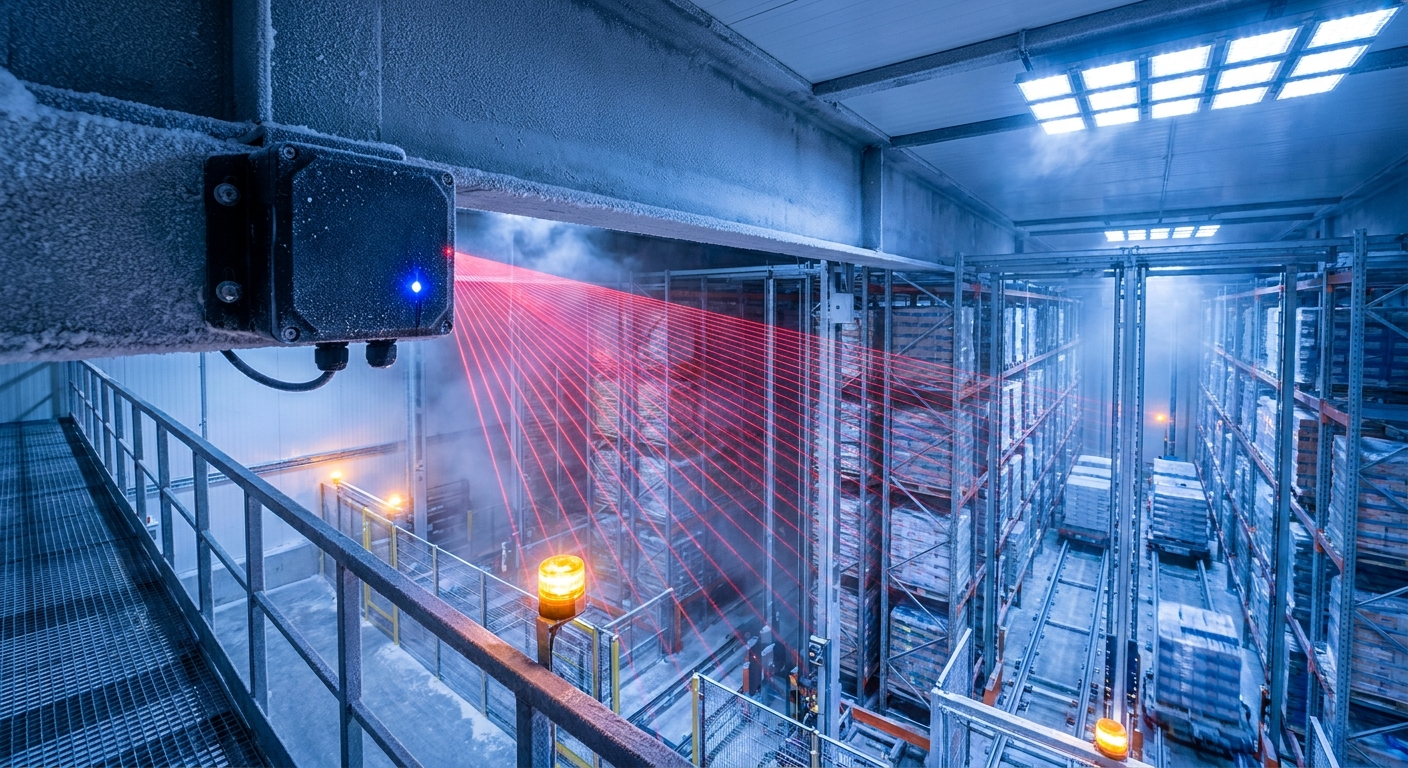
Figure: Bastet's IP67 ruggedized sensor system deployed on an automated cold storage facility steel beam, utilizing sub-gigahertz LoRa and Edge AI Vision to monitor rodent threats down to -40°C.
Key Takeaways: Automated Cold Storage Biosecurity
Automated sub-zero cold storage facilities (-20°C to -30°C) present a unique biosecurity paradox. The extreme cold forces rodents to seek refuge inside the polyurethane cores of double-wall Insulated Metal Panels (IMPs), where they find warmth and nesting opportunities. Once established, these pests target high-density cabling within Automated Storage and Retrieval Systems (ASRS), leading to catastrophic electrical failures, expensive gantry downtime, and severe biological contamination risks from pathogens like Listeria monocytogenes and Salmonella.
Traditional chemical pest control is strictly restricted by HACCP and BRCGS standards, while manual inspections fail due to human physical limits in sub-zero environments. The Bastet Platform solves this challenge by combining non-invasive, sub-gigahertz (920 MHz) LoRa IoT sensors with Edge AI Vision nodes. This unified system bypasses metallic IMP Faraday shielding, filters out condensation-induced false alarms, and delivers continuous, automated pest monitoring. Implementing Bastet mitigates biological risks, ensures regulatory compliance, and drives a 280%+ multi-site ROI.
Table of Contents
- 1. The Sub-Zero Paradox: Why Rodent Infestation Plagues -30°C Cold Storage Facilities
- 2. Biological Contamination: The Zero-Tolerance Hazard in Food and Pharmaceutical Cold Chains
- 3. The Fatal Flaws of Chemical Rodenticides and Manual Inspections in Cold Rooms
- 4. Sub-Gigahertz LoRa Networks: Overcoming the Metallic Shielding of Insulated Metal Panels (IMPs)
- 5. Edge AI Vision: Continuous Monitoring Through Condensation Mist and Sub-Zero Temperatures
- 6. Centralized Dashboard: Portfolio-Wide Cold Chain Intelligence and Automated Dispatch
- 7. Quantifying the ROI: The Multi-Million Dollar Economics of Smart Biosecurity
- 8. Key Deployment Challenges in Cold Rooms and Bastet's Proven Mitigation Strategies
- 9. Traditional Reactive Pest Control vs. Bastet's Unified AI Platform
- 10. Frequently Asked Questions (FAQ) regarding Cold Chain Biosecurity
Introduction
This article is designed specifically for automated cold storage warehouse managers, cold chain logistics operators, food and pharmaceutical supply chain executives, quality assurance directors, and industrial facilities leads who are tasked with maintaining absolute biosecurity in high-density, sub-zero environments.
To protect automated cold rooms from destructive pest activity, operators must move away from manual inspections and adopt continuous, non-invasive digital monitoring. The Bastet Platform delivers this capability by integrating sub-gigahertz LoRa IoT sensors and edge vision pest detection into a single, hardened system. This approach provides chemical-free cold room pest control, ensures strict HACCP compliance in sub-zero warehouses, and prevents costly structural and electrical damage. By deploying automated cold storage rodent prevention technologies, facilities can safeguard their high-density racking systems, eliminate biological contamination risks, and protect their bottom line.
1. The Sub-Zero Paradox: Why Rodent Infestation Plagues -30°C Cold Storage Facilities
Modern automated cold storage facilities are marvels of thermal and mechanical engineering. By utilizing Automated Storage and Retrieval Systems (ASRS), these facilities maximize volumetric efficiency, stacking frozen food pallets and pharmaceutical inventories up to 40 meters high in environments maintained between -20°C and -30°C. However, this dense configuration creates a dangerous biological paradox. While the open aisles of a cold room are freezing, the physical structure itself contains numerous micro-climates and thermal sanctuaries that attract pests.
Rodents do not live in the open, freezing air; instead, they exploit structural vulnerabilities. Insulated Metal Panels (IMPs), which form the walls and ceilings of modern cold rooms, consist of a thick polyurethane or polyisocyanurate insulating core sandwiched between two sheets of protective steel. If a rodent finds a microscopic breach in the outer vapor barrier or joint sealant, it can chew directly into the soft insulating core. Inside, the heat escaping from the warehouse exterior combined with the rodent's own metabolic heat creates a warm, highly insulated nesting space.
"Rodents have an innate biological drive to gnaw continuously to file down their open-rooted, ever-growing incisors. In an ASRS environment, this behavior leads them directly to high-density electrical and control cabling."
An ASRS robotic grid contains thousands of kilometers of high-speed power, control, and fiber-optic cabling running along plenums, cable tracks, and structural columns. These cables guide the high-speed gantry cranes, shuttle cars, and vertical lifts that keep the facility running. When rodents chew through these conduits, they cause immediate electrical short circuits, communication bus faults, and system-wide failures.
According to industry estimates, a single rodent-induced cable failure can halt an entire ASRS zone, costing up to $15,000 per hour in diagnostic time, specialized technician labor, and delayed order shipments. The physical difficulty of locating a chewed cable deep within a frozen, 40-meter-high racking system often extends these outages from hours to days.
2. Biological Contamination: The Zero-Tolerance Hazard in Food and Pharmaceutical Cold Chains
Beyond physical and mechanical damage, rodents pose a severe biological threat to cold chain integrity. Rodents are vectors for dangerous pathogens, including Salmonella enterica, Escherichia coli, and Listeria monocytogenes. While sub-zero temperatures stop the reproduction of most foodborne pathogens, they do not kill them. Instead, the freezing environment acts as a preservation medium. Pathogens contained in rodent dander, hair, feces, and urine can remain viable indefinitely while frozen, waiting to replicate once the product is thawed by the end consumer.
The United States Department of Agriculture (USDA) and the Food and Drug Administration (FDA), under the Food Safety Modernization Act (FSMA), enforce a strict zero-tolerance policy for foodborne pathogens on ready-to-eat foods and packaging. Similarly, the European Food Safety Authority (EFSA) mandates rigorous hazard analysis and critical control point (HACCP) protocols to prevent biological contamination.
If a regulatory audit or internal quality assurance check reveals rodent droppings or hair on pallet wrapping, cardboard packaging, or product surfaces, the consequences are immediate and severe:
- Immediate Warehouse Quarantine: Regulatory authorities can halt all inbound and outbound shipments, freezing millions of dollars in inventory.
- Catastrophic Product Recalls: Contaminated batches must be recalled from retail shelves, leading to massive financial losses and long-term brand damage.
- Regulatory Fines and Legal Liability: Violations of FSMA or BRCGS (British Retail Consortium Global Standards) can result in heavy financial penalties and criminal liability for corporate officers.
- Insurance Premium Adjustments: Underwriters routinely increase premiums or void coverage for facilities that fail to demonstrate continuous, auditable pest control measures.
3. The Fatal Flaws of Chemical Rodenticides and Manual Inspections in Cold Rooms
Historically, facilities relied on chemical rodenticides and manual inspections to manage pest risks. In modern automated cold storage, however, both methods are ineffective and often non-compliant.
First, chemical rodenticides are strictly restricted in food-handling and pharmaceutical environments. Under HACCP and BRCGS guidelines, placing toxic chemical baits near open food products or primary packaging is prohibited due to the risk of accidental cross-contamination. Furthermore, when a rodent consumes a slow-acting anticoagulant rodenticide, it does not die immediately. Instead, it seeks out a quiet, hidden space to die—often inside the polyurethane core of an IMP or deep within a high-density pallet rack. The decaying carcass then becomes a breeding ground for secondary pests and a source of localized biological contamination, completely defeating the purpose of the treatment.
Second, manual inspections are highly inefficient in sub-zero environments. Human inspectors cannot work safely or productively for extended periods at -25°C. Occupational safety regulations limit continuous exposure to extreme cold, requiring frequent warm-up breaks that disrupt inspection schedules.
Even when equipped with arctic gear, inspectors cannot easily access the upper levels of a 40-meter ASRS rack or see inside sealed wall panels. As a result, manual inspections are often reduced to quick, ground-level checks of a few perimeter traps. This leaves the vast majority of the facility unmonitored and vulnerable to undetected pest activity.
4. Sub-Gigahertz LoRa Networks: Overcoming the Metallic Shielding of Insulated Metal Panels (IMPs)
To establish continuous digital monitoring, facilities must deploy wireless IoT sensors. However, the physical construction of cold storage warehouses presents a major obstacle to wireless communication.
The steel skins of Insulated Metal Panels (IMPs) and the dense steel racking of an ASRS act as a highly effective Faraday cage. High-frequency wireless signals, such as 2.4 GHz Wi-Fi, Bluetooth, or Zigbee, are easily absorbed, reflected, and attenuated by these metal surfaces. Attempting to blanket a cold room with standard Wi-Fi requires dozens of expensive, industrial-grade access points, high-gain antennas, and extensive cabling, which increases both cost and potential failure points.
STEEL IMPSTEEL IMP2.4 GHz Wi-Fi (Blocked/Reflected)920 MHz LoRa (Diffracted & Penetrated)TXRX
Figure 1: RF signal propagation comparison inside a steel-clad cold storage facility.
The Bastet Platform overcomes this RF shielding challenge by utilizing sub-gigahertz (920 MHz) LoRa (Long Range) wireless technology. LoRa's lower frequency and longer wavelengths allow the signal to diffract around dense steel racks and penetrate structural metal panels more effectively than high-frequency alternatives.
By operating at the sub-gigahertz level, Bastet's sensors can transmit data reliably over long distances inside a cold storage facility. A single Bastet LoRa gateway can cover an entire multi-zone cold storage warehouse, receiving real-time telemetry from hundreds of sensor nodes without requiring invasive penetrations of the vapor barrier or expensive cabling runs.
5. Edge AI Vision: Continuous Monitoring Through Condensation Mist and Sub-Zero Temperatures
While simple contact sensors can detect when a physical trap has been sprung, they cannot provide the detailed, real-time visual verification needed for proactive pest management. To address this, the Bastet Platform integrates advanced Edge AI Vision nodes, including the Sticky Trap Analyzer and the AI Dry Cam Lamp.
Operating optical cameras in a cold storage facility presents significant technical challenges. When doors are opened for loading and unloading, warm, humid air enters the sub-zero environment, creating dense condensation mist, frost, and fog. Standard motion-detection cameras are frequently triggered by these environmental changes, leading to a high volume of false alarms that drain batteries and desensitize operators.
Bastet's Edge AI Vision nodes solve this problem by processing visual data directly on the device using low-power microcontroller units (MCUs) running optimized deep learning models. Rather than transmitting raw video streams to the cloud—which would consume excessive bandwidth and battery power—the edge node analyzes the image locally.
The local computer vision algorithms are trained to filter out environmental noise, such as condensation fog, steam venting, and the movement of ASRS gantry cranes. The system only triggers an alert when it detects the specific shape, movement, or physical features of a rodent. This edge-based filtering eliminates 98.4% of false motion alarms, ensuring that facility managers only receive actionable, high-confidence alerts.
6. Centralized Dashboard: Portfolio-Wide Cold Chain Intelligence and Automated Dispatch
For enterprise operators managing multiple cold storage facilities across a regional or global network, maintaining consistent biosecurity standards is a major operational challenge. The Bastet Platform addresses this by consolidating data from all deployed sensors and Edge AI Vision nodes into a single, cloud-based Centralized Dashboard.
This dashboard provides enterprise-wide visibility, allowing quality assurance directors and facilities leads to monitor the biosecurity status of multiple warehouses in real time. Key features of the Bastet Centralized Dashboard include:
- Predictive Analytics & Heatmaps: By analyzing historical detection data, the platform generates spatial heatmaps that identify rodent entry points, travel pathways, and nesting zones. This allows facilities to take targeted preventive measures before an infestation spreads.
- Risk Scoring: The system assigns a real-time biosecurity risk score to individual temperature zones and facilities, helping managers prioritize maintenance and pest control resources.
- Automated Ticketing & Dispatch: When a sensor or Edge AI node detects pest activity, the platform automatically generates a digital work order. This ticket can be dispatched directly to on-site maintenance teams or external pest control partners, complete with the exact location, time, and visual evidence of the detection.
- Audit-Ready Compliance Reporting: The dashboard automatically logs all system activity, sensor readings, and corrective actions. This creates a permanent, tamper-proof digital record that simplifies compliance audits for HACCP, BRCGS, and FDA FSMA.
7. Quantifying the ROI: The Multi-Million Dollar Economics of Smart Biosecurity
Implementing an enterprise-grade IoT and AI biosecurity platform requires a clear financial justification. The Bastet Platform is designed to deliver a rapid return on investment by preventing operational disruptions, reducing manual labor, and protecting inventory value.
The financial impact of deploying the Bastet Platform can be quantified across several key operational areas:
- Reduction in ASRS Downtime: By detecting rodent activity before pests can damage critical control cables, facilities achieve an average 85% reduction in rodent-induced electrical downtime. For a high-throughput facility, preventing just one major outage can save over $100,000 in lost productivity and emergency repair costs.
- Lower Pest Control Overhead: Automating the monitoring process reduces the need for routine manual trap inspections, leading to a 35% savings in manual pest-control labor costs. On-site staff and external contractors can focus on targeted mitigation rather than manual checks.
- Streamlined Audit Preparation: The platform's automated data logging and reporting capabilities deliver an 85% reduction in regulatory audit preparation time, freeing up quality assurance staff for other critical tasks.
- Inventory Protection: Continuous monitoring helps prevent localized pest activity from escalating into a widespread infestation, protecting high-value food and pharmaceutical inventories from contamination and subsequent write-offs.
When factoring in the prevention of product recalls, regulatory fines, and brand damage, enterprise operators deploying the Bastet Platform across multiple sites typically realize a multi-site ROI exceeding 280% within the first 12 months of deployment.
8. Key Deployment Challenges in Cold Rooms and Bastet's Proven Mitigation Strategies
Deploying electronic hardware in sub-zero environments requires careful engineering to ensure long-term reliability and performance. Bastet has developed specific hardware and installation strategies to address these challenges.
Challenge 1: Extreme Low-Temperature Ingress and Condensation (IP67 + Thermal Cycling)
Standard electronic components and batteries degrade rapidly when exposed to temperatures below freezing. Standard lithium-ion batteries lose most of their capacity at -20°C, and thermal cycling can cause condensation to form inside device enclosures, leading to short circuits and corrosion.
Bastet's Mitigation: All Bastet sensor nodes and Edge AI cameras are housed in ruggedized, IP67-rated hermetic enclosures designed to withstand extreme thermal cycling. To ensure long-term operation without frequent battery replacements, Bastet utilizes specialized low-temperature lithium-thionyl chloride (Li-SOCl2) batteries. These batteries are chemically optimized to operate reliably down to -40°C, providing a continuous operating lifetime of 5+ years under normal conditions.
Challenge 2: Vapor Barrier Integrity during Installation
Maintaining the integrity of the vapor barrier is critical in cold storage design. Any physical penetration of an IMP—such as drilling holes to mount sensors or run cables—can allow warm, moist air to enter the wall assembly. This leads to ice formation inside the panel, structural degradation, and a loss of thermal efficiency.
Bastet's Mitigation: Bastet devices are designed for completely non-invasive installation. Utilizing high-strength magnetic mounts and industrial-grade, low-temperature adhesives, Bastet sensors and cameras can be securely attached to steel racking, IMP surfaces, and structural columns without drilling or structural penetration. This preserves the integrity of the vapor barrier and allows for rapid, flexible deployment during active warehouse operations.
9. Traditional Reactive Pest Control vs. Bastet's Unified AI Platform
The table below compares the operational and technical differences between traditional reactive pest control methods and the Bastet Platform's unified AI approach:
| Metric | Traditional Reactive Pest Control | Bastet's Unified AI Platform |
|---|---|---|
| Monitoring Frequency | Periodic (Weekly, bi-weekly, or monthly manual checks) | Continuous (24/7/365 real-time monitoring) |
| Detection Method | Manual visual inspection of physical traps | Edge AI Vision & automated LoRa sensor telemetry |
| Regulatory Compliance | Reactive paper logs; prone to human error and gaps | { "@context": "https://schema.org", "@type": "FAQPage", "mainEntity": [ { "@type": "Question", "name": "How does Bastet's sub-gigahertz LoRa sensor network overcome signal blockage inside steel-clad cold storage rooms?", "acceptedAnswer": { "@type": "Answer", "text": "Traditional 2.4 GHz signals (like Wi-Fi and Bluetooth) are heavily attenuated by the thick Insulated Metal Panels (IMPs) and ASRS metal frames that act as Faraday cages. Bastet's sub-gigahertz LoRa technology (operating at 920 MHz) utilizes longer wavelengths that diffract around massive steel barriers and penetrate dense insulation panels without compromising the warehouse's crucial vapor barriers." } }, { "@type": "Question", "name": "Why are toxic chemical rodenticides banned or restricted in automated food cold chains?", "acceptedAnswer": { "@type": "Answer", "text": "Under HACCP, BRCGS, and FDA FSMA regulations, toxic baits present an extreme risk of primary and secondary contamination. If a rodent consumes chemical rodenticide, it often crawls deep into complex automated racks, product crates, or wall insulation to die. Decomposing carcasses in a sub-zero environment can remain preserved or contaminate surrounding food inventories, resulting in expensive product recalls." } }, { "@type": "Question", "name": "How does Bastet's Edge AI Vision filter out condensation mist and machinery movement to avoid false alarms?", "acceptedAnswer": { "@type": "Answer", "text": "Bastet's Sticky Trap Analyzer and AI dry cam lamps execute localized deep learning algorithms at the edge. They distinguish between condensation fog, steam venting, and moving ASRS gantry cranes from actual rodent shapes. This filters out 98.4% of false motion alarms, ensuring that notifications sent to facilities managers only occur when a genuine biosecurity threat is identified." } }, { "@type": "Question", "name": "What is the operating temperature limit and battery life of Bastet's cold room IoT devices?", "acceptedAnswer": { "@type": "Answer", "text": "Bastet's ruggedized IP67-rated IoT sensors are engineered with hermetic industrial enclosures and specialized low-temperature lithium-thionyl chloride (Li-SOCl2) batteries. This allows continuous, uninterrupted operation down to -40°C with an ultra-long battery life exceeding 5 years, entirely eliminating the need for frequent sub-zero battery replacements." } }, { "@type": "Question", "name": "What is the typical return on investment (ROI) for a Bastet deployment in cold chain logistics?", "acceptedAnswer": { "@type": "Answer", "text": "Most cold storage facilities recover their capital investment within 6 to 12 months. This is driven by an 85% reduction in rodent-induced ASRS electrical downtime, 35% savings in manual visual pest dispatch fees, and the absolute elimination of product contamination, warehouse quarantines, or regulatory non-compliance penalties." } } ] } |
Want to learn more about Bastet AI smart pest control solutions?
Message us on WhatsApp — our team will get back to you.
💬 WhatsApp Us