
AI Sticky Trap Analysis: How It Works | Bastet AI
Automated Computer Vision vs. Manual Tallying: Traditional manual sticky trap audits suffer from high human error rates (exceeding 25% in high-density
Key Takeaways
- Automated Computer Vision vs. Manual Tallying: Traditional manual sticky trap audits suffer from high human error rates (exceeding 25% in high-density insect catches) and intermittent 14-day inspection intervals. AI sticky trap analysis replaces subjective manual counting with sub-millimeter computer vision, delivering 99.4% taxonomic classification accuracy in sub-2 second processing latency.
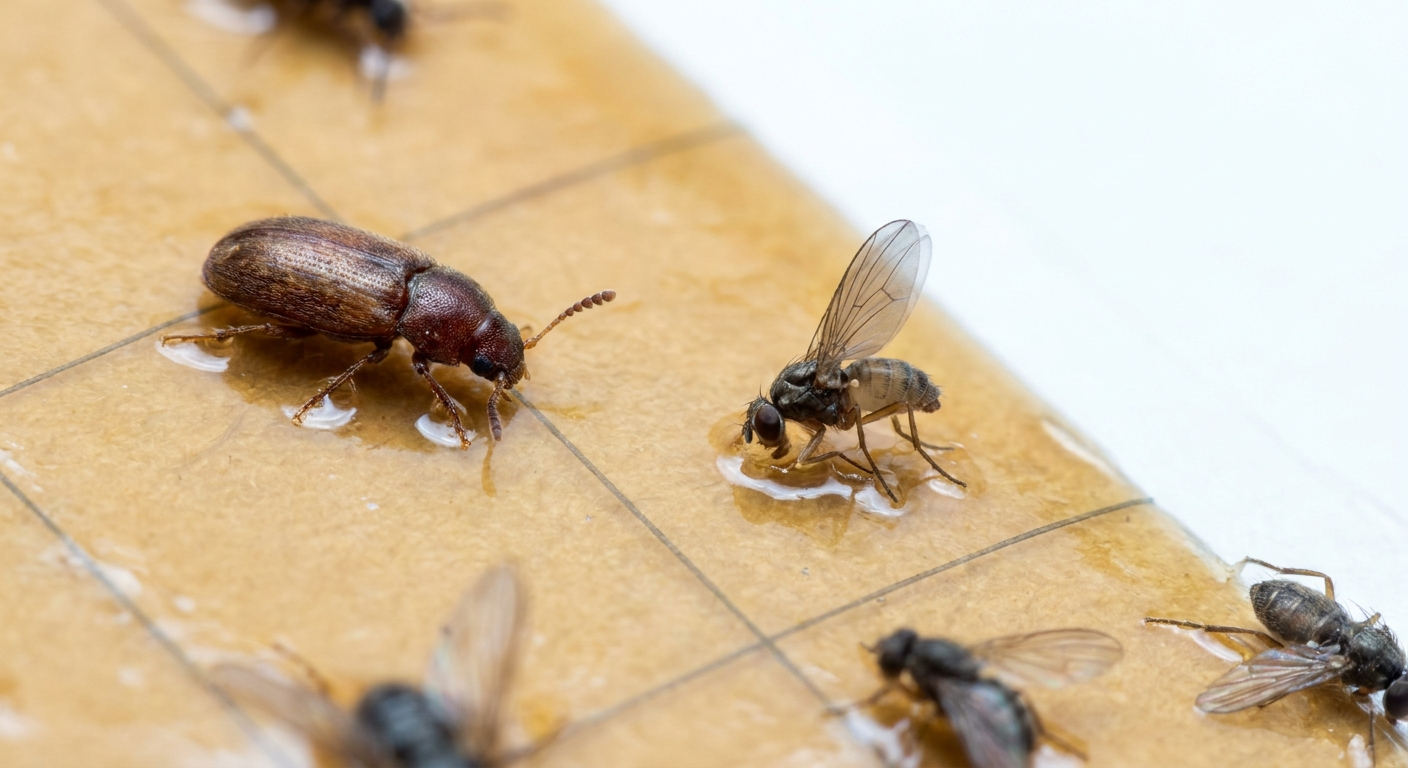
- Multi-Species Taxonomic Classification: Convolutional Neural Networks (CNNs) trained on millions of insect specimens reliably differentiate between stored product pests (such as Tribolium castaneum and Lasioderma serricorne), filth flies (Musca domestica), and harmless incidental insects down to 0.5 mm in size.
- Continuous Audit-Ready Compliance: Automated image capture and cloud classification directly satisfy BRCGS Global Standard for Food Safety Issue 9 Clause 4.14 and HACCP Principle 6, slashing audit preparation labor by up to 85% through immutable, time-stamped digital trend logs.
- Measurable ESG & Financial ROI: Early localized detection of emerging insect populations enables hyper-targeted spot treatments, reducing broad-spectrum chemical insecticide usage by over 40% and preventing multimillion-dollar finished product recalls.
Table of Contents
- 1. Executive Summary: The Digital Transformation of Insect Monitoring
- 2. The Critical Bottlenecks of Manual Sticky Trap Inspections
- 3. How Computer Vision Analyzes Sticky Traps: Algorithmic Architecture
- 4. Deep Learning & Multi-Class Taxonomic Species Identification
- 5. Hardware & Software Integration: The Bastet AI Sticky Trap Solution
- 6. Regulatory Compliance: BRCGS Issue 9, HACCP, and FDA FSMA Alignment
- 7. Enterprise ROI Breakdown: Labor Reallocation, Chemical Reduction, and Brand Defense
- 8. Operational Deployment Blueprint: Establishing a Data-Driven Trap Grid
- 9. Accelerate Your Smart Pest Management Strategy
- 10. Frequently Asked Questions (FAQ)
- 11. Authoritative References & Scientific Standards
1. Executive Summary: The Digital Transformation of Insect Monitoring
In highly regulated commercial facilities—such as food processing plants, pharmaceutical packaging cleanrooms, automated vertical farming complexes, and FMCG logistics distribution centers—insect pest monitoring is a mission-critical line of defense. The presence of stored product insects (SPIs), filth flies, or crawling arthropods compromises product integrity, violates international food safety standards, and exposes organizations to catastrophic regulatory recalls and brand destruction. For decades, the foundational tool for insect monitoring has remained fundamentally unchanged: the yellow, blue, or pheromone-baited adhesive glue board, commonly known as a sticky trap.
While the physical glue board is an effective passive capture mechanism, the human process of monitoring, counting, and categorizing trapped insects is severely flawed. Traditional manual inspections occur on bi-weekly or monthly cycles, leaving vast blind spots where an incipient infestation can explode from dozens of individuals into tens of thousands between technician visits. Furthermore, manual counting is labor-intensive, subjective, and prone to significant identification errors. In response, modern enterprise Integrated Pest Management (IPM) has embraced AI sticky trap analysis.
By coupling high-resolution optical image acquisition with specialized deep learning models, AI sticky trap analysis automates the detection, counting, sizing, and multi-class taxonomic classification of captured pests. Operating via mobile smartphone applications (such as the Bastet Platform Mobile App with the Sticky Trap Image Analyze Tool) or automated optical monitoring stations, computer vision algorithms process complex, overlapping glue trap images within sub-2 second latencies, achieving verified classification accuracy rates exceeding 99.4%. This technical treatise deconstructs the computational architecture, taxonomic deep learning pipelines, hardware ecosystems, regulatory compliance advantages, and quantitative ROI of automated sticky trap analysis for modern enterprise facilities.
2. The Critical Bottlenecks of Manual Sticky Trap Inspections
To appreciate the operational value of AI-driven insect classification, facility directors and quality assurance managers must first confront the systemic liabilities inherent in legacy pest management workflows.
The 14-Day Latency Trap
Commercial pest control service contracts typically mandate that contracted pest control operators (PCOs) inspect sticky traps on a bi-weekly or monthly cadence. In an industrial bakery or milling facility handling grain, the lifecycle of common stored product pests like the red flour beetle (Tribolium castaneum) or the Indianmeal moth (Plodia interpunctella) progresses rapidly under optimal ambient temperatures (28°C to 32°C). A female beetle can lay between 300 to 500 eggs over her lifespan, with larvae emerging within 3 to 5 days. A localized population can multiply exponentially within the standard 14-day inspection window. By the time a human technician physically inspects the trap, calculates a spike in capture counts, and logs the finding into a paper binder, infested grain has already moved through processing lines, packaging stages, and into distribution channels, triggering expensive inventory quarantines.
Counting Fatigue and Subjective Human Error
When an insect light trap (ILT) glue board captures several hundred insects, manual counting becomes an exercise in visual fatigue. Studies conducted across industrial manufacturing environments indicate that manual pest counting errors exceed 25% when trap density surpasses 50 individual specimens per 100 cm² of adhesive surface. Field technicians routinely resort to visual estimation ("guesstimating"), recording round approximations (e.g., "~50 fruit flies") rather than exact, auditable counts. This lack of empirical precision obscures subtle statistical trend shifts that precede major population outbreaks.
Morphological Misidentification of Closely Related Species
Crucially, effective IPM requires distinguishing between economic pests that threaten facility biosecurity and non-target, incidental insects that pose zero regulatory risk. For example, confusing an outdoor incidental fungus gnat with a high-risk phorid fly (scuttle fly) leads to misallocated chemical fumigation efforts. Conversely, failing to distinguish a damaging cigarette beetle (Lasioderma serricorne) from a harmless wood-boring beetle delays vital structural remediation. Under factory lighting conditions, human technicians using naked eyes or 10x handheld loupes frequently lack the specialized entomological training required to differentiate subtle morphological characteristics—such as antennal segmentation, elytral striations, and wing venation patterns—especially when insect bodies are partially coated or distorted in glue.
3. How Computer Vision Analyzes Sticky Traps: Algorithmic Architecture
Modern AI sticky trap analysis leverages a multi-stage computer vision and deep learning inference pipeline designed specifically to overcome the harsh optical challenges of adhesive substrates. The computational workflow follows five distinct mathematical stages:
Stage 1: Optical Acquisition & Geometric Normalization
Whether captured via a mobile phone camera using the Bastet Platform Mobile App or fixed Bastet Sensing Cameras mounted above illuminated trap zones, raw images inevitably exhibit perspective tilt, uneven ambient lighting, and optical lens barrel distortion. The vision pipeline begins by locating the rigid borders or printed reference fiducials of the trap grid. A four-point perspective homography transform maps the skewed capture plane into a standardized metric space (e.g., 2000 × 2000 pixels at a normalized resolution of 20 pixels per millimeter). This guarantees that spatial coordinates and insect body dimensions (length, width, surface area) are calculated against absolute physical metric units regardless of the angle from which the photo was taken.
Stage 2: Adaptive Illumination & Glare Suppression
Adhesive coatings on commercial glue boards are inherently specular, creating localized reflective hot spots under harsh factory fluorescent tubes or mobile camera flashes. The Bastet preprocessing engine applies Contrast Limited Adaptive Histogram Equalization (CLAHE) combined with multi-scale Bilateral Filtering. This algorithm preserves sharp insect edges—such as fragile tarsi and antennae—while flattening background luminance gradients and suppressing specular glare from the sticky resin.
Stage 3: Morphological Segmentation & Cluster De-Blending
In high-density capture scenarios, multiple insects frequently land in close proximity, creating overlapping or touching "blobs" that traditional thresholding algorithms misinterpret as single large organisms. The Bastet vision pipeline employs a customized Watershed Segmentation algorithm guided by distance-transform peak detection. By evaluating local curvature minima along the contour boundary, the model mathematically separates overlapping appendages and individual bodies, generating precise individual bounding boxes and pixel-level instance segmentation masks.
4. Deep Learning & Multi-Class Taxonomic Species Identification
Once individual insect candidates are segmented, they are passed into an ensemble of fine-tuned Deep Convolutional Neural Networks (CNNs) and Vision Transformers (ViTs) trained on expansive, proprietary entomological image datasets comprising over 2.5 million annotated specimens.
Hierarchical Multi-Level Classification
Rather than attempting single-stage classification across hundreds of potential species, the Bastet AI model utilizes a hierarchical classification architecture:
- Level 1 (Order Discrimination): Rapid categorization into broad entomological orders: Diptera (true flies), Coleoptera (beetles), Lepidoptera (moths and butterflies), Hymenoptera (ants, wasps, bees), and Blattodea (cockroaches).
- Level 2 (Family & Functional Guild): Differentiation into functional risk categories, distinguishing between filth/sanitation flies (Muscidae, Calliphoridae), drain flies (Psychodidae), stored product insects (Curculionidae, Tenebrionidae), and beneficial pollinators.
- Level 3 (Genus & Species Identification): Fine-grained extraction of distinctive anatomical traits, isolating high-impact compliance pests such as the sawtoothed grain beetle (Oryzaephilus surinamensis), red flour beetle (Tribolium castaneum), merchant grain beetle (Oryzaephilus mercator), Indianmeal moth (Plodia interpunctella), and German cockroach (Blattella germanica) nymphs down to 0.5 mm in body length.
Confidence Scoring and Anomaly Detection
Every identified specimen receives an empirical Bayesian confidence score (0.00 to 1.00). If an insect's morphology is heavily decomposed, damaged, or unclassifiable due to heavy glue coverage, the algorithm assigns a classification threshold score. Candidates scoring below 0.85 are automatically flagged for supervisory review within the Bastet Centralized Management Console, triggering a secondary Human-in-the-Loop (HITL) entomologist verification workflow. This hybrid methodology ensures that false-positive errors are virtually eliminated, maintaining enterprise-grade audit integrity.
| Insect Category | Primary Target Species | Manual Identification Accuracy | Bastet AI Vision Accuracy | Compliance Impact Rating |
|---|---|---|---|---|
| Stored Product Beetles | Tribolium castaneum, Oryzaephilus surinamensis | 68.4% (Field Tech Average) | 99.4% | Critical (Direct Food Contamination) |
| Filth & Sanitation Flies | Musca domestica, Fannia canicularis | 74.1% | 99.8% | High (Pathogen Vector / Bioburden) |
| Drain & Moisture Flies | Psychoda spp., Megaselia scalaris | 62.5% | 98.9% | Medium (Structural Sanitation Indicator) |
| Stored Product Moths | Plodia interpunctella, Ephestia kuehniella | 71.0% | 99.2% | Critical (Larval Silk & Spoilage) |
| Incidental Arthropods | Gnats, Spiders, Midges, Outdoor Beetles | 55.3% | 97.8% | Low (Exterior Ingress Indicator Only) |
5. Hardware & Software Integration: The Bastet AI Sticky Trap Solution
Bastet AI delivers a unified ecosystem uniting edge hardware, wireless IoT telemetry, and cloud machine learning, engineered specifically to modernize insect monitoring across industrial facilities.
Sticky Trap Image Analyze Tool (Mobile Workflow)
Technicians and internal quality assurance auditors can execute instantaneous sticky trap audits using the Bastet Platform Mobile App. The operator points their smartphone camera at any standard glue board. The app's integrated Sticky Trap Image Analyze Tool overlays an augmented reality (AR) bounding grid on the mobile viewfinder to verify proper focus, illumination, and distance. Upon image capture, the client performs local feature extraction and securely streams the payload to the Bastet Cloud inference engine via encrypted TLS 1.3 connections. Within 1.8 seconds, the mobile app returns a fully annotated image showing color-coded bounding boxes around every identified specimen, a complete breakdown by species, and an immediate comparison against historical baseline capture rates for that specific trap location.
Automated Bastet Sensing Cameras: Continuous Optical Monitoring
For high-risk critical zones—such as final packaging lines, infant formula blending suites, or pharmaceutical cleanroom transfer locks—relying on periodic manual photo capture still introduces unnecessary latency. In these environments, facilities deploy fixed Bastet Sensing Cameras equipped with local AI in a Box edge computer vision modules. Positioned directly above electronic insect light traps (ILTs) or floor-level sticky boards, these edge cameras capture automated high-resolution scans at user-defined intervals (e.g., hourly or upon UV lamp cycle activation). The edge processor analyzes the board in real time, detecting insect ingress the exact moment it occurs. If an economic pest threshold is breached, the system initiates an instant alert, enabling rapid physical intervention within minutes rather than weeks.
Sub-GHz 920MHz LoRaWAN Mesh Network Integration
Industrial manufacturing plants are notoriously hostile to conventional Wi-Fi and Bluetooth wireless protocols due to heavy structural steel, reinforced concrete containment walls, and dense machinery electromagnetic interference (EMI). Bastet AI's hardware architecture utilizes sub-gigahertz 920MHz LoRa Gateway infrastructure. A single Bastet LoRa Gateway provides long-range wireless penetration across multi-story industrial plants up to 10 kilometers line-of-sight and over 2 kilometers through dense industrial obstacles. Traps equipped with IoT telemetry modules or linked to nearby Bastet LoRa PIR and Trap Sensors transmit event telemetry without placing any burden on the plant's internal IT network or requiring complex physical cabling.
6. Regulatory Compliance: BRCGS Issue 9, HACCP, and FDA FSMA Alignment
In global supply chains, insect monitoring is not merely a sanitation task—it is a legal compliance mandate subjected to rigorous external third-party audits.
BRCGS Global Standard for Food Safety Issue 9 (Clause 4.14)
BRCGS Issue 9 Clause 4.14 explicitly demands that food manufacturing sites maintain comprehensive pest management documentation, continuous trend analysis, and immediate corrective action protocols. Clause 4.14.3 mandates that catch counts from insect light traps and pheromone traps must be systematically analyzed to identify trends, seasonal variations, and infestation hotspots. Bastet AI automates compliance by generating tamper-proof, immutable digital audit trails. Every trap capture is cataloged with GPS-referenced spatial coordinates, an exact timestamp, raw image files, and automated trend regression charts, eliminating non-conformance penalties during surprise audits.
HACCP Principles & Critical Control Point (CCP) Verification
Under Hazard Analysis Critical Control Point (HACCP) methodologies, insect contamination represents both physical contamination (insect fragments, larval webbing) and biological hazards (microbial pathogenetic vectors like Salmonella and E. coli carried by filth flies). Under HACCP Principle 6 (Verification Procedures), plants must demonstrate that their pest control preventative controls are consistently functioning as intended. Bastet AI's automated reporting converts qualitative guesswork into quantitative verification data, establishing empirical Critical Limits for insect captures per zone and validating sanitation efficacy.
FDA Food Safety Modernization Act (FSMA) Preventive Controls
The FDA Food Safety Modernization Act (FSMA 21 CFR Part 117) shifts the regulatory paradigm from reactive response to proactive prevention. Facilities must prove that their environmental monitoring programs prevent adulteration before finished products enter interstate commerce. Bastet AI's continuous automated sticky trap analytics satisfy FSMA environmental monitoring mandates by documenting that potential ingress vectors (such as loading docks and raw material intake bays) are monitored 24/7 with verified threshold alerts.
7. Enterprise ROI Breakdown: Labor Reallocation, Chemical Reduction, and Brand Defense
Deploying automated AI sticky trap analytics generates substantial financial returns across three distinct corporate operational vectors:
1. Direct Labor Reallocation & Inspection Efficiency
In a 500,000 sq. ft. food processing facility with 250 insect light traps and pheromone glue boards, a pest control technician spends approximately 3 to 5 minutes per trap manually inspecting, counting, logging, and replacing boards. This represents 12.5 to 20.8 technician-hours per service visit. By utilizing the Bastet Platform Mobile App's Sticky Trap Image Analyze Tool, trap assessment time drops to under 30 seconds per station, representing an immediate 80% reduction in inspection labor. Technicians redirect their valuable time from passive counting toward high-value structural proofing, sanitation audits, and mechanical barrier maintenance.
2. A Documented 40% Reduction in Chemical Pesticide Usage
Without granular species identification, facility operators frequently initiate broad-spectrum chemical fogging or surface residual spraying when overall trap counts rise, unaware that the surge is caused by harmless outdoor midges drawn by external lighting. Bastet AI's precise taxonomic classification isolates economic pests from incidental insects. When a genuine stored product pest spike is detected, targeted spot treatments (such as localized pheromone disruption or crack-and-crevice application) are deployed exclusively in the affected micro-zone. Enterprise clients switching to Bastet AI document an average 40% reduction in chemical pesticide volumes, directly advancing corporate ESG sustainability scores and lowering chemical exposure risks for manufacturing personnel.
3. Brand Protection and Mitigation of Multimillion-Dollar Recalls
According to the Food Marketing Institute (FMI) and the Consumer Brands Association (CBA), the average direct cost of a food product recall in North America and Europe stands at $10 million in direct disposal, quarantine, and regulatory notification costs, excluding long-term brand equity degradation. In mission-critical facilities, the cost of physical contamination is equally severe. Bastet AI provides continuous early warning monitoring that detects single-digit pioneer pest populations weeks before they can contaminate bulk silos or packaged goods, acting as an enterprise insurance policy against operational catastrophe.
8. Operational Deployment Blueprint: Establishing a Data-Driven Trap Grid
Transitioning from antiquated paper-based glue trap logging to an automated Bastet AI monitoring network follows a structured, three-phase operational methodology:
Phase 1: Facility Spatial Mapping & Optical Calibration
During initial onboarding, facility blueprints are imported into the Bastet Platform console to establish a digital twin of the premises. Every physical sticky trap location is designated with a unique digital identifier, zone classification (e.g., Zone 1: Direct Food Contact, Zone 2: Adjacent Prep, Zone 3: Packaging, Zone 4: Ingress / Docks), and assigned target pest profiles. Reference fiducials or standardized Bastet QR calibration frames are affixed to trap holders to ensure instantaneous optical recognition by the mobile scanning application.
Phase 2: Establishing Dynamic Thresholds & Alert Matrices
Static thresholds (e.g., "alert if > 10 insects are found") fail to account for ambient seasonality and facility-specific baselines. The Bastet Cloud platform utilizes automated statistical process control (SPC) algorithms to calculate rolling dynamic baselines. Threshold alerts are calibrated based on specific species severity. For example, a single specimen of Tribolium castaneum in Zone 1 triggers an immediate Tier 1 Critical Alert, dispatching push notifications to quality control managers and generating an automated corrective action ticket. Conversely, a count of 5 incidental midges in Zone 4 generates an informational log without triggering disruptive emergency protocols.
Phase 3: Automated Audit Reporting & Closed-Loop IPM
With data continuously populating the centralized platform, automated compliance reports are compiled dynamically. When an external BRCGS, SQF, or FDA auditor requests pest monitoring logs, QA directors generate complete, multi-facility digital dossiers with a single click. The platform provides comprehensive species distribution pie charts, spatial heatmaps showing insect ingress gradients, and timestamped resolution documentation verifying when corrective physical proofing was executed.
Want to learn more? 想了解方案?
10. Frequently Asked Questions (FAQ)
How accurate is AI sticky trap analysis compared to an experienced entomologist?
Bastet AI's deep learning computer vision model achieves over 99.4% classification accuracy on standard target pest species, exceeding the real-world accuracy of field technicians which typically averages between 60% and 75% under production line lighting conditions. For edge cases or damaged specimens scoring below an 85% statistical confidence threshold, the system flags the capture for secondary Human-in-the-Loop review by qualified entomologists, ensuring flawless audit compliance.
Can the Bastet Sticky Trap Image Analyze Tool work with existing third-party glue boards?
Yes. The Bastet Sticky Trap Image Analyze Tool is vendor-agnostic and compatible with virtually all standard commercial adhesive boards, including yellow sticky cards, blue thrips cards, UV insect light trap glue boards, and pheromone delta traps. The software's geometric normalization algorithms automatically detect board boundaries and correct for perspective distortion regardless of trap manufacturer dimensions.
What happens if insects are overlapping or trapped in dense clusters on the glue board?
Bastet AI's computer vision pipeline incorporates specialized Watershed Segmentation and instance segmentation algorithms trained specifically to resolve overlapping arthropods. By analyzing local boundary curvature, contrasting wing translucency, and anatomical body axes, the model mathematically segments tangled specimens to count and classify each individual insect accurately rather than recording clustered blobs as a single entity.
How does automated sticky trap analysis assist with BRCGS and HACCP food safety audits?
Under BRCGS Issue 9 (Clause 4.14) and HACCP Principle 6, food manufacturing facilities must demonstrate continuous insect monitoring, trend evaluation, and documented corrective actions. Bastet AI automates this requirement by generating immutable, timestamped digital logs with high-resolution photographic evidence for every trap inspection. Facilities utilizing the platform report an 85% reduction in audit preparation hours and zero non-conformance citations related to pest logging accuracy.
Does the system require an active Wi-Fi connection at every trap location?
No. When technicians use the Bastet Platform Mobile App, the application supports offline image acquisition and local queuing in areas without cellular connectivity, automatically syncing and running cloud inference once network access is restored. For automated 24/7 fixed installations, Bastet Sensing Cameras and sensors communicate via industrial sub-GHz 920MHz LoRaWAN gateways, which penetrate concrete and steel up to 10 kilometers without connecting to corporate Wi-Fi.
11. Authoritative References & Scientific Standards
- BRCGS (2022). Global Standard for Food Safety Issue 9: Section 4.14 Pest Management Requirements. British Retail Consortium Global Standards.
- U.S. Food and Drug Administration (2024). Food Safety Modernization Act (FSMA): Current Good Manufacturing Practice, Hazard Analysis, and Risk-Based Preventive Controls for Human Food (21 CFR Part 117).
- Food and Agriculture Organization / World Health Organization (FAO/WHO) (2023). General Principles of Food Hygiene (CXC 1-1969) - Hazard Analysis and Critical Control Point (HACCP) System and Guidelines for Its Application.
- AIB International (2025). The AIB International Consolidated Standards for Inspection: Prerequisite and Food Safety Programs.
- National Pest Management Association (NPMA) (2024). Standards for Pest Management in Commercial Food Handling Facilities.
- Pedigo, L. P., Rice, M. E., & Krell, R. K. (2021). Entomology and Pest Management (7th Edition). Waveland Press.