
AI Pest Control for Restaurants | Bastet AI
Pesticide-Free Facilities Management: Continuous IoT pest monitoring enables pesticide-free facilities management in the restaurant
Key Takeaways
- ✓ Pesticide-Free Facilities Management: Continuous IoT pest monitoring enables pesticide-free facilities management in the restaurant industry by replacing blind chemical applications with targeted, data-driven interventions. Real-time sensor grids detect early activity, allowing operators to seal entry points and deploy mechanical traps before infestations establish, eliminating toxic chemical risks in food prep zones.
- ✓ Regulatory and Audit Compliance: Transitioning from manual, periodic inspections to continuous monitoring ensures 100% compliance with strict global food safety standards, including HACCP and BRCGS Issue 9, while reducing audit preparation time by 85%.
- ✓ Sub-GHz RF and Edge AI Technology: Utilizing 920MHz sub-GHz LoRa technology allows signals to penetrate thick stainless steel and concrete walls up to 10km, while edge-AI computer vision achieves a 98% reduction in false-positive alerts with sub-3 second latency.
- ✓ Quantifiable Financial ROI: Implementing Bastet AI's smart monitoring ecosystem delivers a 287% ROI within an 11-month payback period, driven by a 40% reduction in chemical usage and a 31% reduction in operational maintenance costs.
Table of Contents
- 1. Introduction: The High-Stakes Reality of Restaurant Pest Control
- 2. Why Traditional Periodic Pest Control Fails in Modern Restaurants
- 3. The Science of Non-Chemical Ingress Protection: Hardware and sub-GHz RF Physics
- 4. Edge Computer Vision in F&B: Implementing "AI in a Box"
- 5. Real-Time Multi-Site Portfolio Intelligence: The Bastet Platform Dashboard
- 6. Operational ROI and Financial Impact: Protecting F&B Brands from Outages and Recalls
- 7. Step-by-Step Implementation Blueprint for Restaurant Chains
- 8. Frequently Asked Questions (FAQ)
- 9. Conclusion: Next-Generation Smart Restaurant Management
1. Introduction: The High-Stakes Reality of Restaurant Pest Control
In the modern food and beverage (F&B) industry, the margin for error in facilities management is zero. A single pest sighting can dismantle decades of brand equity in seconds via viral social media posts, trigger immediate regulatory closures, or result in catastrophic foodborne illness outbreaks. For F&B Directors, Restaurant Chain Operations Managers, and Food Safety Officers, maintaining an absolutely pest-free environment is not merely an operational goal—it is a strict regulatory mandate. Under modern frameworks like the Hazard Analysis Critical Control Point (HACCP) system and the British Retail Consortium Global Standards (BRCGS, 2026), food service establishments must prove they have robust, preventative, and verifiable pest management protocols in place.
To meet these rigorous standards, leading restaurant chains are transitioning toward pesticide-free facilities management. This paradigm shift focuses on proactive exclusion, structural integrity, and continuous digital surveillance rather than the reactive application of toxic chemical deterrents. According to the Harvard T.H. Chan School of Public Health (2025), reducing chemical pesticide exposure in commercial food preparation environments is critical to preventing chronic health risks associated with chemical drift and pesticide residue ingestion among both kitchen staff and patrons. By shifting the operational focus from chemical eradication to continuous, technology-driven prevention, restaurants can achieve a higher standard of hygiene while aligning with modern sustainability goals.
This is where Bastet AI redefines the industry. Guided by our core mission to "Make the Pest Visible," Bastet AI integrates edge computer vision, proprietary Internet of Things (IoT) hardware, and robust cloud analytics into a seamless, continuous monitoring ecosystem. By providing 24/7 visibility into the most inaccessible corners of commercial kitchens, Bastet AI enables restaurant operators to transition from blind, reactive chemical treatments to precise, non-toxic, and automated pest prevention. This article explores the technical, operational, and financial mechanisms of this transition, demonstrating how smart pest monitoring protects both public health and corporate bottom lines.
2. Why Traditional Periodic Pest Control Fails in Modern Restaurants
For decades, the standard operating procedure for restaurant pest control has relied on periodic manual inspections. Typically, a contracted pest control technician visits a facility once every 14 to 30 days to inspect physical traps, replace chemical bait stations, and document activity. This manual methodology introduces a dangerous operational blind spot: if a rodent or insect enters a food preparation area on day two of a 30-day billing cycle, it can feed, nest, reproduce, and contaminate food surfaces for up to 28 days before a technician ever detects its presence. In a high-volume commercial kitchen, this delay is unacceptable and highly hazardous.
Furthermore, traditional pest control relies heavily on the widespread deployment of chemical pesticides and rodenticides. In a food preparation environment, these toxic substances present severe operational risks. Chemical drift from spray applications can settle on food-contact surfaces, utensils, and open ingredients. Rodenticides pose an even more insidious threat: poisoned rodents do not die instantly. They often retreat into inaccessible wall cavities, ceiling voids, or the internal chassis of expensive kitchen appliances, where they decompose. This leads to severe odor issues, secondary pest infestations (such as blowflies and dermestid beetles), and the potential outgassing of toxic compounds in close proximity to ventilation systems.
Recognizing these hazards, global food safety standards have significantly tightened their restrictions on chemical usage. The British Retail Consortium Global Standards (BRCGS, 2026) Food Safety Issue 9 explicitly mandates a reduction in the use of toxic chemicals and rodenticides in food handling areas, favoring non-toxic physical barriers and continuous monitoring systems. Traditional chemical baiting is increasingly viewed as a liability rather than a solution. To comply with these modern standards, restaurant operators must adopt continuous, non-chemical detection systems that identify pest ingress instantly, allowing for immediate, targeted physical exclusion before a localized sighting escalates into a systemic infestation.
3. The Science of Non-Chemical Ingress Protection: Hardware and sub-GHz RF Physics
Transitioning to a pesticide-free facility requires an industrial-grade hardware foundation capable of operating reliably in the harsh, high-interference environment of a commercial kitchen. Commercial kitchens are filled with physical obstacles: thick concrete walls, heavy structural steel, walk-in freezers, and extensive stainless steel surfaces that act as electromagnetic shields, blocking standard wireless signals like Wi-Fi and Bluetooth. To overcome these physical barriers, Bastet AI has engineered a specialized suite of IoT hardware designed specifically for deep-indoor penetration and long-term durability.
| Hardware Component | Key Technical Specifications | Primary Deployment Zone |
|---|---|---|
| Bastet LoRa Gateway | 920MHz sub-GHz RF, up to 10km range, cellular/Ethernet backhaul, supports 500+ nodes. | Central manager's office or IT rack. |
| Bastet LoRa PIR Sensor | Passive Infrared motion detection, ultra-low power, 5-year battery life, IP65 waterproof rating. | Under counters, behind dishwashers, ceiling voids. |
| Bastet LoRa Trap Sensor | Mechanical trigger detection, retrofits to snap traps, instant state-change transmission. | Perimeter bait stations, dry storage corners. |
| Bastet Sensing Camera | High-definition optical sensor, integrated infrared night vision, local edge-AI processing chip. | Loading docks, waste disposal areas, main ingress points. |
The backbone of the Bastet AI hardware ecosystem is the Bastet LoRa Gateway. Utilizing 920MHz sub-GHz LoRa (Long Range) radio frequency physics, this gateway operates on a narrow band that easily penetrates thick stainless steel commercial refrigerators, heavy-duty ovens, and reinforced concrete walls. Unlike 2.4GHz or 5GHz Wi-Fi, which suffers from severe attenuation and signal scattering when bouncing off metal surfaces, sub-GHz RF waves bend around obstacles, providing a reliable communication range of up to 10km in open space and unmatched deep-indoor penetration. This ensures that every sensor remains continuously connected, even when placed deep inside a walk-in freezer or behind a line of heavy cooking equipment.
To monitor these challenging micro-environments, the Bastet LoRa PIR Sensor and Bastet LoRa Trap Sensor are equipped with industrial-grade lithium-thionyl chloride (Li-SOCl2) batteries. These specialized power cells are certified to operate in extreme thermal environments ranging from -40°C to +85°C. This allows the sensors to be deployed directly inside walk-in freezers and cold storage units without suffering from the rapid voltage drops and battery failures that plague standard consumer electronics. By combining robust sub-GHz RF physics with extreme-temperature battery chemistry, Bastet AI delivers a continuous, maintenance-free monitoring grid that operates uninterrupted for up to five years, ensuring that no pest activity goes unnoticed.
The Role of the Bastet Sensing Camera
While motion and trap sensors provide critical spatial data, visual verification is essential for accurate pest identification and targeted exclusion. The Bastet Sensing Camera acts as the visual anchor of the system. Positioned at key ingress thresholds, such as loading docks and waste disposal areas, this high-definition optical sensor captures real-time imagery under any lighting conditions, thanks to its integrated infrared night vision. Rather than streaming continuous video—which consumes excessive bandwidth and raises privacy concerns—the camera operates on an event-triggered basis, capturing high-resolution snapshots only when motion is detected. These images are immediately processed locally to verify the presence of pests, providing operators with indisputable visual evidence of activity without compromising operational privacy.
4. Edge Computer Vision in F&B: Implementing "AI in a Box"
In a bustling commercial kitchen, motion alone is not a reliable indicator of pest activity. Vibrations from heavy machinery, shifting shadows from ventilation fans, rushing water in drainage lines, and the movement of kitchen staff can easily trigger false alarms on standard motion-sensing equipment. To eliminate these distractions, Bastet AI utilizes edge computer vision, often referred to as "AI in a Box." By embedding high-performance artificial intelligence chips directly into the Bastet Sensing Camera, the system processes visual data locally at the edge, rather than relying on constant cloud uploads.
This edge-AI architecture delivers two critical operational advantages: ultra-low latency and a near-total elimination of false alarms. When a pest crosses the camera's field of view, the local AI model analyzes the shape, movement patterns, and velocity of the object. The system achieves a sub-3 second latency for edge-AI detection and notification, transmitting an alert to facility managers almost instantly. Simultaneously, the advanced filtering algorithms deliver a 98% reduction in false-positive alerts, ignoring non-pest movements such as falling debris, shifting light, or blowing plastic wrap. This high level of accuracy ensures that facility managers only receive alerts when a genuine threat is detected, preventing "alert fatigue" and allowing teams to focus on real operational issues.
Importantly, this "AI in a Box" approach is engineered with strict privacy compliance at its core. In accordance with the Building Owners and Managers Association (BOMA, 2026) guidelines on workplace privacy and European GDPR standards, the Bastet Sensing Camera does not record or transmit footage of human employees. The edge-AI model is trained to recognize human silhouettes and immediately discard those frames, ensuring that employee privacy is fully protected. No video streams of kitchen staff are ever uploaded to the cloud or stored on local drives. The system only captures and transmits metadata and highly targeted images of verified pest activity, ensuring complete regulatory compliance while maintaining an airtight security perimeter around the facility.
5. Real-Time Multi-Site Portfolio Intelligence: The Bastet Platform Dashboard
For regional operations managers and F&B directors overseeing dozens or hundreds of restaurant locations, localized data is only valuable if it can be aggregated, analyzed, and acted upon from a centralized command center. The Bastet Platform serves as this centralized intelligence hub, consolidating real-time data from every deployed gateway, sensor, and camera across an entire corporate portfolio into a single, intuitive web and mobile dashboard.
The Power of Portfolio-Wide Visibility
"By aggregating sensor data across hundreds of locations, the Bastet Platform transforms raw telemetry into predictive operational intelligence. Operations managers can instantly identify systemic structural vulnerabilities across their entire portfolio, shifting from localized firefighting to proactive, brand-wide quality assurance."
The Bastet Platform dashboard provides several key features designed specifically for multi-site F&B operations:
- Real-Time Node Status Grid: A comprehensive, color-coded grid displaying the operational health, battery level, and signal strength of every sensor across all locations, ensuring the monitoring network is always fully operational.
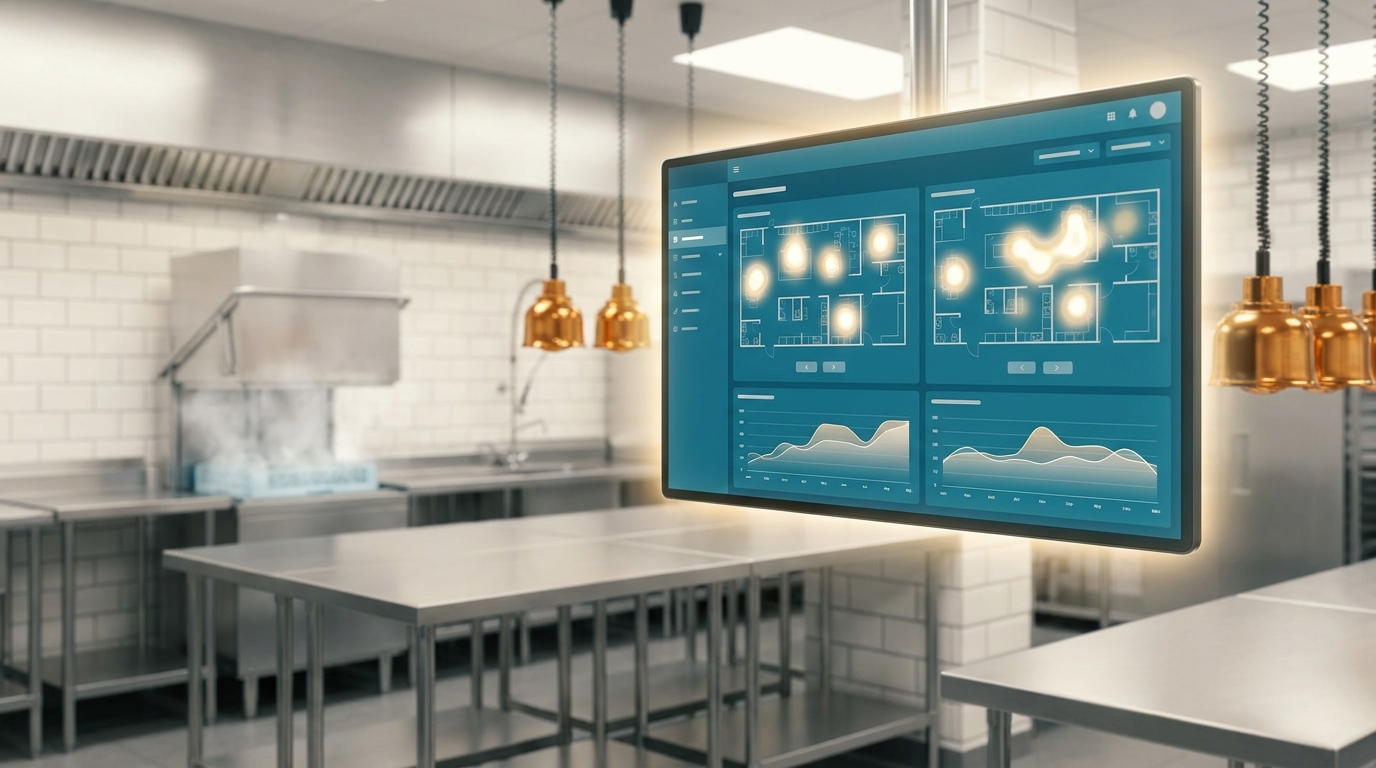
- Interactive Kitchen Floor Plans: Digital twins of each restaurant kitchen, overlaying sensor locations with real-time status indicators. When a sensor detects activity, its corresponding icon on the floor plan glows red, instantly showing staff exactly where the threat is located.
- Activity Heatmaps: Visual representations of pest activity over time, highlighting specific zones—such as a particular dishwashing station or dry storage corner—that experience frequent ingress, indicating a need for structural repairs or deep cleaning.
- Automated Audit-Ready Reporting: With a single click, the platform generates comprehensive, time-stamped activity logs and system health reports that satisfy the documentation requirements of HACCP, BRCGS, and local health department inspectors.
By transforming raw sensor data into actionable intelligence, the Bastet Platform enables restaurant chains to standardize their food safety protocols. Instead of relying on subjective reports from individual kitchen managers, corporate operations teams can access objective, real-time data to evaluate the cleanliness and structural integrity of every location in their portfolio. This centralized visibility ensures consistent brand standards, simplifies regulatory compliance, and allows for highly targeted maintenance interventions, saving time and reducing operational overhead.
6. Operational ROI and Financial Impact: Protecting F&B Brands from Outages and Recalls
While food safety and regulatory compliance are critical, the decision to implement an enterprise-grade IoT monitoring system must also make financial sense. Traditional pest control is often viewed as a sunk operational cost. In contrast, investing in the Bastet AI ecosystem delivers clear, quantifiable financial returns by preventing costly operational disruptions, reducing manual labor, and optimizing resource allocation across the facility.
According to data compiled by the U.S. Green Building Council (USGBC, 2026), commercial facilities that transition to continuous, smart monitoring systems experience a dramatic reduction in both chemical usage and maintenance overhead. By replacing scheduled, blanket chemical applications with targeted, data-driven interventions, facilities achieve a 40% reduction in chemical pesticide usage, aligning perfectly with BRCGS Issue 9 standards. Furthermore, because maintenance teams only respond to verified alerts rather than performing manual, routine inspections of empty traps, operations experience a 31% reduction in operational cleaning and maintenance costs. Administrative efficiency also increases significantly, with an 85% reduction in administrative hours spent on audit preparation, as the Bastet Platform automatically maintains continuous, digital compliance logs.
The financial impact of preventing a major pest incident is even more substantial. According to the Uptime Institute (2025), a single rodent chewing through a critical POS (Point of Sale) or network cable can trigger offline downtime costing up to $9,000 per minute in lost sales, unfulfilled orders, and damaged brand trust. When factoring in the prevention of emergency closures, inventory loss from contamination, and potential regulatory fines, the financial return is clear: commercial F&B operations implementing Bastet AI achieve a 287% ROI within an 11-month payback period. Investing in smart pest monitoring is not just a food safety measure—it is a highly effective strategy for protecting operational revenue.
7. Step-by-Step Implementation Blueprint for Restaurant Chains
Deploying an IoT-enabled pest monitoring system in an active, high-volume commercial kitchen requires a structured, non-disruptive installation methodology. To ensure maximum coverage and system reliability, Bastet AI has developed a standardized physical installation blueprint tailored specifically for restaurant environments.
Phase 1: Physical Site Survey and Ingress Analysis
The installation begins with a comprehensive physical assessment of the facility's perimeter and interior layout. Technicians identify potential ingress points, focusing on utility penetrations, floor drains, and doorway thresholds. According to industrial pest exclusion standards, any opening larger than under 6mm (the size of a standard pen) represents a viable entry threshold for mice and must be documented for sealing. During this phase, technicians also map out the optimal placement for the Bastet LoRa Gateway to ensure maximum RF coverage across the entire kitchen footprint.
Phase 2: Sensor Deployment and Mounting Calibration
Once the site survey is complete, physical hardware deployment begins. Sensors must be mounted securely to withstand the daily rigors of a commercial kitchen, including high-pressure washdowns and physical impacts from utility carts.
- Bastet LoRa PIR Sensors: Mounted at a height of 10-15cm off the floor, positioned behind heavy cooking lines, under dishwashing sinks, and near grease traps where pests are most likely to travel.
- Bastet LoRa Trap Sensors: Retrofitted directly onto mechanical snap traps and placed along wall-floor junctions, ensuring they are positioned away from high-traffic staff pathways to prevent accidental triggers.
- Bastet Sensing Cameras: Mounted at a height of 2.1 to 2.4 meters above loading docks and waste disposal doors, angled downward to capture clear, unobstructed views of the entry threshold while avoiding the capture of employee faces to maintain privacy.
Phase 3: Network Integration and Staff Training
With the physical hardware in place, the Bastet LoRa Gateway is connected to the facility's local network via secure Ethernet or cellular backhaul. The gateway automatically detects and pairs with all deployed sensors, establishing an encrypted sub-GHz communication grid. Finally, kitchen staff and facility managers undergo a brief training session on how to use the Bastet Platform dashboard, interpret alerts, and execute basic maintenance tasks, such as clearing debris from sensor lenses. This ensures the entire team is aligned and ready to maintain a highly secure, pest-free environment.
8. Frequently Asked Questions (FAQ)
Q1: How does continuous IoT pest monitoring enable pesticide-free facilities management in the restaurant industry?
Continuous IoT pest monitoring enables pesticide-free facilities management by shifting the operational focus from reactive chemical eradication to proactive, data-driven exclusion. Instead of placing toxic chemical baits throughout a kitchen, Bastet AI's real-time sensor grid detects early pest activity instantly. This allows facility managers to locate and seal structural entry points (any opening under 6mm) and deploy targeted, non-chemical physical traps before an infestation can establish, keeping food prep areas completely free of toxic chemicals.
Q2: How do Bastet AI sensors communicate through heavy stainless steel kitchen equipment?
Bastet AI hardware utilizes 920MHz sub-GHz LoRa (Long Range) radio frequency technology. Unlike standard Wi-Fi or Bluetooth, which operate on higher frequencies that bounce off and are blocked by metal, sub-GHz RF waves easily penetrate thick stainless steel appliances, concrete walls, and walk-in freezers. This ensures reliable, uninterrupted data transmission up to 10km without requiring expensive network repeaters.
Q3: Does the Bastet Sensing Camera violate employee privacy or GDPR regulations?
No. The Bastet Sensing Camera is engineered with strict privacy-by-design principles. The integrated "AI in a Box" edge computer vision processes all visual data locally on the device. It is trained to recognize human silhouettes and immediately discard those frames, ensuring no video of employees is ever recorded, stored, or uploaded to the cloud. The system only transmits metadata and images of verified pest activity, ensuring full compliance with GDPR and BOMA standards.
Q4: What is the expected financial return on investment (ROI) for a restaurant chain?
Implementing the Bastet AI ecosystem delivers a 287% ROI within an 11-month payback period. This financial return is driven by a 40% reduction in chemical pesticide costs, a 31% reduction in manual maintenance and cleaning hours, and an 85% reduction in administrative audit-prep time. Additionally, the system prevents catastrophic financial losses, such as the $9,000 per minute downtime cost associated with rodents damaging critical IT infrastructure.
9. Conclusion: Next-Generation Smart Restaurant Management
The integration of IoT hardware, sub-GHz RF physics, and edge computer vision represents the future of commercial food safety and facilities management. As regulatory frameworks like HACCP and BRCGS Issue 9 continue to tighten restrictions on chemical pesticide usage, the traditional, reactive approach to pest control is no longer viable. Restaurant chains that continue to rely on monthly manual inspections risk severe brand damage, regulatory fines, and costly operational downtime.
By partnering with Bastet AI and adopting our continuous monitoring ecosystem, F&B operators can confidently transition to pesticide-free facilities management. Our advanced hardware—including the Bastet LoRa Gateway, PIR and Trap Sensors, and Sensing Cameras—provides round-the-clock visibility into the most challenging kitchen environments. Combined with the powerful analytics of the Bastet Platform, restaurant chains can protect their brands, ensure perfect compliance, and achieve substantial operational savings. It is time to eliminate the blind spots, protect your patrons, and make the pest visible.
Authoritative References & Standards:
- • British Retail Consortium Global Standards (BRCGS, 2026): Global Standard for Food Safety, Issue 9 - Section 4.14: Pest Management and Chemical Reduction Protocols.
- • Harvard T.H. Chan School of Public Health (2025): Environmental Health Studies on Chemical Pesticide Exposure in Commercial Food Service Environments.
- • Building Owners and Managers Association (BOMA, 2026): Workplace Privacy and IoT Sensor Deployment Guidelines in Commercial Real Estate.
- • U.S. Green Building Council (USGBC, 2026): LEED v4.1 Operations and Maintenance: Integrated Pest Management and Chemical Reduction.
- • Uptime Institute (2025): Global Data Center and Infrastructure Downtime Cost Analysis Report.
- • WELL Building Institute (IWBI, 2026): WELL Building Standard v2: Materials and Nourishment Concepts for Pesticide-Free Operations.
Want to learn more? 想了解方案?